Weather Windows in British Columbia’s Mountains
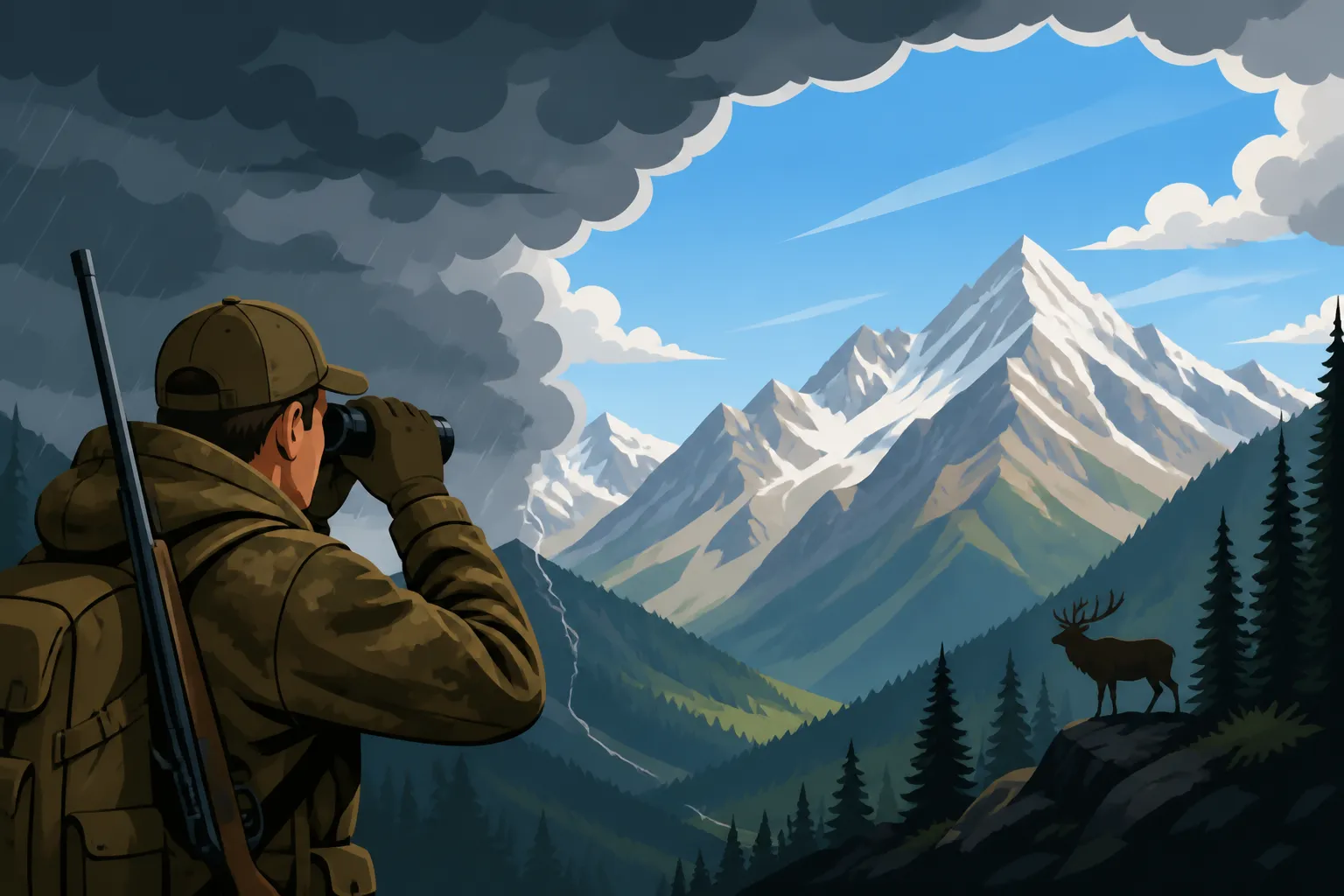
It's a familiar scenario for any hunter who's spent time in British Columbia's vast, wild mountains: you wake up to bluebird skies, full of optimism, only for a torrential downpour or a whiteout snow squall to roll in an hour later, completely derailing your well-laid plans. The unpredictable nature of mountain weather here isn't just an inconvenience; it can be a genuine safety concern and the biggest factor determining the success or failure of a hunt. This guide is all about understanding and capitalizing on those fleeting "weather windows" – those precious periods of stable, favorable conditions that can make or break your time in the backcountry.
Understanding British Columbia's Mountain Weather Dynamics
British Columbia's diverse geography means its mountain weather is notoriously complex and often localized. What's happening in one valley can be vastly different from a ridge just a few kilometers away, and a forecast for a regional hub rarely tells the whole story for high country.
The Pacific Influence and Interior Extremes
Our province sits directly in the path of weather systems rolling off the Pacific Ocean, especially along the coast. This means the Coast Mountains, and even further inland ranges like the Cariboos and Purcells, are heavily influenced by moist air. This moist air slams into the mountain ranges, gets pushed upwards, cools, and drops its moisture – often as rain or heavy snow, depending on the season and elevation. This is why you can often encounter prolonged periods of wet, foggy conditions, sometimes lasting for days, especially in the western parts of the province.
However, as you move further east into the Interior, particularly into the Rocky Mountains, the weather tends to become more continental. Here, you'll experience greater temperature extremes; scorching hot and dry in summer, bitterly cold in winter. While still mountainous and prone to sudden changes, the influence of vast, dry air masses can lead to clearer, more stable patterns punctuated by intense but often faster-moving fronts. Understanding this basic coastal-to-interior gradient is your first step in predicting what kind of weather patterns you're likely to face.
Microclimates and Elevation's Role
Beyond the broad regional influences, mountain weather is all about microclimates. Every valley, ridge, basin, and slope can have its own mini-weather system. Wind patterns are dictated by terrain, funnelling through passes or swirling in cirques. Temperature inversions, where colder air settles in valleys while ridge tops remain warmer, are common, especially in early morning or late evening. This is crucial for hunters because game animals often use these microclimates to their advantage, bedding on leeward slopes to escape wind or seeking sunny faces for warmth.
Elevation plays an undeniable role. A gentle rain in the valley can quickly become a driving snowstorm just a few hundred meters higher up. The tree line is often a critical boundary; above it, you're exposed to the full force of the elements, while below, the timber offers some respite. When you're Hunting British Columbia's Alpine in September, understanding these elevation-based changes becomes paramount. Always assume conditions will be more severe at higher altitudes, with stronger winds, lower temperatures, and faster-accumulating precipitation. This nuanced understanding is why simply checking the forecast for the nearest town isn't enough; you need to envision how those general conditions will manifest on the specific piece of mountain you intend to hunt.
Identifying and Interpreting Weather Windows
Spotting a weather window isn't just about hoping for sunshine; it's about actively looking for specific atmospheric patterns that signal a period of stability, even if short-lived. This requires a bit of meteorological detective work.
Recognizing Stable High-Pressure Systems
The holy grail for mountain hunters is a stable high-pressure system. These systems bring descending air, which suppresses cloud formation and precipitation, leading to clear skies, lighter winds, and generally more predictable conditions. On a weather map, high-pressure systems are typically marked with a large 'H' and closely spaced isobars (lines of equal pressure) often indicating light winds.
When you see a forecast promising clear days, light winds, and a gradual warming or steady temperature, that's often your high-pressure window. These are the days when the thermals will rise predictably as the sun heats the slopes, and animals might be more active. However, watch out for temperature inversions, especially in early spring or late fall, where the valleys can remain socked in with fog or cold air while the peaks are bathed in sunshine. These periods are ideal for Glassing an Alpine Basin for Rams or other high-country game, as visibility is at its peak, and animals might be out feeding. Take full advantage of these periods; they are often the most productive and safest times to be in the high country.
Tracking Frontal Systems and Post-Frontal Clearing
Not all weather windows are high-pressure events. Sometimes, the best opportunities arise right after a frontal system has passed. A frontal system, whether warm or cold, brings with it a change in air mass, often accompanied by strong winds, heavy precipitation, and a drop or rise in temperature. These are the conditions that often make for miserable, unproductive hunting.
However, the period immediately following the passage of a cold front can be incredibly productive. As the cold air pushes through, it often brings a rapid clearing of the skies, a drop in humidity, and brisk, clean air. Animals that have been holed up during the storm often become very active, feeding heavily in the calm after the squall. You might encounter heavy snow on the ground, making tracking easier, or find game moving down from higher elevations to seek shelter or accessible feed. When Hunting British Columbia Late When Snow Closes Roads, paying close attention to these post-frontal clearings can be the key to success. This brief window, often just a day or two, can provide prime hunting conditions before the next system rolls in or conditions stabilize back to normal. It’s about being prepared to push hard when that window opens.
Tactical Considerations for Hunting During Weather Windows
Knowing a weather window is coming is one thing; effectively capitalizing on it is another. Success hinges on precise planning and adaptability.
Planning Your Approach and Gear Selection
When a weather window is identified, your planning should pivot to maximize its potential. If a period of calm, clear weather is expected, this might be your chance to push higher into the alpine, attempt a longer stalk across open terrain, or access a remote basin that's usually shrouded in cloud. Knowing that the weather will be stable for a few days can give you the confidence to commit to a multi-day backpack hunt where you might be Setting a Spike Camp Above Timberline.
Gear selection is crucial. Even in a "window," mountain weather can be fickle. Always pack layers – a good base layer, insulating mid-layers like fleece or down, and a bomb-proof waterproof/breathable outer shell are non-negotiable. Don't leave your rain gear behind just because the forecast looks good. Optics will be your best friend during clear periods, so ensure your binoculars and spotting scope are clean and readily accessible for extended glassing sessions. If you're heading into high-elevation, rocky terrain, reliable footwear with good ankle support is paramount. Consider bringing extra fuel for your stove and more robust shelter if you anticipate needing to hunker down longer than planned, even in a forecasted window.
Maximizing Opportunities During Fleeting Clearings
Sometimes, a "weather window" isn't a continuous blue sky for days, but rather a series of fleeting clearings between squalls. These moments demand immediate action. If you're Hunting British Columbia's Alpine in Early September when afternoon storms are common, use the mornings to cover ground and glass aggressively. When the clouds part and the sun breaks through, don't waste a second. Get your binoculars up, scan open slopes, and be ready to make a move. This is when animals often emerge from cover to feed or sun themselves after a period of foul weather.
Being flexible and having contingency plans is also vital. If your original plan was a long ridge walk, but a brief clearing allows for a quick descent into a sheltered basin, be ready to change course. This often means having your rifle or bow ready, rangefinder accessible, and knowing your shot distances. Don't get caught admiring the view; be actively hunting. After a period of heavy rain or snow, animals might be on the move, and these clearings offer excellent opportunities to spot them crossing open areas or feeding in visible locations. This quick-response mentality can significantly increase your chances of success during unpredictable mountain conditions.
Tools and Resources for Forecasting Mountain Weather
While reading the sky and understanding local signs is invaluable, modern technology provides powerful tools to help predict those critical weather windows.
Utilizing Modern Weather Apps and Services
Gone are the days when you relied solely on the evening news forecast. Today, numerous weather apps and online services offer highly detailed, often localized forecasts. Apps like The Weather Network, AccuWeather, or Weather Underground provide hourly updates, radar maps, and future predictions that can be invaluable for planning. However, remember that these are often general forecasts. For true mountain accuracy, look for services that use higher-resolution models or incorporate terrain data.
For hunters, specifically in mountainous British Columbia, tools that offer detailed topographical maps and overlays can be incredibly useful. Many hunters utilize platforms like GoHunt, which integrate various data points, including weather, to help scout and plan trips more effectively. When you're poring over maps on a platform like GoHunt, you can cross-reference forecasted wind directions with topography to identify sheltered bedding areas or potential thermal drafts. Some advanced apps, such as Windy.com, offer stunning visual representations of wind, temperature, and precipitation at various altitudes, allowing you to see how a weather system is truly interacting with the mountainous terrain. Using a combination of these digital resources can help you form a much clearer picture of incoming weather windows.
Localized Forecasts and On-the-Ground Observation
While digital tools are powerful, they aren't foolproof, especially in the complex, remote terrain of British Columbia. Always seek out localized forecasts if available. For instance, Avalanche Canada provides highly detailed mountain weather forecasts and avalanche risk assessments, which, even if you're not specifically backcountry skiing, offer an excellent insight into high-elevation conditions, snowpack, and wind patterns that affect hunting. Similarly, local guiding operations or BC Parks often have more granular weather stations and reporting that can be more accurate than general forecasts.
Crucially, nothing replaces on-the-ground observation. The ability to "read the weather" in the field is a skill honed over many hunts. Are the clouds building rapidly on the western horizon? Is the wind shifting suddenly? Is the air feeling unusually still or heavy? These subtle cues can give you a better real-time understanding of an approaching change or a lingering window than any app. When you're camping in the backcountry, especially when you need to be mindful of Bear Safety While Hunting in British Columbia, being aware of your surroundings, including weather shifts, is paramount for both success and safety. Pay attention to how the thermals are working, how dew or frost is forming, and the behaviour of local wildlife – they often react to impending weather changes long before humans do. Combining these observations with your digital tools gives you the most complete picture.
| Weather Phenomenon | Forecast Indicators | Hunting Implications |
|---|---|---|
| Stable High Pressure | Clear skies, light winds, steady temps, 'H' on map | Excellent visibility, predictable thermals, good for glassing high-up. Game might be active. |
| Post-Frontal Clearing | Rapid clearing after storm, brisk air, temp drop | Game often moves after hiding during the storm. Good tracking in snow. Wind may be strong initially. |
| Incoming Front | Increasing clouds, rising wind, falling pressure, rain/snow | Game might feed heavily before storm, then seek cover. Poor visibility. Use caution for safety. |
| Temperature Inversion | Fog/cold in valleys, clear/warm on ridges (esp. AM/PM) | Valley game might be less active, ridge game more visible. Great for higher elevation hunting. |
| Persistent Rain/Fog | Low pressure, constant precipitation, reduced visibility | Tough hunting. Focus on timber, sheltered areas. Use scent control. Requires extreme gear prep. |
| Strong Winds | Isobars close together, wind warnings | Game seeks leeward slopes. Difficult for glassing, shooting. Masks human scent but makes stalking harder. |
Important Disclaimer
Hunting in British Columbia's mountains involves inherent risks, including but not limited to unpredictable weather, difficult terrain, wildlife encounters, and remote conditions. This guide provides general information and recommendations only. Always prioritize your safety, carry appropriate emergency gear, inform others of your plans, and be prepared for rapidly changing conditions. Consult official British Columbia hunting regulations and local weather authorities for the most accurate and up-to-date information before embarking on any hunt.