Glassing an Alpine Basin for Rams
There's nothing quite like the immense feeling of standing in a vast British Columbia alpine basin, staring at endless rock and heather, knowing that somewhere out there, a magnificent ram is moving through its ancient domain. The sheer scale of the landscape can feel overwhelming, making the idea of finding a needle in a haystack seem easy by comparison. This guide is dedicated to breaking down the formidable task of glassing these incredible high-country environments, transforming the seemingly impossible into a systematic and achievable pursuit.
Understanding the Alpine Environment and Ram Behavior
When you're out there, surrounded by jagged peaks and sprawling meadows, it's easy to feel lost in the immensity of it all. But just like any good hunter knows their deer habits in the timber, understanding the sheep's world is the first step to finding them. Alpine basins aren't just random patches of rock; they're intricate ecosystems with predictable patterns.
Reading the High Country Landscape
The mountains of British Columbia are truly spectacular, but that beauty often hides the challenges of hunting. When you're glassing an alpine basin, you're not just looking at a pretty view; you're analyzing a potential home for sheep. Think of it as peeling back layers. The first thing to consider is the overall shape of the basin. Are there deep cirques carved by ancient glaciers? Long, gentle slopes of scree and rock? Or abrupt cliffs and broken ledges? Each feature plays a role.
Rams, particularly mature ones, prefer terrain that offers both feed and security. This often means steep, broken ground with plenty of escape routes. Look for benches or shelves that might not be obvious from a distance, or small pockets of green vegetation tucked into rocky folds. These areas provide vital forage in an otherwise harsh environment. Water sources, even small seeps, are also critical, especially in the dryer parts of the interior ranges. Also, pay attention to the timberline—where the last stunted trees cling to the rock. Sheep often feed above it during the day but might drop just below it for bedding or to seek shelter from harsh weather. Sometimes, just above the sparse alpine fir and whitebark pine, you'll find those elusive rams. Understanding these subtle shifts in habitat is paramount when you're Backpacking Into British Columbia Sheep Country.
Ram Habits and Seasonal Movements
Sheep aren't just randomly wandering around the high country; their movements are dictated by a blend of necessity and instinct. In the summer months, when most of our sheep seasons open, rams are primarily focused on feeding to pack on condition for the upcoming rut and the long winter. They'll often be found in bachelor groups, sometimes as large as a dozen or more, but more often in smaller bands of 2-5 animals. These groups tend to frequent specific areas of good forage—lush alpine meadows, south-facing slopes that melt out early, or old burns that have regrown with nutritious plants.
During the peak heat of the day, especially if the sun is intense, rams will often bed down in shaded areas. This could be under a small rock outcrop, on a north-facing slope, or even tucked into a patch of snow if available. This is where patience really pays off; a ram that was invisible at noon might suddenly stand up and start feeding in the late afternoon. As the season progresses towards September, rams might begin to move more, sometimes venturing into slightly lower elevations as they start to think about the rut, but generally, their home is the high, rugged country. Being aware of these seasonal patterns, along with specific Mountain Sheep Season Dates and Curl Rules, will greatly increase your chances of finding them.
Essential Gear for Effective Alpine Glassing
You wouldn't try to build a house with a butter knife, and you shouldn't try to hunt British Columbia's alpine without the right tools. Effective glassing in such vast terrain isn't just about having good eyesight; it's about having the right gear and knowing how to use it.
Optics Selection and Setup
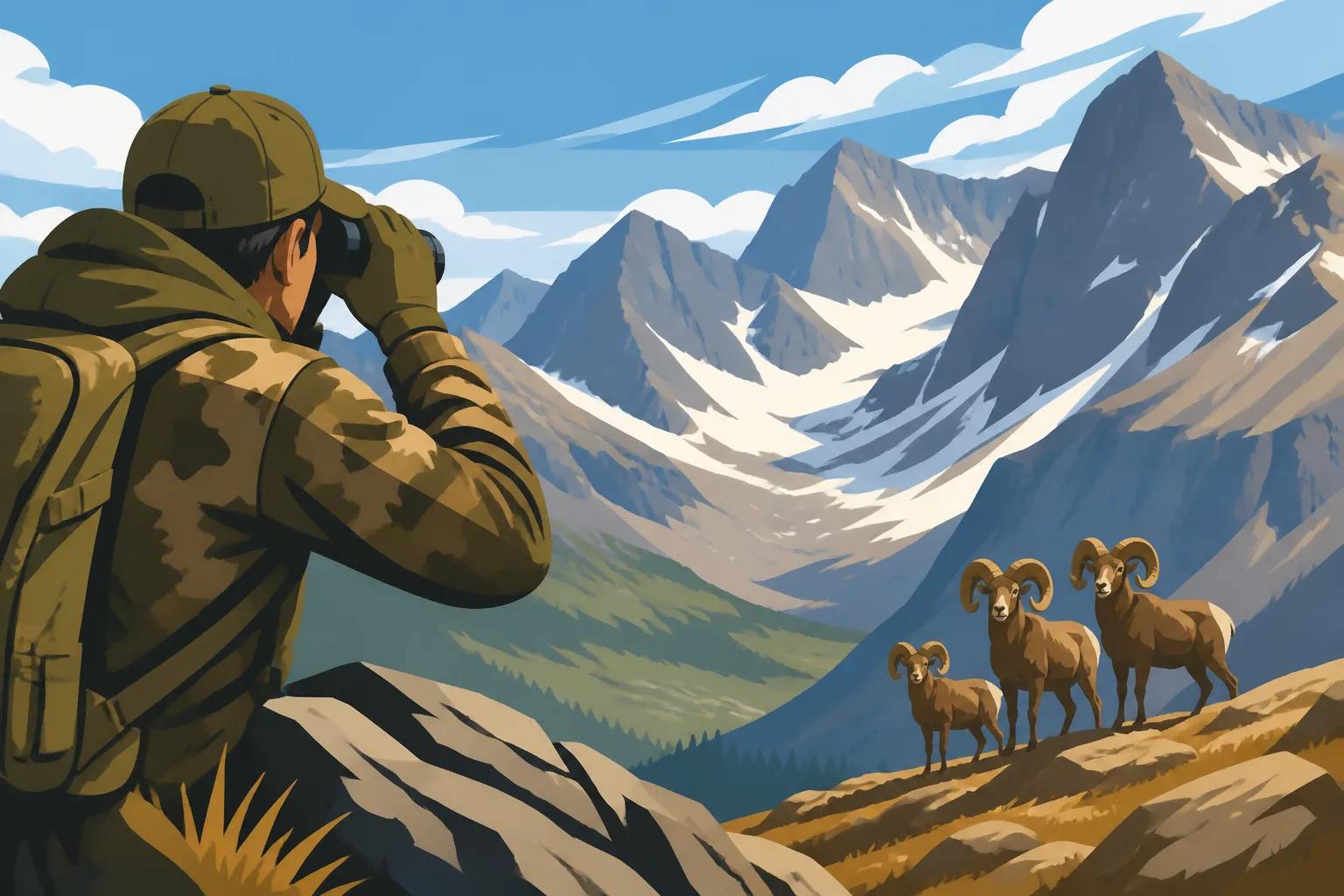
When it comes to sheep hunting, your optics are arguably more important than your rifle. You're going to spend 90% of your time, if not more, behind glass. A high-quality binocular is your primary tool. Something in the 10×42 or 12×50 range is ideal for scanning broad areas. Brands like Swarovski, Kowa, and Vortex are common choices among serious hunters for their exceptional clarity and light-gathering capabilities, which are crucial in low light conditions often encountered at dawn and dusk. For detailed scrutiny of distant slopes, a spotting scope is indispensable. A 65mm or 85mm objective lens with a variable eyepiece (e.g., 20-60x or 27-60x) will allow you to pick apart terrain that's miles away.
Crucially, both your binoculars and spotting scope need to be mounted on a stable tripod. Trying to hold high-powered optics steady for extended periods is a recipe for fatigue and missed details. A sturdy, lightweight carbon fiber tripod with a good fluid head will make all the difference. Many hunters now use an adapter to mount their binoculars directly to the tripod, which can save your arms and neck when scanning for hours. Investing in top-tier glass from companies like GoHunt, which often reviews and rates various optics, can significantly improve your effectiveness and reduce eye strain over long days. Remember, the goal isn't just to see something, it's to see everything clearly enough to identify what you're looking for.
The Importance of Comfort and Readiness
Sitting for hours, often in exposed locations, can quickly turn a hopeful hunt into a miserable endurance test if you're not prepared. Comfort is key to patience and effective glassing. Start with appropriate layering for the unpredictable alpine weather. Even on a sunny day, high winds can bring a rapid chill, and a sudden squall can drop temperatures dramatically. Having a good quality hardshell jacket and pants that are both waterproof and breathable is non-negotiable. Warm, dry socks and excellent Boots for Steep British Columbia Country are also vital.
Beyond clothing, a small, insulated sitting pad can make a world of difference when parked on cold, hard rock for hours. Keep readily accessible water and high-energy snacks in a small pack; getting up to retrieve things means breaking your focus and potentially missing an animal. A lightweight pack allows you to carry these essentials without burdening you on the strenuous climbs often associated with sheep hunting. Many hunters will choose to Setting a Spike Camp Above Timberline for several days, allowing them to capitalize on prime morning and evening glassing opportunities without having to make a grueling climb each day. The more comfortable you are, the longer and more effectively you can glass, and the better your chances of success.
Strategies for Systematically Glassing Alpine Basins
The sheer size of British Columbia's mountain ranges can make a systematic approach feel futile, but it's the only way to ensure you're not overlooking a ram. Randomly sweeping your glass across the landscape might catch a fleeting glimpse, but it won't uncover the hidden gems.
Breaking Down the Basin
When faced with an enormous basin, the trick is to break it down into manageable sections. Resist the urge to scan the entire landscape quickly. Instead, pick a starting point, perhaps a prominent ridge line or a distant patch of timber, and work your way across the terrain in a grid pattern. Start by scanning the entire basin with your naked eye, looking for anything that seems out of place – a subtle colour change, a horizontal line in a vertical world, or a patch of snow.
Then, use your binoculars to systematically dissect the area. Pick a small section, like a single rock slide or a short stretch of hillside, and meticulously scan every inch. Once you've covered that, move to the adjacent section, slightly overlapping your previous scan. Don't forget to glass both the sunlit and shaded areas. Rams often seek shade during the day, making them nearly invisible against dark rock. The low light of dawn and dusk, when animals are most active, is also often the best time to catch movement. Many seasoned hunters utilize tools like GoHunt's mapping features to mark out sections of a basin they plan to systematically glass, ensuring comprehensive coverage. This deliberate, methodical approach is far more effective than erratic searching.
The Art of Patient Observation
Glassing isn't just about seeing; it's about observing. Most sheep aren't going to be standing out in the open, waving at you. They blend in perfectly with their surroundings. Instead of looking for an entire animal, train your eyes to look for parts of an animal or subtle clues. A horizontal line that doesn't quite fit the vertical rock formations might be a ram's back. A patch of white that seems a bit too bright, or a horn tip catching the sun, can be the giveaway. Look for movement, no matter how slight. A flick of an ear, a shift in weight, or a ram standing up from a bed often happens in the blink of an eye.
Spend significant time on each section, letting your eyes relax and really soak in the details. Often, an animal will materialize out of the landscape only after you've stared at a spot for several minutes. Sometimes, it's not even the animal itself you see first, but the disturbed earth of a game trail, or a patch of fresh browse. Remember that sheep, especially rams, are masters of camouflage. What looks like a rock could very well be a bedded ram. This level of patient, detailed observation is a cornerstone of effective Hunting British Columbia's Alpine in September.
Dealing with Environmental Challenges
The alpine environment is beautiful, but it's also incredibly demanding and constantly changing. Weather and light conditions can swing wildly and directly impact your ability to glass effectively. Fog can roll in quickly, reducing visibility to mere feet, while intense midday sun can create harsh glare and heat shimmer that distorts images.
When fog descends, it's often best to pack up and find shelter, or use the time to move to a new vantage point if conditions allow. For glare, experiment with different angles relative to the sun. Sometimes, moving just a few yards can drastically reduce the blinding effect. A good quality lens hood on your spotting scope can also help. Heat shimmer, common on warm days, makes everything wavy and hard to define. There's no perfect fix for this, but sometimes waiting until later in the day when temperatures drop, or focusing on closer slopes, can help. The key is to be adaptable and resilient. Being prepared for these challenges is part of Emergency Planning in British Columbia's Backcountry, ensuring you can make the most of those brief, clear windows of opportunity. Don't get discouraged by poor conditions; instead, see them as part of the unique challenge of hunting British Columbia's high country.
What to Do When You Spot a Ram
That heart-stopping moment when a grey patch of rock resolves into the undeniable form of a ram is what all the tedious glassing is for. But the job isn't done; it's just beginning.
Confirming and Evaluating
Once you've spotted what you believe to be a ram, the first thing to do is confirm it's actually a legal animal and not a ewe or a young ram that isn't legal for harvest. Use your spotting scope to get the clearest possible view. Focus on the horns: are they full curl? Do they extend past the eye and bridge the nose? Are they heavy enough to meet the legal requirements in that specific management unit? British Columbia's sheep regulations often specify very particular curl criteria, so knowing how to interpret these is vital. Even for experienced hunters, judging a ram in the field can be tricky, so take your time. This detailed assessment is precisely why resources like "GoHunt" provide detailed harvest reports and regulations, helping hunters understand what constitutes a legal animal.
Look at the ram's body size and overall appearance. Mature rams typically have a more robust, blocky build compared to ewes or younger males. Pay attention to any distinguishing marks or characteristics. If there are multiple animals, observe their interactions. Sometimes, an older, more dominant ram will stand out among a group. For a deeper dive into this, you'll want to review how to apply the principles of Judging a Full-Curl Ram in the Field. This critical step ensures ethical hunting and compliance with the regulations.
Planning Your Stalk
After confirming you've found a legal ram, the next exhilarating, and often nerve-wracking, phase begins: the stalk. This is where all your scouting, fitness, and judgment come into play. The first rule of any successful stalk is to ensure the wind is in your favour. Always approach from downwind, no matter how circuitous the route. Alpine winds can be fickle, swirling unpredictably, so constant vigilance of wind direction is paramount.
Next, analyze the terrain between you and the ram. Where are the natural features that can provide cover? Ridges, rock slides, and deep draws can all be utilized. Avoid skylining yourself on ridges; always stay just below the crest. Pay close attention to the sun's position – you want the sun in your favour, not glaring off your optics or silhouette. Consider potential escape routes for the ram and try to anticipate them. Sometimes, a long, patient detour is far more effective than a direct, rushed approach. Remember, it’s not always about the shortest path; it's about the path that gives you the best chance to get within shooting range undetected. Just as one might carefully choose an approach when Hunting Mountain Goat on British Columbia Rock, the same meticulous planning is required for rams. In these remote areas, especially if you've relied on Horseback Access to British Columbia's Alpine or a float plane, you want every effort to count.
Disclaimer
Please remember that hunting regulations, seasons, and access can change. Always consult the most current British Columbia Hunting and Trapping Regulations Synopsis before planning any hunt. Safety in the backcountry is paramount; always inform someone of your plans, carry appropriate emergency gear, and be prepared for rapidly changing weather conditions. Utilizing resources like Satellite Communication on a Remote Hunt is highly recommended for any remote trips.