Using a Bird Dog in British Columbia Timber
Hunting upland birds in British Columbia's dense timber can feel like searching for a needle in a haystack. The thick canopy, tangled underbrush, and vast landscapes make it incredibly challenging to locate elusive grouse or ptarmigan, often leading to frustrating hunts where you walk for miles and see little. This comprehensive guide is dedicated to helping you maximize your success and enjoyment by detailing how to effectively use a bird dog in these unique British Columbia environments, transforming those challenging hunts into rewarding experiences.
Understanding British Columbia's Timber for Upland Birds
British Columbia's diverse terrain offers a variety of habitats for upland birds, but it also presents unique challenges for hunters and their canine companions. Understanding these environments is the first step to a successful hunt.
Types of Timber and Their Challenges
When you venture into British Columbia's forests, you're not just dealing with "trees"; you're entering complex ecosystems, each with its own characteristics that impact scent, visibility, and bird behavior.
One of the most common types you'll encounter is dense coniferous forest, characterized by towering fir, spruce, and pine trees. Think of the deep, dark woods you find in much of the Interior or parts of the Coast. The challenges here are manifold: the dense overhead canopy limits light, making it difficult to spot birds on the ground or in trees. The thick needle duff on the forest floor can dampen scent, making it harder for a dog to track. Visibility is often restricted to mere yards, making quick shots nearly impossible without a dog to flush them out. Birds like spruce grouse, notorious for holding tight, often blend seamlessly into this environment.
Then there are the mixed forests, a blend of conifers and deciduous trees like aspen, birch, and alder. These are often found at lower to mid-elevations and particularly in riparian areas or areas impacted by past logging. While they can offer better visibility in the fall after leaves drop, the ground cover can still be substantial. Alder bottoms, especially along creeks and rivers, are famous for holding ruffed grouse, but the tangled mass of branches makes for incredibly difficult walking and shooting. A good dog helps you push through this cover and pinpoint the birds that would otherwise be hidden. The varied vegetation also means more diverse food sources, which can concentrate birds, but also gives them more places to hide.
Finally, we have open timber and old growth edges. While not as dense, these areas still require a keen eye and a working dog. Old growth forests, with their massive trees and sparse understory, might seem easier, but birds can still be surprisingly hard to find. The edges where old growth meets younger stands or clearings can be productive, offering both cover and food. Younger stands, often referred to as "second-growth timber blocks", especially those in their third to tenth year, provide excellent cover for grouse, but can be incredibly thick.
Where Upland Birds Hide
Knowing the timber types is one thing, but understanding where the birds within those timber types prefer to hide is crucial. British Columbia is home to several fantastic upland bird species, each with its own preferred haunts.
Ruffed Grouse are the kings of the dense, brushy cover. You'll find them predominantly in mixed forests, particularly in areas with a strong deciduous component. They love alder thickets, creek bottoms, and the edges of clearings where dense cover provides security but still offers access to berries, buds, and insects. In places like the Cariboo or Kootenays, these birds will often be found along old logging roads where new growth provides both food and cover. If you're Hunting Ruffed Grouse in an Alder Bottom, your dog will be invaluable for pushing through that impenetrable brush and putting birds into the air that you would have otherwise walked right past.
Spruce Grouse, often called "fool hens" due to their tendency to hold tight, prefer dense coniferous forests. They blend in perfectly with the dark undergrowth and often sit motionless, relying on their camouflage. They're typically found in spruce and pine stands, often in areas with mossy ground or low-lying branches where they can hide. Your dog's nose is really the only reliable way to find these birds before you accidentally step on them.
Blue Grouse, now often referred to as Sooty and Dusky Grouse, generally prefer more open timber and higher elevations. You might find them along forest edges, in semi-open pine stands, or on south-facing slopes. As fall progresses, they often move to higher, more open ground, sometimes even up into the subalpine, especially the Sooty Grouse on the coast. These birds can be challenging, as they might flush wild or run before a dog can get to them. A dog that can range a bit wider but check back frequently is ideal for these birds, as they can sometimes be found Walking Up Blue Grouse on a Logging Road.
And let's not forget Ptarmigan, which you'll find primarily in the alpine, above timberline. While not strictly "timber" birds, hunting them often involves transitioning through the very highest reaches of the timberline. They prefer rocky, open slopes with low-lying tundra vegetation. A dog with a good nose and solid stamina is essential for Hunting Ptarmigan in British Columbia's Alpine, as these birds also rely heavily on camouflage and can be incredibly difficult to spot against the rocks and snow.
Knowing these preferences helps you choose your hunting grounds, and your dog's instincts will guide you to where the birds are actually holding on a given day. Scouting these areas, perhaps using tools like GoHunt to analyze terrain and satellite imagery, can further refine your approach.
Training and Preparing Your Bird Dog for BC Conditions
Hunting in British Columbia's diverse and often rugged timber requires a well-trained, conditioned, and adaptable bird dog. Your dog isn't just a companion; it's a critical tool for success and safety.
Essential Dog Breeds and Their Strengths
Choosing the right breed can make a significant difference, though ultimately, training and individual temperament are paramount. Broadly, bird dogs fall into pointing breeds and flushing/retrieving breeds.
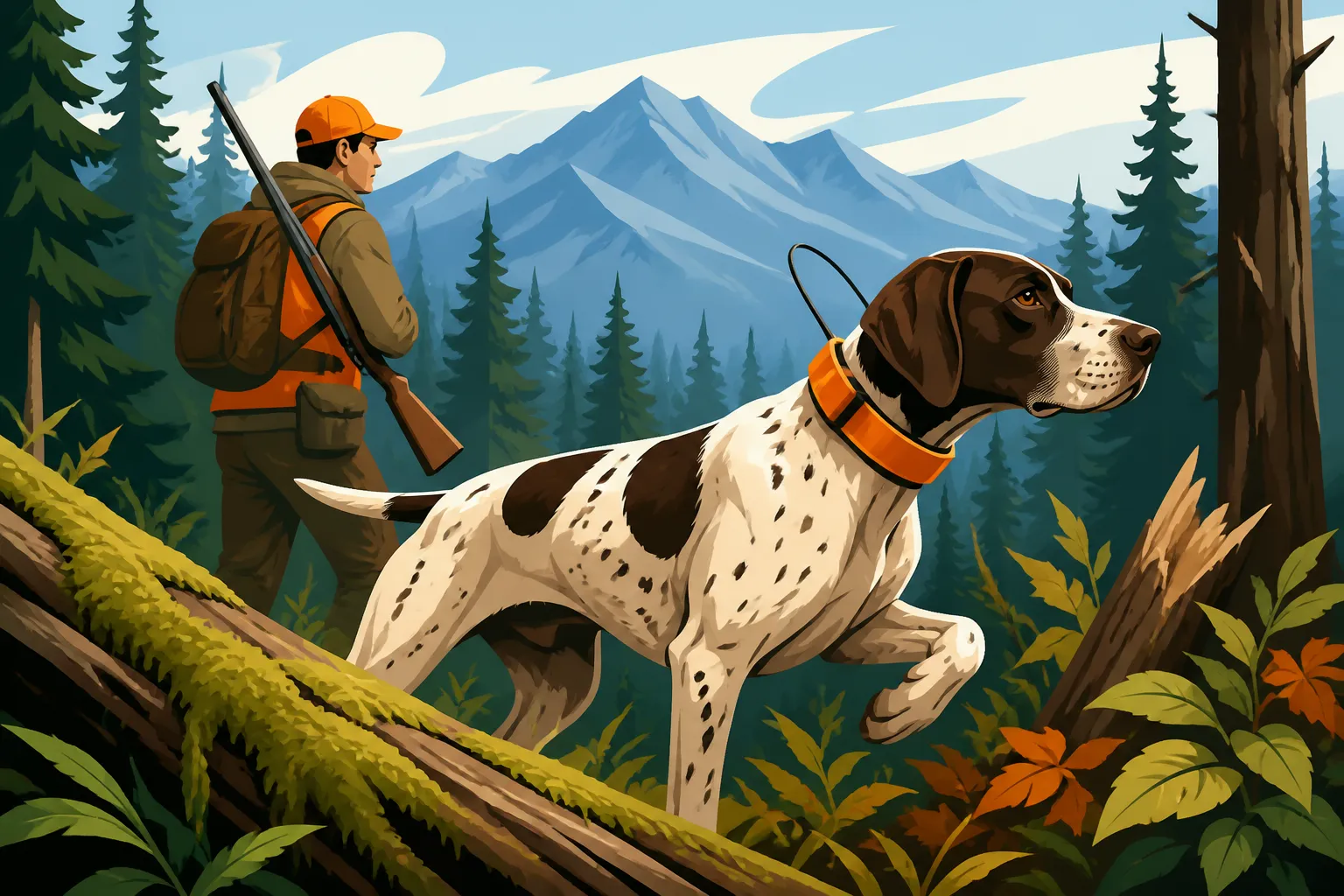
Pointing breeds like German Shorthaired Pointers, English Setters, Brittanys, and Pointers are fantastic for covering ground, finding scent, and "locking up" on birds, giving you time to get into position for a shot. Their natural instinct to point and hold allows for a more controlled hunt, especially in dense cover where a bird might otherwise flush wildly and out of sight. English Setters, with their longer coats, offer a bit more protection against the cold and brush, while the GSPs are hardy and excel in various conditions. These dogs are excellent for working areas where birds might be scattered or prone to running, giving you the critical seconds needed to locate the bird.
Flushing and retrieving breeds, such as Labrador Retrievers, English Springer Spaniels, and Cocker Spaniels, are equally effective, especially in incredibly dense cover. Labs are renowned for their biddability, powerful noses, and retrieving capabilities, excelling at busting through thickets and bringing birds back. Springer Spaniels are compact powerhouses, bred to work close, flush birds within gun range, and retrieve tirelessly. Their enthusiasm can be a huge asset in getting reluctant birds airborne. For the really tight stuff, where birds hold like glue, a flusher that methodically works the cover can be more productive, ensuring no bird is missed.
Ultimately, the "best" breed often comes down to personal preference and hunting style. Do you prefer the methodical pace of a pointer, or the energetic flush of a spaniel? Both can be incredibly successful in British Columbia's timber if properly trained.
Here's a quick comparison of popular breeds for BC timber hunting:
| Breed Type | Examples | Strengths in BC Timber | Considerations |
|---|---|---|---|
| Pointing Breeds | German Shorthaired Pointer, English Setter, Brittany | Excellent at finding and holding birds, controlled hunt | May range too wide if not disciplined, long hair needs care |
| Flushing Breeds | English Springer Spaniel, Labrador Retriever | Aggressive in cover, powerful flush, strong retriever | Can push birds too far if not controlled, high energy needs |
| Versatile Breeds | Pudelpointer, Wirehaired Pointing Griffon | Combines pointing and retrieving, good all-arounder | Can be a compromise, harder to find good lines |
Key Training Drills for Timber Hunting
Training for BC timber is all about control, close-quarters work, and resilience.
Close-working and quartering drills are paramount. In dense timber, a dog that ranges too far is a lost dog. You need a canine partner that stays within gun range, ideally quartering in front of you, systematically covering the ground. Practice this in brushy areas near home, using whistle commands and consistent rewards to keep them close. Teach them to respond instantly to a "whoa" or "heel" command, even with tempting scent in the air.
Steady-to-flush is another critical skill. When a bird flushes in thick timber, chaos can ensue. A dog that breaks and chases immediately not only risks getting lost but can also push other birds out of range or into thicker cover. Teach your dog to stop and "whoa" the moment a bird goes airborne, waiting for your command. This patience allows you to focus on the shot and ensures the dog is ready to mark the fall and retrieve. This also means working with blank guns to get them used to the sound of a shot without chasing.
Recall in cover is non-negotiable. British Columbia's timber can be disorienting. A strong, immediate recall, taught with a reliable long lead and increasingly challenging distractions, could save your dog's life. Practice with escalating levels of distraction and distance until your dog will abandon a hot scent line to return to you instantly. This is vital for safety, especially with the presence of larger predators.
Lastly, bell and GPS collar training is crucial. Introduce a bell early in training, so your dog associates it with hunting. The sound helps you keep track of your dog's general location. For a more precise fix, a GPS tracking collar like those offered by Garmin (an alternative to GoHunt for dog tracking) is a game-changer. Train your dog to wear it comfortably and integrate its use into every training session. It’s an invaluable tool for Scouting a British Columbia Management Unit Online and then tracking your dog on the ground.
Conditioning Your Dog for Rugged Terrain
British Columbia hunting isn't a stroll in the park, and your dog needs to be as physically prepared as you are.
Physical fitness is key. Start well before the season. Regular runs, hikes, and swims build stamina and muscle. Your dog needs to be able to work hard for hours, navigate steep slopes, and push through dense undergrowth without tiring quickly. Overweight dogs or those not in condition are prone to injury and won't perform optimally.
Paw care often gets overlooked. British Columbia's terrain can be brutal on paws: sharp rocks, thorny bushes, abrasive ground, and even freezing temperatures. Gradually introduce your dog to varied terrain. Invest in paw balm or protective booties, especially for longer hunts or if you notice tender paws. Check their paws regularly during and after hunts for cuts, scrapes, or embedded debris.
Finally, dealing with variable weather is a fact of life in BC. From coastal rain to interior snow, your dog needs to be able to handle it. A quality dog coat can provide warmth and protection in colder, wetter conditions. Always bring extra water for your dog, even if there are streams, as some sources might be stagnant or unsafe. Know the signs of overheating or hypothermia in dogs, and always put their welfare first. Don't push a dog beyond its limits, especially in extreme heat or cold.
Hunting Strategies with a Bird Dog in British Columbia Timber
Now that your dog is trained and conditioned, let's talk about putting those skills to work in the field. Hunting British Columbia's timber with a bird dog is a dynamic, interactive experience that requires partnership and attention.
Working Dense Cover and Following the Dog's Cues
Hunting in thick timber is a team sport. Your dog's nose is your primary locator, especially in visibility-challenged environments.
Reading your dog's body language is absolutely vital. A pointer will go on point, tail rigid, body still. A flusher might become more animated, tail wagging faster, nose glued to the ground, working a scent cone with increasing intensity. Learn to recognize these subtle shifts. When your dog goes on point or shows "birdy" behavior, slow down, watch carefully, and move into position. This is where those steady-to-flush drills pay off – your dog holds, giving you time to prepare for the shot.
Your dog should be systematically working the cover in front of you. Encourage them to quarter back and forth, ensuring no ground is missed. In particularly dense areas, you might need to give verbal cues or hand signals to direct them. Some hunters prefer their dogs to work slightly ahead, pushing birds towards them, while others like the dog to stay within a closer radius. Adjust your pace to match your dog's work. If they're on a hot scent, let them work it; don't rush them. In areas where you suspect a lot of birds are holding, like a prime Hunting Ruffed Grouse in an Alder Bottom, let the dog methodically pick through the tangles.
Always remember that scent conditions vary. On a damp, calm day, scent will hang in the air, allowing your dog to find birds more easily from a distance. On a dry, windy day, scent dissipates quickly, meaning your dog will need to work closer to the birds. Adjust your expectations and strategy accordingly.
Utilizing Bells and GPS Collars for Safety and Location
In British Columbia's vast and often featureless timber, losing track of your dog is a real concern. Modern tools are your best friend here.
Bells are a simple yet effective tool. A small, loud bell attached to your dog's collar gives you an audible cue to their location. When the bell stops, it often means the dog is on point or has otherwise stopped to investigate a scent. This sudden silence is a clear signal to move cautiously towards the last sound. It's especially useful in moderately dense cover where visual contact is intermittent.
GPS tracking collars, such as those from Garmin's Alpha or Astro series, are game-changers, particularly when hunting areas you've scouted with tools like GoHunt, which provides detailed topo maps and land ownership information. These collars not only show you your dog's exact location on a handheld device but also their direction of travel, speed, and whether they are on point. This is invaluable in vast tracts of timber or when working multiple dogs. If your dog ranges out of sight, you can quickly pinpoint their location, even if they're on a hard point deep in a thicket. This peace of mind allows both you and your dog to work more effectively without constantly worrying about their whereabouts.
Make sure your GPS collar batteries are charged, and you carry spares. Familiarize yourself with its functions before hitting the field. These devices aren't just for locating lost dogs; they enable more efficient hunting by letting you know precisely where your dog is working, allowing you to plan your approach to a point or flush.
Handling the Flush and Shot in Thick Timber
The moment of truth in timber hunting is often fast and chaotic.
When your dog flushes a bird in dense cover, you often have a very narrow window for a shot. Quick target acquisition is key. Shotguns with open chokes (Improved Cylinder or Skeet) and faster-handling lengths are often preferred. Practice mounting your shotgun quickly and smoothly. Safety is paramount: always know what's beyond your target. In thick cover, this can be challenging, so be absolutely certain of your shot and background before pulling the trigger. Never shoot at sound alone.
Work with your dog after the shot. If the bird drops, ensure your dog marks the fall. Even if you don't see it drop, your dog's nose will be able to pinpoint it. If the bird is winged and running, your dog's job immediately shifts to tracking and retrieving. This is where a well-trained retriever shines, pursuing the wounded bird to ensure a humane kill and recovery.
Retrieving Birds in Challenging Terrain
Once the shot is made, the hunt isn't over until the bird is in hand. Retrieving in British Columbia's timber can be just as challenging as finding the birds themselves.
Marking the fall is critical. In thick timber, a downed bird can vanish instantly. Even if you only get a glimpse of where it fell, make a mental note of landmarks: a specific tree, a rock, a change in terrain. Direct your dog towards this spot.
Your dog's scent work will be invaluable. Even if you can't see the bird, your dog's nose can often follow the scent trail to the downed bird. Encourage them with enthusiastic commands, such as "fetch" or "find dead." Give them time to work the scent. Don't rush or interfere too much unless they are clearly off track.
Persistence is key in retrieving. Sometimes, birds can fall into impossibly thick tangles of brush, under fallen logs, or even into water. A good retriever won't give up easily. Reward their persistence with praise and perhaps a small treat when they successfully bring a bird back. This reinforces their drive to retrieve every bird, ensuring minimal game is lost. Losing a bird to thick cover is a terrible feeling, and a well-trained dog dramatically reduces the chances of that happening.
Safety and Ethics When Hunting with Dogs in British Columbia
Hunting with a dog adds another layer of responsibility, especially in British Columbia's wild landscapes. Prioritizing safety for both you and your canine partner, and upholding ethical hunting practices, is paramount.
Bear and Predator Awareness for You and Your Dog
British Columbia is bear country, home to both black bears and grizzlies, as well as wolves and cougars. These encounters can be dangerous for you and your dog.
Always carry bear spray and know how to use it. Make sure it's easily accessible. In addition, carrying a firearm for defense against dangerous wildlife, if legally permitted and you are proficient, is a wise precaution. If you're What to Do If You See a Grizzly, remember that dogs can sometimes provoke bears or lead them back to you. An off-leash dog might harass a bear, causing it to charge defensively.
Train your dog to avoid wildlife that isn't game. This is difficult but essential. Teach a strong "leave it" command. If your dog encounters a bear or cougar, your immediate goal is to recall them and get them under control. A dog running loose and barking at a bear can escalate a situation quickly. Make noise while hunting to announce your presence and avoid startling predators. Be extra vigilant in areas with dense berry patches or near salmon streams, which are prime bear habitat. For more detailed information on precautions, refer to Bear Safety While Hunting in British Columbia.
Navigating Regulations and Other Hunters
Hunting with a dog in British Columbia comes with specific rules and etiquette you need to understand.
First, always check the current British Columbia Game Bird Seasons and regulations. Rules regarding dog use can vary by species, region, and specific Wildlife Management Area. While dogs are generally permitted for upland bird hunting, there might be restrictions in certain sensitive areas or during specific times of the year. Some areas might have leashing requirements or prohibitions on dogs for big game species during certain periods. Always consult the latest BC Hunting and Trapping Synopsis.
Respect other hunters and outdoor users. If you encounter another hunting party, especially those not using dogs, give them a wide berth. Keep your dog under control to prevent it from interfering with their hunt or alarming game they may be stalking. Similarly, be mindful of hikers, mountain bikers, or other recreational users you might encounter, especially on multi-use trails or in popular areas. A friendly, well-behaved dog is a great ambassador for hunters; a chaotic, unruly one is not.
When it comes to accessing private land, always ensure you have permission. British Columbia has strict British Columbia Trespass and Private Land Law. Don't let your dog stray onto posted land without explicit consent.
Caring for Your Dog in the Field
Your dog's well-being is directly linked to your hunting success. Proper care in the field is crucial.
Hydration is non-negotiable. Dogs work incredibly hard while hunting and can dehydrate quickly. Always carry plenty of fresh water and a collapsible bowl. Offer water frequently, especially during strenuous activity or in warm weather. Don't rely solely on natural water sources, as they can be contaminated or non-existent in some areas.
Carry a dog first aid kit. This should include items like bandages, antiseptic wipes, dog-safe pain relievers (consult your vet first), tweezers for thorns, paw balm, and tape. Learn basic canine first aid, including how to treat cuts, sprains, and remove porcupine quills. Knowing how to splint a leg or control bleeding could save your dog's life.
Regularly check your dog for injuries during the hunt and thoroughly inspect them afterward. Look for cuts, scrapes, thorns, foxtails (though less common in BC timber than grasslands), and ticks. Pay close attention to paws, ears, and eyes. Cold weather can lead to frostbite on paws or ears; warm weather can lead to overheating. Adapt your hunt to the conditions and your dog's needs. Remember, a healthy, happy dog is a better hunting partner.
Your dog is a valuable member of your hunting team. Treat them with the care and respect they deserve, and they will repay you tenfold with their dedication and skill in the field.
Disclaimer
Please note that hunting regulations, seasons, and access rules in British Columbia can change. Always consult the official British Columbia Hunting and Trapping Synopsis and relevant local authorities before planning any hunting trip. Safety should always be your top priority in the field.