Hunting Ruffed Grouse in an Alder Bottom
There's nothing quite like the heart-stopping flush of a ruffed grouse, but if you've spent any time chasing them, you know how frustrating it can be when they seem to vanish into thin air, especially in the thick, tangled world of alder bottoms. These dense thickets, while prime grouse habitat, can feel like an impenetrable fortress, leaving many hunters feeling bewildered and empty-handed. This guide is here to unravel the secrets of hunting ruffed grouse in these challenging yet rewarding environments, offering practical advice to turn those frustrations into successful outings in British Columbia's diverse landscapes.
Understanding Ruffed Grouse Habitat in Alder Bottoms
Ruffed grouse, often affectionately called "partridge" by many old-timers, are creatures of cover. They thrive in environments that offer a mosaic of food sources and protection from predators, and alder bottoms fit this bill perfectly. Understanding why these areas are so attractive to grouse is the first step toward effectively hunting them.
Why Alder Bottoms Are Grouse Havens
Alder bottoms are characterized by their dense stands of alder trees, often growing along stream banks, wet depressions, or in areas where old logging has created ideal conditions for their rapid growth. The key here is the sheer density. These areas offer unparalleled escape cover, providing a natural fortress against aerial predators like hawks and owls, and ground-based threats such as coyotes and bobcats. A grouse can simply melt into the thicket, making it incredibly difficult for a predator, or a hunter, to spot them.
Beyond just cover, alder bottoms are also incredibly rich in food. Alder buds and catkins are a staple, especially during the lean winter months. As spring progresses into summer and fall, these areas burst with other food sources like berries (such as highbush cranberry, huckleberry, and salal), various tender shoots, and a plethora of insects that thrive in the damp, fertile soil. The constant moisture ensures a healthy understory of ferns and other ground vegetation, further enriching the food supply. In many parts of British Columbia, from the coastal rainforests to the interior valleys, you'll find these green, often soggy, havens. Think about the damp lowlands along creeks in the Fraser Valley, or the edges of beaver ponds in the Cariboo; these are classic alder bottom scenarios.
Identifying Key Food Sources and Cover
While an entire alder bottom might look uniform, grouse have specific preferences. They're often found where the alders are mixed with other species, or where there's a subtle change in topography. Look for edges where the alder meets a more open forest, a logging road, or a small clearing. These transition zones offer both the security of the thick cover and easier access to varied food. Good reconnaissance, perhaps using a tool like GoHunt to scout aerial imagery, can help you pinpoint these subtle changes before you even set foot in the field.
Beyond alder itself, keep an eye out for other specific plants. Aspen and birch stands often intersperse with alder, providing additional buds and catkins. During late summer and fall, any berry-producing shrubs will be a major draw. Water sources, whether a small creek or a seep, also attract insects and maintain succulent vegetation, making them hotspots. A drumming log – typically a fallen tree that a male grouse uses as a territorial display perch – is a clear sign you're in active grouse country. These logs are usually somewhat decayed and in an area that offers both a clear view for the grouse and dense cover nearby for quick escapes.
Seasonal Movements and Behavior
Ruffed grouse behavior changes significantly with the seasons, and understanding these shifts is crucial for successful hunting. In the early fall, when British Columbia's hunting seasons often open, grouse can be more widely dispersed as food is abundant and they haven't yet felt significant hunting pressure. They'll utilize a wider range of habitats, including the edges of clearcuts and even open timber, but as the leaves fall and the weather turns colder, they retreat to the densest cover available – which often means the alder bottoms.
Late season hunting, when snow begins to fall, can be particularly productive in alder thickets. The snow drives grouse to areas where food is still accessible, such as the buds and catkins high in the alders, and the dense cover provides vital thermal protection. At these times, they are less likely to flush wild and more likely to hold tight, sometimes even burying themselves in soft snow for warmth. This is when patience and slow, deliberate movements pay off handsomely. It's also when you might find multiple birds in a relatively small area, as they congregate for warmth and food.
Gear and Tactics for Alder Bottom Hunting
Hunting ruffed grouse in alder bottoms demands specific gear and a honed approach. It's not a walk in the park; it's a grind, but the rewards are well worth the effort.
Essential Shotguns and Ammunition
When you're pushing through dense alders, quick, close-range shots are the norm. A lightweight, fast-handling shotgun is your best friend. Many experienced grouse hunters prefer a 20-gauge or even a 28-gauge for its lighter weight and reduced recoil, which is a blessing after a long day of shouldering a gun through tangled brush. An over-under or side-by-side with short barrels (24-26 inches) can be ideal for maneuvering in tight spaces, though a pump or semi-auto works just as well if you're comfortable with it.
Choke selection is critical. Forget about tight chokes like full or modified; they'll turn a close-flushing grouse into a cloud of feathers. An improved cylinder or even a cylinder (open) choke is typically preferred. Some hunters will even run two different chokes in a double barrel, perhaps an improved cylinder in the first barrel for close flushes and a modified in the second for a slightly longer follow-up shot. For ammunition, small shot sizes like 7.5 or 8 are perfect. They offer a dense pattern for grouse and are sufficient to bring down these relatively small birds.
| Choke Type | Pattern at 20 Yards | Ideal for | Notes |
|---|---|---|---|
| Cylinder / Open | Very Open | Extremely close flushing birds in dense cover | Maximizes spread, minimizes damaged meat. |
| Improved Cylinder | Moderately Open | Close to medium range in most alder bottoms | Excellent balance of spread and pellet density for versatile grouse hunting. |
| Modified | Medium | More open timber edges, slightly longer shots | Might be too tight for birds flushing right underfoot in the thickest stuff. |
| Full | Tight | Rarely used for grouse in thick cover | Generally too tight, will destroy birds at typical flush distances. |
Always double-check local rules, especially regarding Non-Toxic Shot Rules in British Columbia if you're near water or in specific wildlife management areas, as these regulations are becoming more common.
Clothing and Footwear for Wet, Dense Terrain
Alder bottoms are often wet, muddy, and full of snags. Your clothing needs to be tough, waterproof, and allow for easy movement. A good quality waterproof and breathable jacket and pants are non-negotiable. Look for materials that resist tearing from thorns and branches. The persistent dampness found in many alder bottoms, particularly on the coast, means you'll need gear suited for Hunting British Columbia's Coastal Rain. Layers are also key, as pushing through dense cover can generate a lot of body heat, even on a cold day. You'll want to shed layers as you warm up to avoid sweating out and then getting a chill.
Footwear is equally important. Waterproof boots with good ankle support and aggressive tread are essential for navigating slippery mud, fallen logs, and uneven terrain. Knee-high rubber boots or waterproof hiking boots with gaiters are popular choices. Remember, comfort is paramount; a blister can ruin a hunt faster than anything. Always carry a compass or GPS, and a fully charged cell phone (though service might be spotty) for safety, and consider referring to our article on Emergency Planning in British Columbia's Backcountry.
Effective Still-Hunting and Flushing Techniques
Still-hunting is the name of the game in alder bottoms. You're not covering ground quickly; you're moving at a snail's pace, pausing frequently, and listening intently. The cadence should be "stop, look, listen, step." Take a few steps, then freeze for 30 seconds to a minute. Listen for the rustle of leaves, the quiet cluck of a grouse, or the tell-tale thump-thump-thump of a bird drumming. When a grouse flushes, it's often a blur, so having your gun ready to mount and swing is crucial.
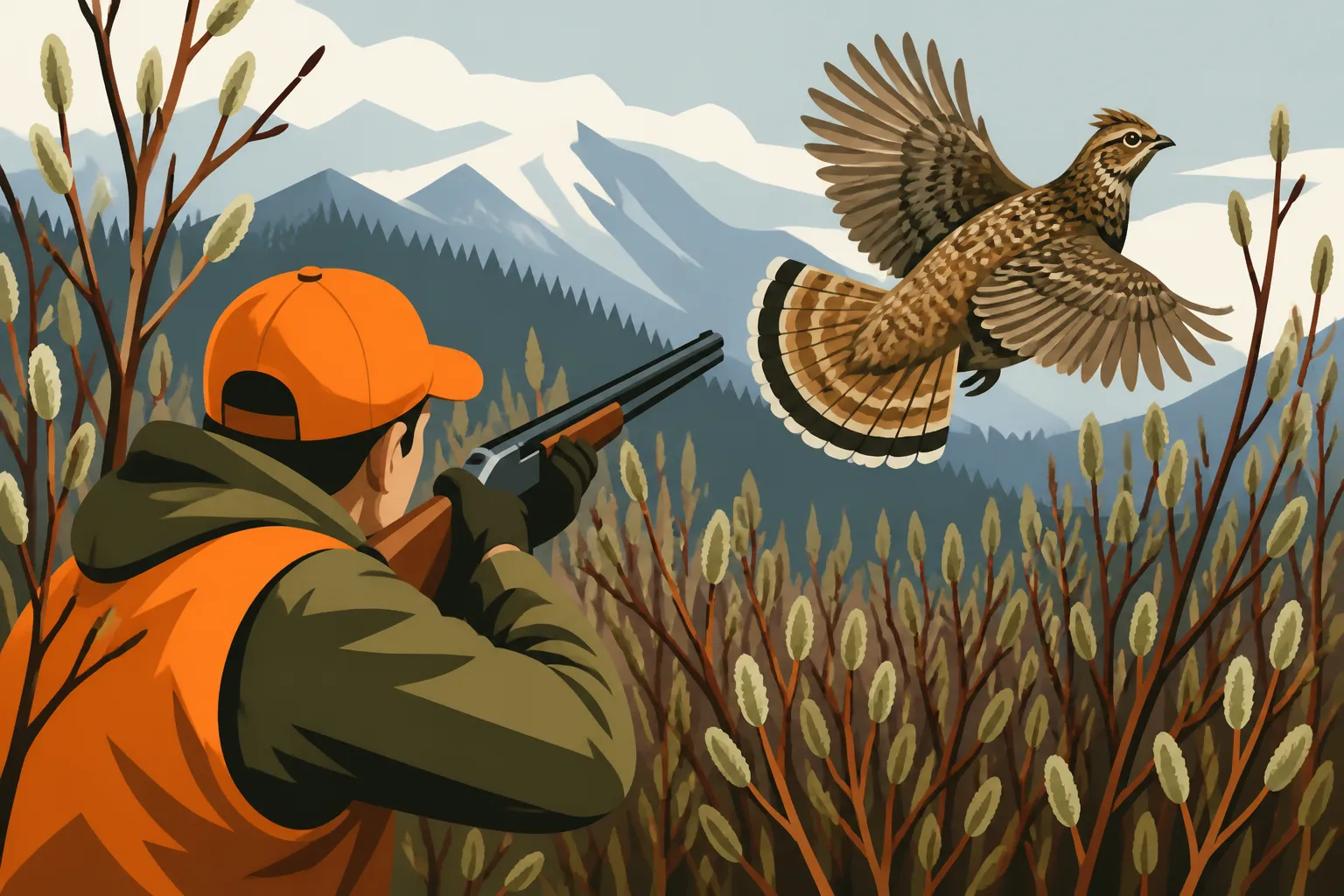
Walk with your gun held in a ready position, safety on, but ready to click off as you bring it to your shoulder. Keep your eyes peeled for any flicker of movement, a patch of brown feathers, or the characteristic shape of a grouse tucked against a log. Often, they won't flush until you're right on top of them. When one does flush, try to pinpoint its flight path and mark where it lands. Sometimes they'll only fly a short distance and re-roost, giving you a chance for a second flush. Working with a partner, spread out about 20-30 yards apart, can help cover more ground and flush birds that might otherwise hold.
Using Dogs in Thick Cover
A well-trained bird dog can be an incredible asset for hunting ruffed grouse in alder bottoms, but it also presents unique challenges. Both pointing breeds and flushing breeds can be effective. A good pointer will lock up on a bird, allowing you to move in for the flush, which is especially helpful in dense cover where you might not see the bird until it's airborne. Flushers, on the other hand, will actively seek out and push birds into the air, giving you more shooting opportunities. Our guide on Using a Bird Dog in British Columbia Timber offers excellent insights into working with your canine companion.
The biggest challenge with dogs in thick alders is keeping track of them and preventing them from getting too far ahead or out of sight. Bells on their collars are a must, allowing you to hear their movements even when you can't see them. GPS collars are also increasingly popular, providing real-time tracking that can be a lifesaver if your dog gets disoriented or locked on a bird far off. You need a dog that is "close-working" and responsive to commands, as a wide-ranging dog will push birds out of shooting range. Introduce your dog to dense cover gradually, and make sure they're comfortable navigating it.
Navigating the Challenges of Dense Cover
Hunting ruffed grouse in alder bottoms is as much about mental fortitude as it is about physical endurance. The density of the cover throws up unique challenges that can test even the most patient hunter.
Dealing with Impenetrable Thickets
It's inevitable: you'll encounter patches of alder so thick you feel like you need a machete to get through. These "impenetrable" thickets are where grouse often hold tightest, feeling completely secure. The trick is not to always try to push directly through them. Instead, look for natural lanes – old game trails, dry creek beds, or the edges where the alder gives way to a slightly different cover type. These provide easier passage and still allow you to influence birds within the thicket. You'll often find birds on the edges of these impenetrable areas, where they can quickly dive into the fortress.
When you do have to push through a particularly dense spot, do so slowly and methodically. Use your shotgun as a probe to push branches aside. Keep your head on a swivel. Remember, the grouse has the advantage here, seeing you before you see it. Your goal is to move in a way that minimizes their warning time and hopefully causes them to flush within your shooting window. This is where patience is key; rushing will only result in missed opportunities and frustration. Sometimes, simply walking parallel to the densest section, just outside its edge, can be more effective than trying to bust through the middle.
Safety Considerations in Dense Cover
Safety is paramount, especially when hunting in environments where visibility is severely limited. Blaze orange clothing is not just a recommendation; it's often a legal requirement in British Columbia during firearm seasons, and it's always a good idea when upland hunting. Make sure your hunting partners are also wearing plenty of it. You'll want to verify current British Columbia Blaze Orange Rules before each outing.
Communication is vital. If you're hunting with a partner, constantly check in with verbal cues. Establish clear shooting lanes and angles before you start moving. Only shoot at game you can clearly identify, and always be aware of what's beyond your target. In thick cover, it's easy to lose track of where your partners are, so disciplined movement and constant communication are essential. Hearing protection is also a good idea, as shotgun blasts can be surprisingly loud in the confined space of a dense alder bottom. Remember, you're responsible for every pellet that leaves your barrel.
Reading Sign and Tracking
While grouse don't leave tracks as obvious as a deer, they do leave signs. Learning to read these subtle indicators can dramatically improve your success. Droppings, or "crouses," are a common sign. They are small, dark, and often cylindrical, and you'll typically find them under roosting trees or near drumming logs. The fresher the droppings, the more recently grouse have been in the area.
Dust baths – small depressions in dry, dusty soil – are another clear sign of grouse activity. They use these to preen their feathers and remove parasites. Feathers, especially wing feathers after a flush or body feathers from a roosting spot, also indicate presence. Even subtle disturbances in the undergrowth or peck marks on buds can point to grouse feeding. Remember that many of these signs can be fleeting, especially in wet conditions, but honing your observation skills is a huge part of being a successful upland hunter. This skill set is akin to Reading Blacktail Sign in Wet Ground, just on a smaller scale. You're constantly piecing together clues to understand recent activity.
Post-Hunt Considerations and Regulations
Congratulations! You've successfully navigated the thickets and connected with a ruffed grouse. Now, it's important to ensure you handle your game properly and adhere to all regulations.
Field Dressing and Care
Proper field dressing and care are crucial for ensuring the meat is high quality. As soon as possible after the shot, field dress your grouse. This involves removing the entrails to allow the carcass to cool down quickly. You can often do this simply by making a small incision and pulling the guts out. Some hunters prefer to pluck them whole in the field, while others will skin them. If you plan to pluck, do it sooner rather than later, as it gets harder once the bird is cold.
Once field dressed, allow the bird to cool. In cooler weather, hanging it in a game bag (ventilated cloth bag) at camp works well. In warmer early seasons, keeping the bird cool can be a challenge. You might need a cooler with ice to prevent spoilage, especially if you have a long hike back to the vehicle. The quicker you can cool the bird, the better the meat quality will be.
British Columbia Regulations for Ruffed Grouse
Before you even step foot in the woods, it's your responsibility to be intimately familiar with British Columbia's hunting regulations. This includes season dates, bag limits, and any specific rules for the Management Unit (MU) you plan to hunt. You'll want to be familiar with the broader British Columbia Grouse Season and Limits before heading out. For grouse, seasons are generally quite generous across most of the province, but bag limits are enforced.
Always carry your valid hunting license and any required permits. It's always wise to verify current British Columbia Shooting Hours and British Columbia Blaze Orange Rules before each outing, as these can vary slightly by region or specific regulations. Regulations are designed to ensure sustainable hunting practices and the health of wildlife populations. Reputable resources like the BC Hunting and Trapping Regulations Synopsis or online tools like GoHunt provide up-to-date information, but it's crucial to consult the official government synopsis for the most accurate and current rules. For broader access information, understanding British Columbia Wildlife Management Area Rules can also be useful, as these areas sometimes have unique rules that apply to upland birds.
Disclaimer
Hunting is an inherently risky activity. The information provided in this guide is for informational purposes only and should not replace proper training, local regulations, or professional advice. Always prioritize safety, follow all applicable laws, and respect wildlife and the environment. Ensure you possess the necessary licenses, permits, and landowner permissions before hunting.