Still-Hunting Second Growth for Blacktail
Hunting elusive blacktail deer in the dense, tangled world of British Columbia's second-growth forests can feel like trying to find a ghost in a maze. It’s incredibly challenging, often frustrating, but also immensely rewarding when you finally connect. This guide is all about equipping you with the knowledge and tactics to effectively still-hunt these wily creatures in their preferred, often impenetrable, habitat.
Understanding Second Growth and Blacktail Behavior
Before you can successfully still-hunt blacktail, you need to deeply understand the environment they call home and how they interact with it. Second growth isn’t just a patch of trees; it's a dynamic ecosystem shaped by logging and time, offering unique challenges and opportunities.
What is "Second Growth" and Why it Matters to Blacktail
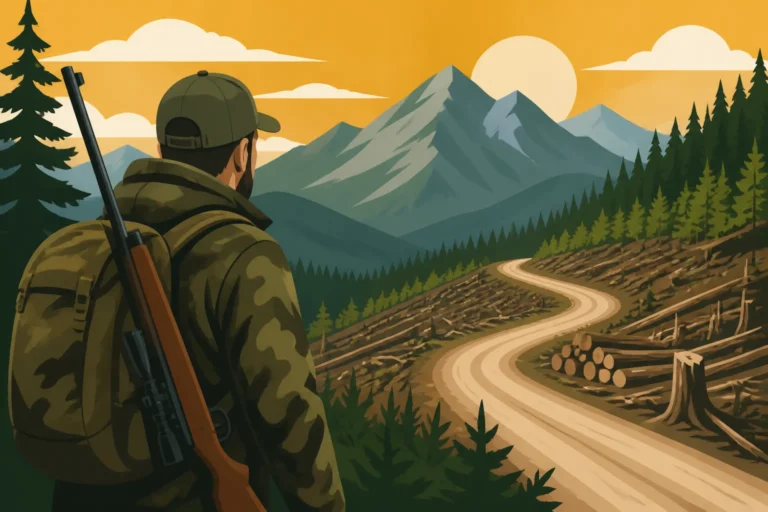
When we talk about second growth in British Columbia, we're typically referring to areas that have been logged, often extensively, and are now regenerating. This isn't just a simple clearcut; it's a mosaic of different regrowth stages. You might find areas of dense, pole-sized conifers just a few decades old, intermingspersed with areas of heavier brush like salal, huckleberry, and willow, often growing incredibly thick and tall. These areas can be incredibly frustrating to hunt, as visibility often extends only a few yards.
But this very density is precisely what attracts blacktail deer. For them, it's a sanctuary. The thick canopy and underbrush provide unparalleled cover from predators, both four-legged and two-legged. It offers abundant browse and forage, from the tender new growth of various shrubs to the needles of young conifers. Crucially, it provides a network of escape routes and bedding areas where a blacktail can simply vanish with a few quiet steps. This is why understanding the specific characteristics of these regenerating forests is key to success. You might find yourself on a British Columbia Island Clearcut Edge where the new growth is just starting to take hold, offering slightly better visibility, or deep within a nearly impenetrable block of 20-year-old fir and hemlock.
Blacktail Habits in Dense Cover
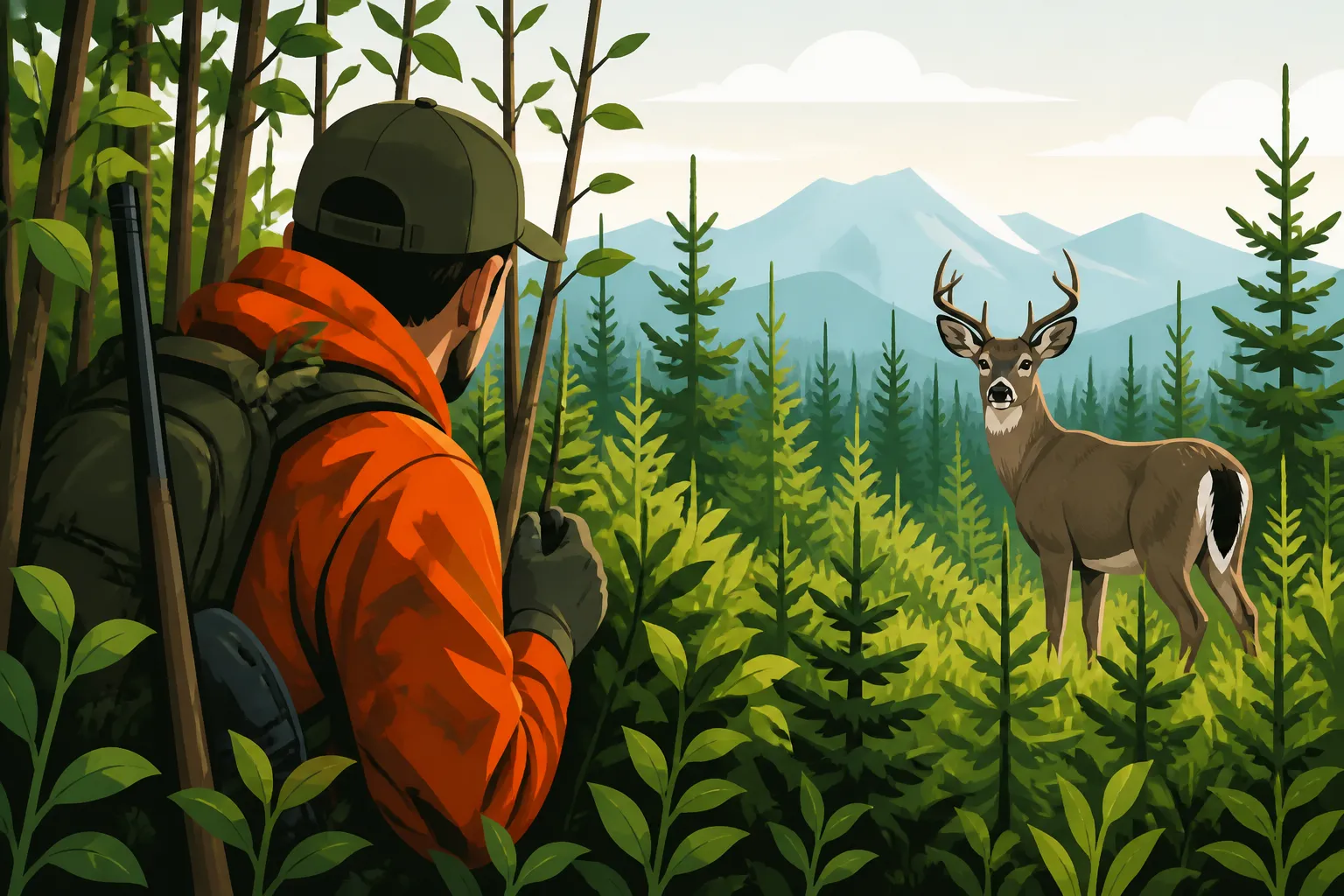
Blacktail deer are masters of evasion, and this is amplified when they operate in dense second-growth. Unlike mule deer that might try to outrun or outsmart you in more open country, a blacktail's first instinct in thick timber is often to freeze, relying on its incredible camouflage, then subtly melt away. They move like phantoms, often using the slightest depressions, windfalls, or established game trails to navigate the dense undergrowth silently.
Their primary senses in this environment are scent and hearing. They use the wind to detect intruders long before they're seen, and their large ears are constantly twitching, picking up the slightest rustle or snap. You'll often find them bedded down in thick pockets of cover, sometimes just a few feet off a main game trail, perfectly hidden. Understanding these habits means recognizing that you are hunting on their terms, in their fortress. You need to enter their world with the utmost respect for their senses and their innate ability to disappear. If you've ever tried Hunting Blacktail in British Columbia's Coastal Rain, you know exactly how challenging this can be, as the wet conditions can amplify sounds while making sign harder to spot.
Mastering the Art of Still-Hunting in Second Growth
Still-hunting isn't about covering ground; it's about covering it slowly and observing intensely. This method is tailor-made for the dense, visibility-limiting conditions of second growth, where a quick pace guarantees you'll bump deer unseen.
The "Slow and Slower" Approach to Movement
If there's one golden rule for still-hunting second growth for blacktail, it's this: go slower than you think you need to. And then go even slower. We're talking about taking one to two steps, then pausing for several minutes, sometimes even five to ten minutes, to observe and listen. This isn't just about moving quietly; it's about giving your eyes and ears time to process the environment. Our brains are hardwired to detect movement, and by staying still, you increase your chances of spotting a deer that might be moving, or that simply hasn't detected you yet.
During these pauses, use your binoculars to scrutinize every shadow, every tangle of branches, every patch of brush. Look for horizontal lines (a deer's back), contrasting patches of colour (its face or belly), or the tell-tale flicker of an ear or tail. These small details are often the first things you'll see. Practice shifting your gaze, not just staring, but slowly scanning, letting your eyes absorb information. Listen for the subtle sounds of the forest – a rustle, a twig snap that isn't your own, the distant sound of a raking antler. This extreme patience is what allows you to pick apart the dense cover. When you do move, focus on placing your feet heel-to-toe, testing the ground for loose debris before committing your weight. Avoid snapping twigs, scuffing leaves, or crunching through frosted brush. You're trying to become part of the forest, not an intruder. This meticulous approach is key when you're Hunting a Second-Growth Timber Block, where every advantage counts.
Utilizing Wind, Thermals, and Cover
Hunting a blacktail, especially in second growth, is a chess match where the wind and terrain are your most critical pieces. Always, always hunt into the wind. If the wind is at your back, your scent is traveling ahead of you, broadcasting your presence to every deer downwind. Blacktail will smell you long before you ever see them, no matter how quiet you are. Pay attention to how the wind shifts, especially in hilly or mountainous terrain, where thermals play a significant role. In the morning, as the sun warms the earth, thermals rise, carrying your scent uphill. In the evening, as the air cools, thermals fall, carrying your scent downhill. Plan your routes to take advantage of these natural air currents, always trying to keep your scent from reaching the deer's nose.
Beyond wind, utilize the available cover to your advantage. Move from tree to tree, through dense patches of brush, or along the edges of clearings, using the vegetation to break up your silhouette. Avoid skylining yourself on ridges or walking through wide-open areas where you'll be easily spotted. When you pause, position yourself behind a tree or a thick bush. Think like a deer: where would you hide if you were trying to avoid detection? Move slowly enough that if you spot a deer, you can freeze instantly without being noticed. This mindful movement and constant awareness of your surroundings are paramount, especially when Hunting Vancouver Island Blacktail in Second Growth, where the terrain can be incredibly varied and unforgiving.
Reading Sign and Anticipating Movement
Still-hunting isn't just about walking slowly; it's about constantly interpreting the story the forest tells. Fresh sign is your roadmap to finding blacktail. Look for fresh tracks, paying attention to how recently they were made – are the edges sharp or rounded? Are there fresh dew drops in them? Fresh droppings, still moist and shiny, indicate deer were recently in the area. Browsed vegetation, especially tender shoots and leaves, will show fresh, jagged edges where a deer has torn them.
Rubs on small trees or saplings, where bucks have scraped their antlers, are clear indicators of buck activity. Scrapes, patches of ground pawed clear, often with an overhanging branch, indicate a buck marking its territory. Understanding these signs, and their freshness, helps you determine if you're in an active area and if you should slow down even further. As you move, try to identify natural travel corridors within the second growth – faint trails, openings between dense thickets, or paths along the base of ridges. These are the "highways" blacktail use. A tool like GoHunt, with its detailed satellite imagery and topographical maps, can be invaluable for identifying these potential travel routes and pinch points even before you step foot in the woods, helping you plan your still-hunting path more effectively. When you find fresh sign, it's not just a discovery; it's a prompt to increase your vigilance and anticipate an encounter. You’re no longer just looking; you're expecting to see a deer. Interpreting the nuances of Reading Blacktail Sign in Wet Ground becomes a particularly important skill, as rain can obscure or wash away some details.
Essential Gear and Strategy for Success
Having the right gear won't guarantee a blacktail, but having the wrong gear can certainly guarantee failure. For still-hunting second growth, your equipment choices should prioritize stealth, protection from the elements, and efficient target acquisition in tight spaces.
Clothing and Footwear for Stealth and Comfort
Your clothing needs to be quiet, comfortable, and capable of handling British Columbia's often wet and variable weather. Layers are absolutely crucial. Start with a moisture-wicking base layer, add insulating layers like fleece or wool (which remains warm even when wet, unlike cotton), and top it off with a quiet, waterproof, and breathable outer shell. Modern materials that are silent when you brush against branches are a game-changer. Avoid anything that rustles loudly. Camouflage patterns should break up your silhouette, but movement is your biggest give-away, not just colour.
Footwear is arguably the most critical component. You need waterproof boots with excellent ankle support for the uneven, often steep, and slippery terrain found in second-growth. The soles should provide good traction but also be flexible enough to allow for quiet, deliberate foot placement. A stiff boot might offer great support but can make too much noise. Consider gaiters to keep brush, mud, and water out of your boots, as Hunting in British Columbia's Coastal Rain means constantly wet conditions.
Optics, Scent Control, and Other Tools
Good optics are essential, even in dense cover. A compact pair of binoculars (8x or 10x with a wide field of view) is invaluable for scrutinizing dense brush for deer. You’re not trying to see far, but rather to pick apart small areas for subtle signs of a deer. A rangefinder is also extremely useful; in thick timber, distances can be deceiving, and quickly ranging a patch of cover where you expect a deer to emerge can be the difference between a hit and a miss.
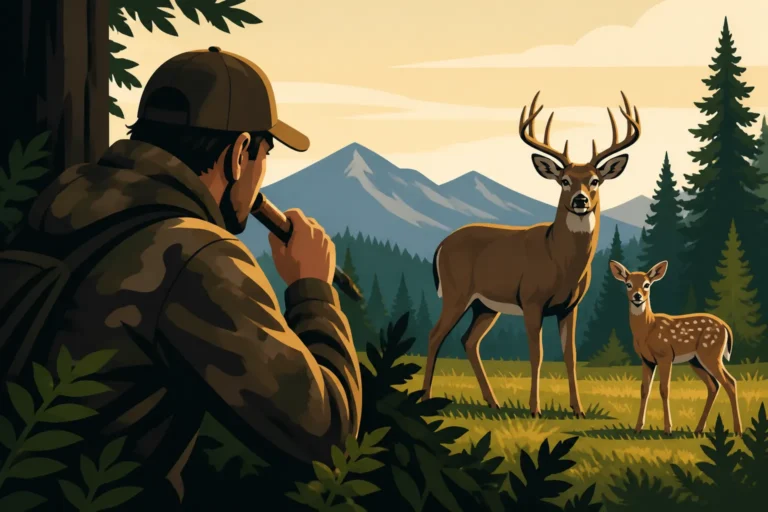
Scent control is paramount. While you can't eliminate all human scent, you can significantly reduce it. Wash your hunting clothes in scent-eliminating detergent, store them in airtight bags, and consider using a scent-eliminating spray on your outerwear before heading out. Avoid strong-smelling foods, soaps, or deodorants on hunt days. Sometimes, a subtle call can make a difference. A fawn bleat or a quiet grunt tube might pique a blacktail's curiosity, causing it to pause or even step into a clearer lane. Knowing when and how to use it – sparingly and softly – is key, especially if you're attempting Calling a Blacktail Buck With a Fawn Bleat. Leveraging platforms like GoHunt can also help you with gear selection, providing reviews and insights on optics or other tools tailored for specific hunting conditions.
Shot Placement and Follow-Up in Thick Cover
Getting a clear shot in dense second growth is often the biggest challenge. Patience is key; wait for the deer to offer a clean, ethical shot. Avoid rushing. You might only get a small window, so practice quick, decisive movements to shoulder your rifle or draw your bow. Aim for the vitals, understanding that shot angles can be tricky in the timber.
Even if you're confident in your shot, assume the deer is wounded and needs to be tracked. Mark the exact spot where the deer was standing when you shot, and where you last saw it. Pay attention to its reaction. Take your time, sometimes 15-30 minutes, before beginning to track, giving the deer time to bed down. Follow every drop of blood, every scuff, every broken twig. Tracking in thick second growth can be an arduous task, so a good tracking light, even in daylight, can be a huge asset. Don't give up too soon. Knowing how to efficiently Getting Meat Out of Steep British Columbia Country will also be crucial once you've successfully harvested your animal.
Specific Challenges and Advanced Tactics
Still-hunting second growth isn't for the faint of heart. It presents unique challenges that require adaptability and a willingness to embrace difficulty.
Dealing with Changing Weather and Terrain
British Columbia’s weather is notoriously fickle, and hunting in second growth means you’ll often face rain, fog, and sometimes even unexpected snow, even during early seasons. Rain can be a double-edged sword: it quiets the forest, masking your sounds, but it also dulls a deer's sense of smell and can make tracking much more difficult. Fog severely limits visibility, forcing you to slow down to an even crawl, relying almost entirely on sound and close-range observation. Always be prepared for adverse weather, dressing in layers and ensuring your gear is waterproof.
The terrain itself is another challenge. Second growth often grows on steep, uneven slopes, littered with blowdowns, logging debris, and hidden holes. This makes quiet movement incredibly difficult and demands a high level of physical fitness and sure-footedness. Don't underestimate the energy drain of constantly navigating such obstacles. Hunting these areas might mean you're essentially Hunting Above Timberline in Cold Weather in terms of physical exertion, even if you're at lower elevations.
Integrating Other Hunting Methods
While still-hunting is the primary tactic, it can be enhanced by selectively incorporating other methods. If you find yourself in a second-growth area with an elevated vantage point—perhaps an old logging spur or a small knoll—take some time to glass. Even dense cover has small openings, and a patient eye with good binoculars can sometimes spot a blacktail moving through a narrow lane or feeding in a small pocket of slightly thinner vegetation. This combines the principles of Glassing an Interior Hillside for Mule Deer, adapting it to the much tighter confines of blacktail habitat.
Another advanced tactic is to use your still-hunting to locate fresh sign and then switch to a "sit-and-wait" approach on a well-used game trail or near a bedding area. After meticulously still-hunting through a section, identifying key travel routes or feeding zones, you might find it advantageous to settle into a well-concealed position downwind and let the deer come to you. This can be especially effective during the rut when bucks are more active and less cautious. Utilizing digital mapping tools like GoHunt, which can highlight topography and potential game trails, can assist in identifying these strategic ambush points within the thick timber, allowing you to optimize your time and effort. Ultimately, success hinges on your ability to adapt to the conditions and the deer's behavior.
Successfully still-hunting second growth for blacktail deer in British Columbia is a masterclass in patience, stealth, and observation. It’s a hunt that will test your resolve, push your physical limits, and hone your bushcraft skills like no other. But when that moment comes, and a beautiful blacktail buck materializes from the dense cover, the satisfaction is profound and truly earned.
Disclaimer
Hunting is an inherently dangerous activity. Always prioritize safety, follow all local and provincial hunting regulations, and be aware of your surroundings. This guide provides general information and should not replace professional training or expert advice. Always check the most current British Columbia Hunting and Trapping Synopsis before heading into the field.