Hunting a British Columbia Cutblock Edge
The frustration of trying to find game in vast, unbroken timber can be incredibly real and disheartening. It feels like searching for a needle in an impossibly large haystack. This guide is here to unravel the mystery of hunting British Columbia's cutblock edges, showing you how these dynamic zones become magnets for game and how you can effectively hunt them.
The Allure of the Cutblock Edge: Why Animals Love Them
A cutblock edge in British Columbia is more than just where the trees stop and a cleared area begins. It's a vibrant, ever-changing transition zone, a biological hotspot, and for many big game species, it's home. If you've ever spent time driving the sprawling network of British Columbia's Forest Service Road Network, you've undoubtedly passed countless cutblocks, often without fully appreciating the incredible hunting potential they hold. The edge is where two different habitat types meet, and this creates a wealth of opportunities that continuous forest or open clearcut alone simply cannot provide.
Imagine a deer, a moose, or a bear. What are their primary needs? Food, cover, and security. A cutblock edge often provides all three in close proximity, creating an ideal living and foraging environment. The dense timber provides crucial thermal cover, especially during harsh weather or when they need to bed down and feel safe. It's their sanctuary, their impenetrable fortress. Right next to this sanctuary, the regenerating clearcut offers a smorgasbord of browse. Young willows, aspen, huckleberries, fireweed – these pioneer species thrive in the sunlight that reaches the forest floor after logging, providing a buffet of high-energy forage that just isn't available under the mature forest canopy. This juxtaposition is key; animals can step out to feed and quickly retreat to the safety and concealment of the standing timber, making them feel secure. This is why you'll often find game actively moving along these edges, particularly during prime feeding times.
Beyond food and cover, cutblock edges also act as natural travel corridors. Animals will often skirt the perimeter of a cutblock, using the dense cover as a screen while they move from one feeding area to another, or from bedding grounds to water sources. These edges can be especially productive during the rut, as bucks and bulls will scent-check the fringes for receptive females who are also drawn to the abundant forage. Understanding this fundamental appeal is the first step to successful hunting in these areas. It's not just about finding a cutblock, but understanding why that specific edge is attractive to the animals you're pursuing.
Reading the Land: Identifying Productive Cutblock Edges
Not all cutblock edges are created equal, and knowing how to discern a promising one from a less productive one is a critical skill for any BC hunter. This is where modern scouting tools and a keen eye for terrain features truly shine. Start your scouting long before you ever set foot in the woods. Tools like onX Hunt or GoHunt are invaluable for pre-season desktop scouting. You can identify potential cutblocks, analyze their age (if imagery is current enough), and, crucially, examine the surrounding terrain. Look for edges that are adjacent to old growth timber, particularly north-facing slopes which offer cooler bedding areas in early season, or south-facing slopes that warm up faster in spring and fall. Access to water, even a small creek or seep, can significantly increase the attractiveness of an edge.
When you're boots on the ground, or even just driving a Finding Open Forest Roads in British Columbia, pay close attention to the features of the cutblock itself. The age of the regeneration is paramount. A brand new cutblock, often just a sea of stumps, offers little in the way of cover or diverse forage. Conversely, a cutblock that has been regenerating for 3 to 10 years, where the new growth is dense but not yet fully canopy-closed, is often a gold mine. This is when the shrubs and young trees are at their peak for browse, and the cover is just thick enough to hide animals but still allows for some visibility. Hunting a Recent Cutblock in Its Third Year can be especially productive. Look for benches, draws, or small pockets of timber left within the cutblock – these act as internal refuges and can be highly effective ambush points. Reading game sign is also critical: fresh tracks, droppings, rubs, and beds will tell you if animals are actively using that specific edge. A well-used trail entering or exiting the timber at a certain point along the edge is a flashing neon sign.
| Cutblock Age (Years) | Vegetation Characteristics | Hunting Potential (General) | Target Species (Likely) |
|---|---|---|---|
| 1-2 | Stumps, low pioneer plants, very open | Low, limited cover and forage | Bears (early berries) |
| 3-10 | Dense young trees/shrubs, abundant browse | High, excellent cover and food | Deer, Moose, Bear, Elk |
| 11-25 | Growing trees, canopy closing, less ground browse | Moderate, depends on understory & adjacent timber | Deer, Bear, Moose |
| 25+ | Dense young forest, declining browse | Low to Moderate, more like regular timber | Deer, occasional Bear |
Remember to factor in aspect – which direction the slope faces. South-facing slopes will get more sun, melting snow faster in late season, and promoting earlier spring growth, which can be attractive to deer and elk looking for green-up. North-facing slopes, conversely, hold snow longer and offer cooler bedding in hot weather, making them ideal for bears or moose seeking refuge from summer heat.
Strategies for Success: Hunting the Cutblock Edge
Hunting a cutblock edge requires a blend of patience, careful movement, and knowing when to capitalize on animal behaviour. There isn't a one-size-fits-all approach, but rather a few key strategies that can be adapted to the specific conditions you face.
Still-Hunting and Sneaking the Edge
One of the most effective ways to hunt a cutblock edge is by still-hunting or slowly sneaking along its perimeter, often just inside the standing timber where your presence is less exposed. This technique is particularly effective in varied terrain or areas with thick underbrush. The goal is to move incredibly slowly, taking a few steps, then pausing to glass and listen for several minutes. Use your binoculars to pick apart every shadow and clump of brush, both within the standing timber and out into the clearcut. Animals are often just inside the timber, taking advantage of the cover while still keeping an eye on the open area. Pay close attention to the wind direction; you always want the wind in your face or quartering. Scent control is paramount. This method allows you to cover ground quietly and discover animals that might be bedded or slowly feeding. For species like blacktail deer, Still-Hunting Second Growth for Blacktail can be incredibly productive, as they are masters of blending into dense cover right on the edge of visibility.
Glassing from a Vantage Point
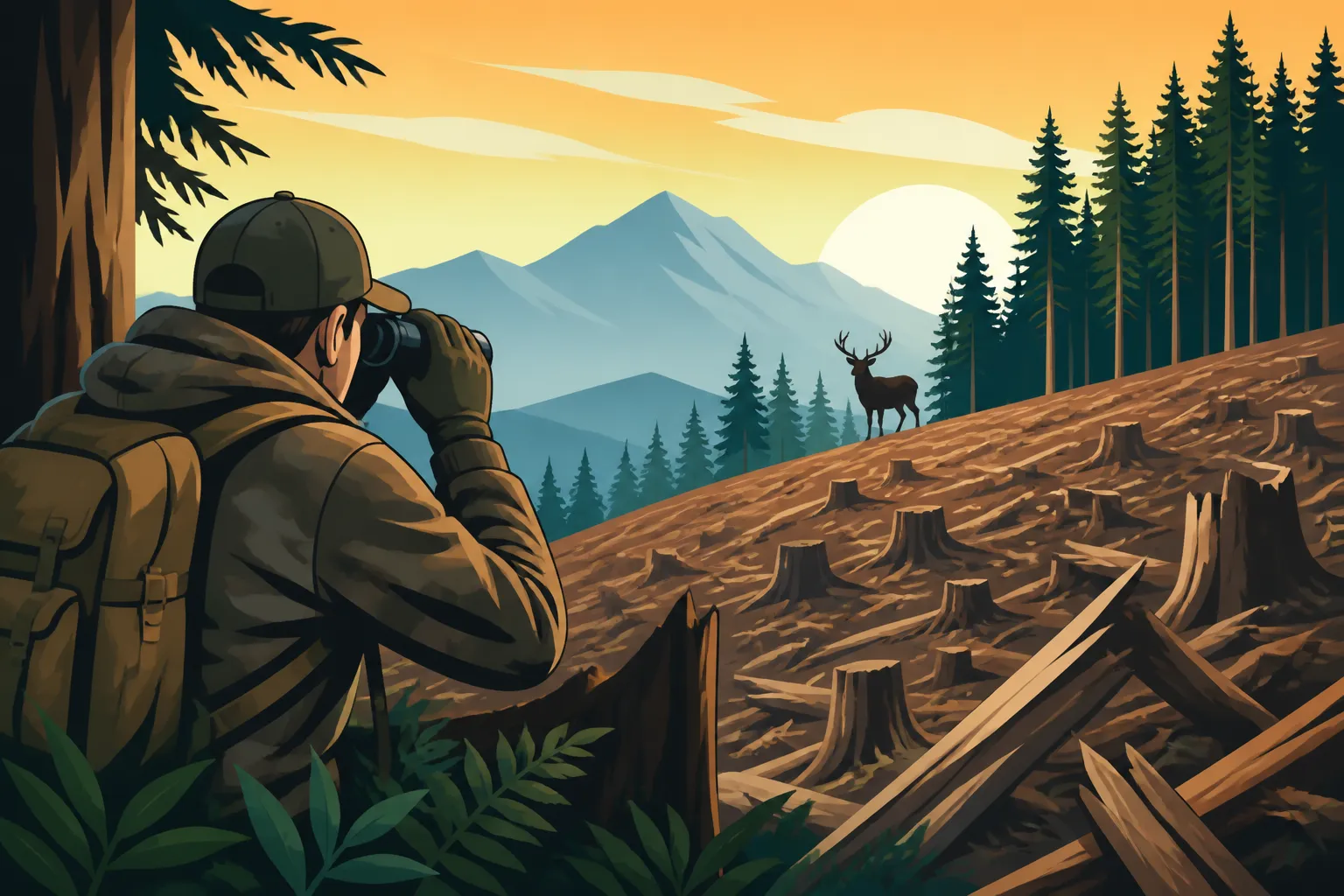
If the topography allows, establishing a glassing point overlooking a large cutblock or a series of edges can be incredibly productive, especially for species like mule deer or elk. Glassing an Interior Hillside for Mule Deer is a prime example of this strategy. Get to your vantage point before first light, settle in, and begin systematically picking apart the cutblock with high-quality optics. Focus on areas where the edge forms a pocket, a point, or where a draw runs into the timber. Animals will often feed out into the open areas during the early morning and late evening, then retreat to the security of the timber as the sun rises. Be patient; animals can appear seemingly out of nowhere. A good spotting scope can help confirm details and evaluate animals from a distance. Once you spot an animal, plan your stalk carefully, taking into account wind, terrain, and available cover to close the distance.
Ambush and Stand Hunting
For smaller, more defined cutblocks, or specific travel corridors along a longer edge, setting up an ambush point can be highly effective. This involves identifying pinch points, well-used trails, or natural funnels where animals are likely to travel. Consider the time of day and typical feeding patterns. If deer are feeding in a particular section of the cutblock in the evening, they will likely enter or exit the timber at specific points. Set up downwind and out of sight, either on the ground with natural cover or in a portable tree stand if allowed and practical. This strategy requires good pre-scouting to identify these key locations. For moose, specifically, understanding how they utilize edges is crucial; Hunting Moose on a Cutblock Edge often involves finding those subtle paths they create through the brush. Be prepared to wait, quietly and patiently, for your opportunity.
Essential Gear and Safety Considerations
Hunting cutblock edges often means navigating challenging terrain, from tangled blowdowns and thick regeneration to steep slopes. Having the right gear isn't just about comfort, it's about safety and effectiveness.
Footwear and Clothing
Your boots are perhaps your most critical piece of gear. You'll need sturdy, waterproof boots with excellent ankle support to navigate uneven ground, fallen logs, and potentially muddy or wet conditions. Gaiters can be a lifesaver, preventing debris and moisture from getting into your boots, especially when pushing through thick brush. Layered clothing is essential, as temperatures can fluctuate wildly between the cool, shaded timber and the open, sunny clearcut. Good quality rain gear is a must in British Columbia, as precipitation can change rapidly. Avoid cotton; opt for synthetic or wool base layers that wick moisture and retain warmth even when wet. And don't forget blaze orange, depending on the season and specific regulations for the British Columbia Rifle Season Dates or British Columbia Archery Season Dates you are hunting – it’s a critical safety item.
Optics and Navigation
As mentioned, good binoculars (10×42 or 10×50 are great all-around options) are non-negotiable for effectively glassing cutblock edges. A rangefinder is also extremely useful for judging distances in varied terrain. For navigation, a reliable GPS unit or a smartphone with a robust mapping app like onX Hunt or GoHunt is crucial. These apps allow you to mark your location, plan routes, and identify property lines or specific management unit boundaries. Always carry a physical map and compass as a backup, and know how to use them. Cell service can be spotty or non-existent in many remote BC hunting areas, so Satellite Communication on a Remote Hunt is highly recommended for emergencies.
Bear Safety and Active Logging Zones
British Columbia is bear country, and cutblocks, with their dense berry bushes and abundant forage, are often prime bear habitat. Always carry bear spray, know how to use it, and have it readily accessible. Make noise as you move through thick cover, especially where visibility is limited, to avoid surprising a bear. Be aware of signs of bear activity, like scat, claw marks on trees, or overturned rocks. For more in-depth information, refer to Bear Safety While Hunting in British Columbia.
Another critical safety consideration when hunting British Columbia's cutblocks is the presence of active logging operations. These areas are working industrial sites, and loggers often operate heavy machinery, sometimes around the clock. Always be aware of your surroundings, listen for machinery, and look for active logging signs. Many active logging roads require specific radio channels to communicate your travel plans. If you encounter active logging, it's best to respect their work and move to a different area. It’s not worth the risk. Always check for Road Closures on British Columbia Forest Roads and active work sites before heading out.
When you do manage to connect with an animal, especially in these thicker areas, remember that Packing Out of British Columbia's Steep Country can be a serious challenge. Having a good frame pack and a plan for game retrieval is just as important as the hunt itself.
Disclaimer
This article is for general informational purposes only and does not constitute professional advice. Laws, prices and regulations vary by location and change over time. Consult a qualified professional for guidance on your specific situation.