Boots for Steep British Columbia Country
The mountains and valleys of British Columbia are stunning, but they are also relentlessly unforgiving. Many hunters underestimate the sheer physical toll this varied and often vertical landscape takes on their feet, leading to painful blisters, twisted ankles, and even prematurely ended hunts. This guide will walk you through the critical features to look for in hunting boots specifically designed to tackle British Columbia's steep country, ensuring your feet are your allies, not your Achilles' heel.
The Relentless Reality of British Columbia's Steep Country
If you’ve spent any time chasing game in British Columbia, you know it’s not just picturesque meadows and gentle slopes. Our province throws everything at you: crumbling shale slides, slick, moss-covered boulders, dense wet timber, and ascents and descents that feel like climbing a ladder that never ends. Your boots are often the most critical piece of gear you own, directly impacting your comfort, safety, and ultimately, your success.
Why "Good Enough" Just Isn't Enough Here
I've seen it countless times – a hunter shows up with boots that might be perfectly fine for flat ground or rolling hills, but they are utterly unprepared for the abuse they're about to endure. In British Columbia, "good enough" usually translates to "not good enough." Imagine side-hilling on a 45-degree slope, your ankle constantly trying to roll, or traversing a scree field where every step feels like you're walking on marbles. This isn't your grandfather's woodlot hunt. This is British Columbia. The terrain is constantly trying to break you down, and poor footwear will be the first thing to fail.
The sheer variety of ground underfoot means your boots need to be jacks-of-all-trades, yet masters of stability and protection. One moment you're sinking into spongy muskeg on the coast, the next you're scrambling over jagged rock ledges in the alpine. Later, you might be slogging through muddy clearcuts in the interior. Your boots need to withstand constant abrasion, provide traction on diverse surfaces, and keep your feet dry and protected through it all. This isn't a place for compromise; it's a place for purpose-built gear. This is especially true if you’re planning a hunt that involves a lot of vertical, like Backpacking Into British Columbia Sheep Country.
The Cost of Inadequate Footwear
The price you pay for skimping on quality footwear in British Columbia isn't just discomfort; it can be much higher. The most common immediate consequence is blisters. A small hot spot can quickly turn into a debilitating blister that makes every step agony, distracting you from the hunt and draining your morale. Beyond blisters, there's the very real risk of sprained or broken ankles from inadequate support on uneven ground. A twisted ankle in the backcountry isn't just painful; it's a serious emergency that can turn a hunt into a life-threatening situation.
Then there's the cold and wet. British Columbia is notorious for its rain, especially in coastal regions or higher elevations. If your boots aren't truly waterproof, your feet will get soaked. Wet feet quickly become cold feet, leading to potential frostbite in colder temperatures, or uncomfortable, chafed skin and even trench foot in prolonged damp conditions. All these factors combined can prematurely end your hunt, force an emergency extraction, or at the very least, make an otherwise incredible experience miserable. Thinking about the sheer effort of Packing Out of British Columbia's Steep Country with aching, blistered feet is enough to make anyone prioritize proper boots.
Essential Features for British Columbia Mountain Hunting Boots
When you're looking for boots that can handle the specific demands of British Columbia's steep and varied terrain, you're not just looking for something that "fits." You're looking for a carefully engineered piece of equipment that will protect and support you when you need it most. Forget fashion; here, function is king.
Stiffness and Support: Your Ankle's Best Friend
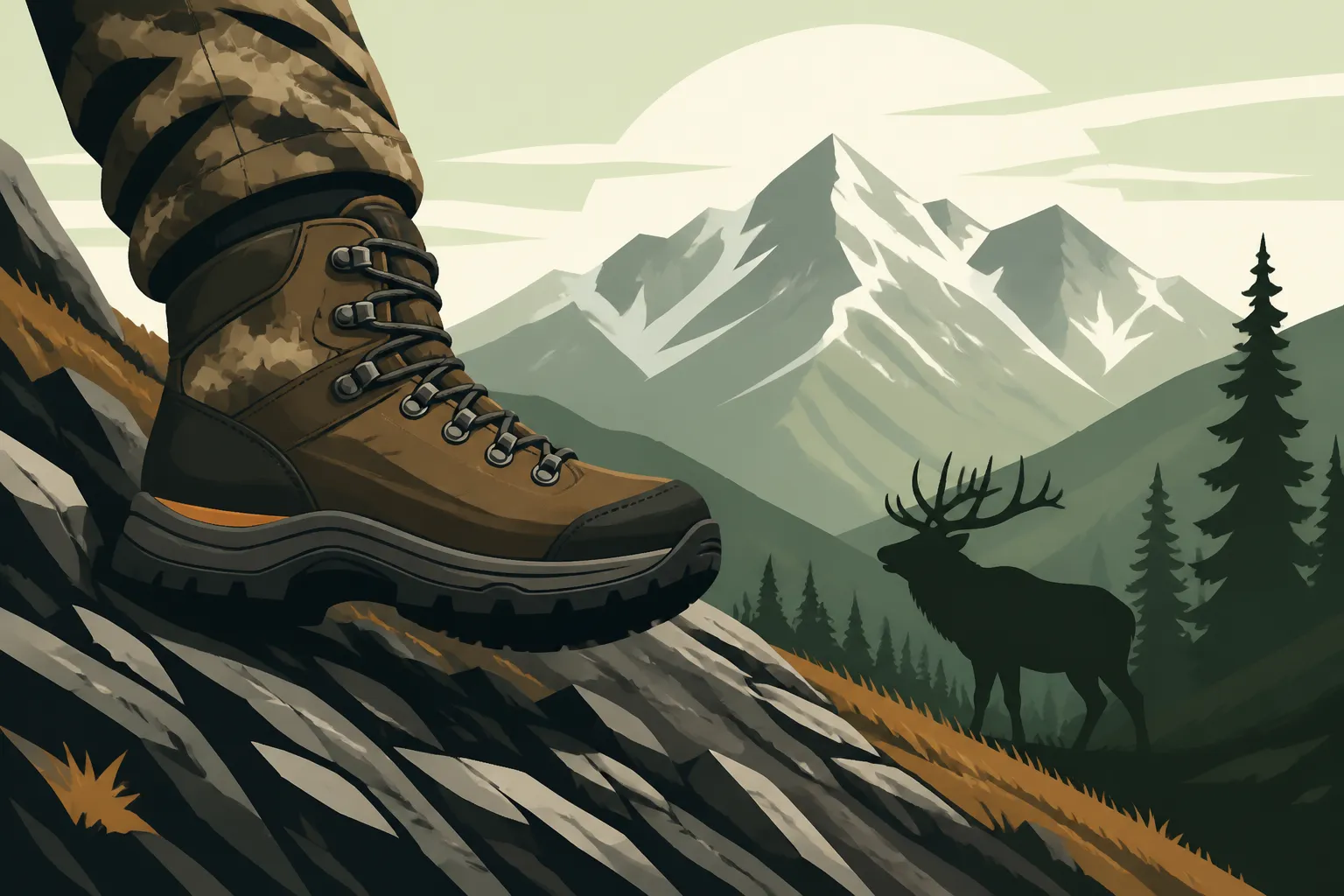
The single most critical feature for hunting in British Columbia's steep country is a stiff sole. We're talking about boots with a full shank, often steel or a robust composite material, running the entire length of the sole. Why is this so important?
Firstly, it provides unparalleled stability when side-hilling. When you're traversing a steep slope, a flexible sole allows your foot to bend and twist with the contour of the ground. This puts immense strain on your ankles and the small muscles in your feet, leading to fatigue and dramatically increasing your risk of an ankle injury. A stiff sole, however, acts like a mini-platform, keeping your foot flat and stable regardless of the angle of the terrain. This is vital whether you're climbing up a scree slope after a goat or carefully descending a muddy timbered ridge with a heavy pack.
Secondly, a stiff sole protects your feet from sharp rocks and uneven ground. Imagine stepping on a pointy rock with a flexible-soled boot; you'll feel every protrusion. A stiff sole distributes that pressure across a wider area, preventing bruised soles, which can be incredibly painful and make walking almost impossible. The robust construction also contributes to excellent ankle support, often extending high up the calf with sturdy lacing systems. This cradles your ankle, minimizing lateral movement and providing crucial stability against rolls and twists. When you're trying to gain elevation on Hunting Mountain Goat on British Columbia Rock, that ankle support can be the difference between making it to your objective and turning back early.
Waterproofing and Breathability: The Wet-Dry Balance
British Columbia, especially the coastal and interior mountain regions, is synonymous with moisture. Rain, snow, dew-soaked vegetation, stream crossings – your feet will encounter water. Therefore, reliable waterproofing is non-negotiable. Most high-quality mountain hunting boots utilize a waterproof-breathable membrane like Gore-Tex, eVent, or similar proprietary technologies. These membranes are designed to prevent external water from entering the boot while allowing internal moisture (sweat) to escape.
However, it's not enough for a boot to just be waterproof; it needs to breathe. Imagine your feet trapped in a non-breathable plastic bag – they'd quickly become saturated with sweat, leading to the same problems as external water penetration. Good breathability is essential to keep your feet as dry as possible from the inside out, preventing discomfort, blisters, and potential fungal issues. Always look for boots with a reputable waterproof-breathable lining and consider their construction. While full-grain leather boots can be incredibly durable and naturally water-resistant, they also require diligent care and conditioning to maintain their waterproofing. Synthetic boots, on the other hand, often rely entirely on the membrane, which can be vulnerable to punctures or wear over time if not properly cared for. When researching potential hunts, resources like BookYourHunt often detail the typical weather conditions, which can help inform your boot choice.
Traction and Durability: Gripping the Grime
Steep British Columbia terrain is often loose, wet, or both. Your boot's outsole, the rubber tread on the bottom, is your primary contact with the ground and absolutely critical for safety. Look for outsoles with deep, aggressive lugs and a multi-directional tread pattern. These deep lugs dig into soft earth, mud, and snow, providing crucial grip. The specific rubber compound also matters; some are designed for better grip on wet rock, while others excel in dry, loose scree. Vibram is a well-known manufacturer of high-performance outsoles, and many top boot brands utilize their technology.
Beyond grip, durability is key. These boots will be scraped, scuffed, and generally abused by sharp rocks, dense brush, and rough terrain. Full-grain leather uppers are often preferred for their inherent toughness and ability to resist abrasion. Some boots incorporate robust synthetic materials or rubber randing around the perimeter to add an extra layer of protection against cuts and scrapes. Stitching, hardware (eyelets, lace hooks), and the overall construction quality should be top-notch. Loose stitching or flimsy hardware will be the first things to fail when you're pushing hard in the BC backcountry. When planning your multi-day excursions into areas like Hunting British Columbia's Alpine in September, you need to know your boots can take a beating and keep performing.
Matching Boots to British Columbia's Diverse Challenges
The "best" boot isn't a one-size-fits-all answer; it depends on the specific type of hunting you're doing and the terrain you expect to encounter. British Columbia offers such a vast array of landscapes that you might even find yourself needing different boots for different species or regions.
Heavy-Duty Mountain Boots: For the True Vertical Grind
These are the workhorses of the British Columbia mountain hunting scene. When you're eyeing a Stone's sheep high on a distant ridge or pursuing a wily mountain goat through truly gnarly rock slides, these are the boots you need. They are characterized by their maximum stiffness, often a full-length, rigid shank, and very robust ankle support. The uppers are typically thick, full-grain leather, often with extensive rubber randing for ultimate abrasion resistance against jagged rock.
These boots are designed for stability, protection, and the ability to handle extremely heavy loads (like packing out an entire animal) over very rough, steep, and often off-camber terrain. They excel at side-hilling without fatiguing your ankles and provide a solid platform for climbing and descending. The trade-off is often weight and a longer break-in period. They can feel clunky on flatter ground and are generally overkill for casual hunts. However, when you're 10 miles deep into the high country, scrambling up a Hunting a Rock Slide for Goats or traversing a Hunting a Mountain Pass in British Columbia, you'll be grateful for every ounce of their heavy-duty construction. Before committing to such an arduous trip, consulting resources like GoHunt can help you understand the elevation profiles and typical terrain, confirming if these specialized boots are truly necessary.
Mid-Weight Backpacking Boots: Versatility for Varied Terrain
For many British Columbia hunts, especially those involving elk, moose, or mule deer in more rolling or timbered country with occasional steep sections, a mid-weight backpacking boot offers an excellent balance of support, durability, and comfort. These boots typically feature a three-quarter or half shank, offering good stiffness but with a bit more flexibility than a full-on mountain boot. This makes them more comfortable for covering longer distances over varied terrain, including logging roads and less extreme climbs.
They still provide ample ankle support, good waterproofing, and aggressive outsoles, but they might be a bit lighter and require less break-in. Think of hunts where you might be Hunting Moose on a Cutblock Edge or Spot-and-Stalk Mule Deer in British Columbia, where you're covering a lot of ground but still need to be prepared for some steep climbs or river crossings. They are rugged enough for substantial abuse but offer better walking comfort for longer treks. These are often a great choice for a general-purpose British Columbia hunting boot if you're not planning extreme alpine expeditions every year.
Lighter, More Flexible Options: Limited Use Cases
While the focus for "steep country" is on heavier, stiffer boots, it's worth acknowledging lighter, more flexible options and understanding their limitations. Boots designed more for hiking or lighter backpacking might be suitable for very specific British Columbia hunts – perhaps early season grouse on flat logging roads, or chasing blacktail in milder, lower-elevation coastal forests where the ground is primarily soft duff and moss, and you're not gaining much elevation.
These boots offer excellent comfort for high mileage on easier terrain and are often quicker to break in. However, they lack the crucial stiffness and ankle support needed for true steep country. Their soles are more flexible, offering less protection from sharp rocks, and their overall durability against the abrasion of rugged terrain is often compromised. Taking a lightweight, flexible boot into challenging mountain terrain is a recipe for injury and discomfort. Always err on the side of too much support rather than too little when hunting British Columbia's vertical world.
Here's a quick comparison of boot types and their typical applications in British Columbia:
| Boot Type | Sole Stiffness | Ankle Support | Ideal Terrain & Hunt Types | Pros | Cons |
|---|---|---|---|---|---|
| Heavy Mountain Boot | Full (Rigid) | Maximum (High Cuff) | Steep alpine, scree, shale, heavy packing (Sheep, Goat, high-elevation Elk) | Unmatched stability, protection, load-carrying | Heavy, long break-in, less comfortable on flats |
| Mid-Weight Backpacking | 3/4 or 1/2 Shank | Excellent (Mid-High) | Varied terrain, rolling hills, timbered slopes (Mule Deer, Moose, lower-elevation Elk) | Good balance of support & comfort, versatile | May lack ultimate stiffness for extreme vertical |
| Lightweight Hiking | Flexible (No Shank) | Moderate (Mid Cuff) | Light trails, logging roads, low-elevation, easy terrain (Grouse, early-season low-country Deer) | Light, comfortable, quick break-in | Insufficient support for steep/rocky terrain, less durable |
Breaking In, Maintenance, and Beyond
Even the most expensive, technically advanced boots are useless if they aren't properly prepared for the field or cared for afterward. Investing in a quality pair of boots is just the first step; the subsequent commitment to break-in and maintenance is equally important.
The Non-Negotiable Break-In Period
This cannot be stressed enough: NEVER take brand new boots straight into the backcountry on a hunt. That's a recipe for disaster. Break-in is not just about making the boots comfortable; it's about moulding them to your feet and allowing the materials to soften and flex naturally.
Start with short walks around your neighbourhood or local park. Wear the socks you intend to hunt in. Gradually increase the duration and difficulty of your walks. Progress to longer hikes with a daypack, then with a weighted pack similar to what you'd carry on a hunt. Tackle some hills, even if they're not British Columbia steep. This process might take weeks, even months, for truly stiff mountain boots. Pay close attention to any hot spots and address them immediately with moleskin or athletic tape. Many a hunt has been saved by diligent break-in at home. This preparation is part of your overall Fitness for a British Columbia Sheep Hunt, ensuring your body and gear are ready.
Regular Care for Longevity
Your boots are an investment, and like any investment, they require care to perform well and last. Neglecting maintenance is one of the quickest ways to shorten the lifespan of your expensive hunting boots.
After every trip, especially in British Columbia's often wet and muddy conditions, clean your boots. Remove all mud, dirt, and debris from the uppers and especially the outsole. Use a stiff brush and water. For leather boots, apply a quality leather conditioner or treatment to keep the leather supple and prevent cracking. This is crucial for maintaining their natural water resistance. For boots with waterproof membranes, ensure they are clean to prevent clogging the pores, which would inhibit breathability. Periodically, you might need to reapply a durable water repellent (DWR) treatment to the outer fabric to help water bead off.
Crucially, always dry your boots properly. Never use direct heat sources like campfires or heaters, as this can damage leather, synthetic materials, and adhesives, leading to cracking or delamination. Instead, remove the insoles, open the laces wide, and allow them to air dry in a well-ventilated area, preferably at room temperature. Stuffing them with newspaper can help absorb moisture and speed up the process. Regularly inspect your laces, eyelets, and stitching for wear and tear, and replace components as needed. A simple re-lacing can prevent a trip-ending failure.
Beyond the Boots: Socks and Foot Care
Even the best boots can't do it all alone. The right socks are just as critical for comfort and performance. Merino wool socks are overwhelmingly the preferred choice for hunting in British Columbia. They offer excellent moisture-wicking properties, keeping your feet dry even when sweating, and they retain warmth even when wet. They also resist odour buildup, a bonus on multi-day backcountry trips. Consider wearing a thin liner sock underneath a thicker outer wool sock to reduce friction and help prevent blisters.
Proactive foot care throughout your hunt is also essential. Before you start, trim your toenails short and file any rough edges. If you feel a hot spot developing, stop immediately and apply moleskin or athletic tape before it turns into a blister. Carry a small foot care kit in your pack. Keeping your feet dry, clean, and well-cared for is paramount to staying comfortable and effective in the field. When you're planning for longer hunts, like those where you'll be Hunting Above Timberline in Cold Weather, having extra dry socks and a robust foot care routine becomes even more critical for success and safety.
Disclaimer
This article is for general informational purposes only and does not constitute professional advice. Laws, prices and regulations vary by location and change over time. Consult a qualified professional for guidance on your specific situation.