Hunting a Sagebrush Bench in the Okanagan
Hunting the sun-drenched, arid sagebrush benches of the Okanagan can be one of British Columbia’s most rewarding, yet frustrating, pursuits. Hunters often face the challenge of vast, open landscapes where cover is minimal, and mule deer, in particular, seem to vanish into thin air despite being right in front of you. This guide is designed to peel back the layers of this unique environment, providing you with practical strategies, scouting insights, and gear recommendations to help you navigate these distinctive hunting grounds and increase your chances of success.
The Unique Allure of Okanagan Sagebrush Benches for Hunters
The Okanagan region, with its rolling hills, Ponderosa pine stands, and iconic sagebrush flats, offers a vastly different hunting experience compared to the dense coastal forests or the rugged alpine peaks British Columbia is famous for. For many, it's the sheer challenge and the rewarding sight of a big-bodied mule deer buck silhouetted against a golden sunrise that draws them back year after year. However, this environment demands a specific set of skills and a deep understanding of how game animals interact with such open terrain.
A Distinctive Landscape and Its Primary Game
Sagebrush benches are characterized by their open nature, dominated by various species of sagebrush, bunchgrasses, and scattered Ponderosa pine or Douglas fir on the steeper slopes and north-facing aspects. This isn't your typical dense forest hunting; visibility can stretch for miles, making both spotting game and remaining undetected a delicate balance. This unique ecosystem, often carved by ancient glacial activity and seasonal water flows, creates specific pockets of feed, cover, and water that become critical attractants for wildlife.
The star of these benches, without a doubt, is the mule deer. Their impressive antlers and cunning ability to use sparse cover to their advantage make them a highly sought-after trophy. These deer thrive on the browse offered by the sagebrush and other native plants, moving between higher, cooler bedding grounds in the timbered draws and the lower benches for feeding, especially during the cooler parts of the day. You'll also find a surprising variety of upland birds like chukar, Hungarian partridge, and even California quail in these areas, particularly near water sources or rocky outcroppings. The hunting pressure, especially on readily accessible benches, can be significant, so understanding how deer react to human presence is key to finding undisturbed animals.
Seasonal Dynamics: How Game Movement Shifts
The Okanagan experiences distinct seasons, each profoundly influencing how mule deer and other game utilize the sagebrush benches. Early season hunts, particularly in September, can be brutally hot, pushing deer into shaded timber during the day and making them most active at dawn and dusk. Water sources become paramount during these dry periods, and smart hunters will focus their efforts around springs, creeks, or even stock ponds where deer might be watering. Hunting British Columbia's September Seasons touches on this in more detail.
As autumn progresses into October and November, temperatures cool, and the landscape often receives its first dusting of snow. This change triggers increased deer activity during daylight hours, and the rut begins to pick up, making bucks more visible as they search for does. The sagebrush benches can become prime rutting grounds, especially those interspersed with small stands of timber or deep draws providing momentary cover. However, heavy snow can quickly push deer to lower elevations, sometimes entirely off the benches, making access difficult and changing their patterns dramatically. Understanding these seasonal shifts is crucial for timing your hunt effectively and adapting your strategy to the prevailing conditions. British Columbia Deer Season Dates by Region can provide more specific dates for planning.
Strategic Scouting: Unlocking the Secrets of the Sagebrush
Successful hunting on Okanagan sagebrush benches isn't just about showing up with a rifle; it's about meticulous preparation and understanding the lay of the land before you even set foot in the field. Effective scouting combines powerful digital tools with invaluable boots-on-the-ground reconnaissance, allowing you to build a comprehensive picture of where game might be and how to approach it.
Digital Scouting Tools for the Okanagan Hunter
In today's hunting world, ignoring digital scouting tools is like hunting with one hand tied behind your back. Applications like onX Hunt have revolutionized how we plan our hunts, allowing you to study satellite imagery, topographical maps, and public/private land boundaries right from your living room. For the Okanagan's vast and often checkerboarded land ownership, knowing precisely where Crown land starts and private land ends is non-negotiable. You can identify potential access points, pinpoint water sources, mark bedding areas (often on north-facing slopes or in small pockets of timber), and trace travel corridors between feeding and bedding areas.
Another excellent resource is GoHunt, which provides detailed draw odds and unit breakdowns, helping you understand the potential of a specific management unit for mule deer or other species. While less focused on mapping, it's invaluable for big-picture planning and understanding success rates in various zones. Using these tools, you can identify natural funnels, potential glassing points high above a bench, and escape routes deer might use when pressured. Layering these different map views, from satellite to topo, allows for a truly three-dimensional understanding of the terrain, making your physical scouting much more efficient. Scouting a British Columbia Management Unit Online delves further into digital preparation.
Boots-on-the-Ground Reconnaissance: Reading the Land
While digital maps are a fantastic starting point, nothing replaces actually walking the ground. Physical scouting confirms your digital observations and reveals subtle nuances that no map can convey. Pay close attention to fresh tracks, droppings, and rub lines, especially on smaller trees or sagebrush bushes, which indicate bucks are in the area. Look for well-used game trails leading to and from water, food sources, and bedding cover. Bedding areas on sagebrush benches are often found on slight rises that offer a commanding view of the surrounding terrain, or tucked into small depressions or sparse timber where deer can quickly melt away if disturbed.
During your physical scouting, spend time glassing the benches from different angles at various times of day, mimicking potential hunting scenarios. This helps you identify blind spots, understand how shadows fall, and determine effective glassing strategies for when you're actually hunting. Consider wind patterns in specific draws and saddles, as these microclimates can dictate how deer move and where they feel safe. If you find fresh sign in a particular area, take the time to understand why the deer are there. Is it a preferred food source, easy access to water, or simply undisturbed cover? This detective work builds a mental map of deer movement and helps you predict their behavior on opening day. Reading Blacktail Sign in Wet Ground offers similar insights, though in a different habitat.
Effective Hunting Methods for the Okanagan's Open Country
Hunting sagebrush benches is often a game of patience, stealth, and keen observation. The open nature of the terrain means that a successful hunt hinges on your ability to spot game from afar, plan an undetectable approach, and make a precise shot when the opportunity finally presents itself. These methods require a blend of tactical skill and a deep respect for the animal's senses.
Spot-and-Stalk Tactics in Open Terrain
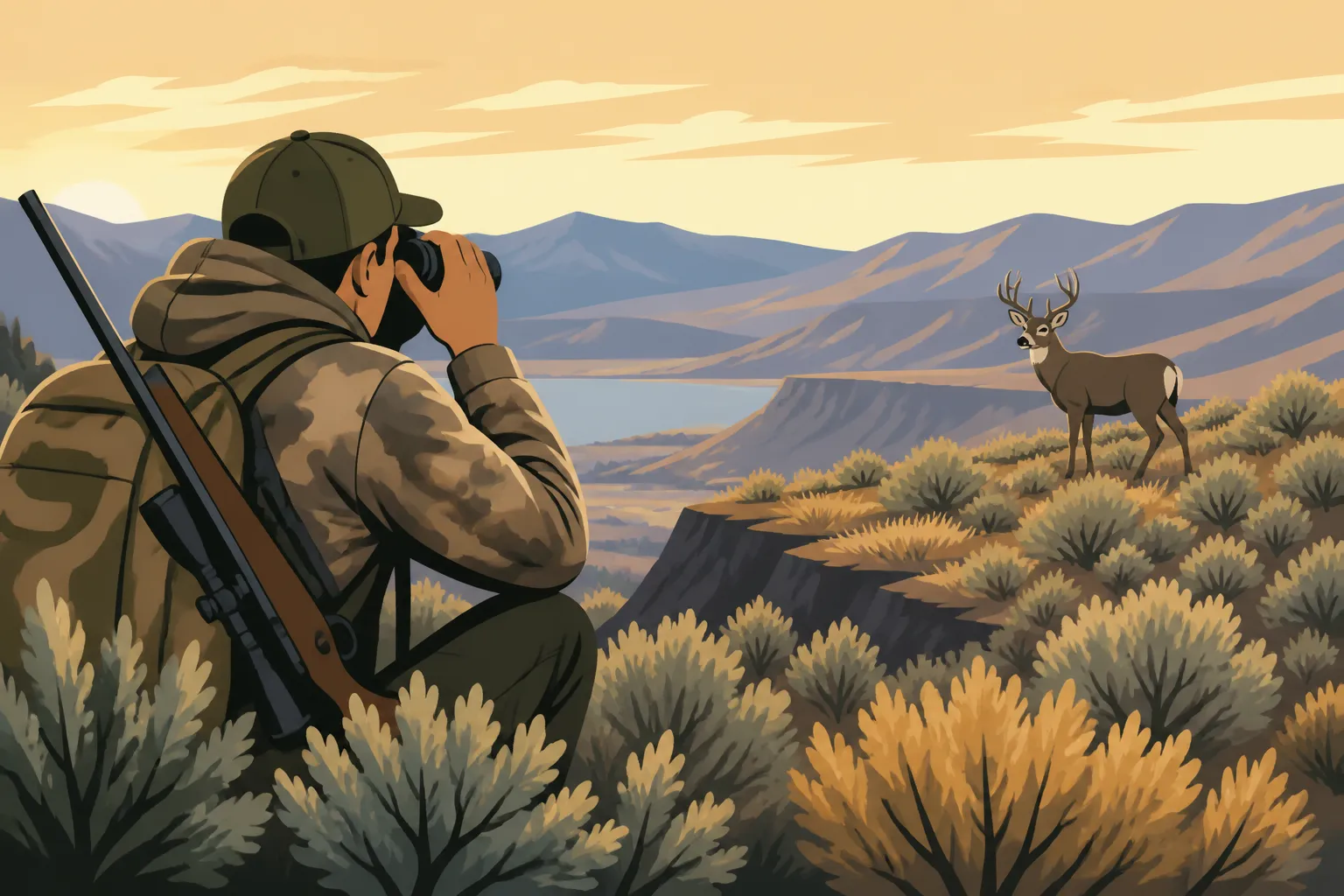
Spot-and-stalk is arguably the most effective method for hunting mule deer on Okanagan sagebrush benches. It begins with finding a high vantage point that offers expansive views of the surrounding country. Think big, long-range optics for this. You'll spend hours behind your binoculars or spotting scope, systematically dissecting every fold, bench, and patch of cover. This is where patience is truly a virtue. Once a deer is spotted, the real work begins. Your next challenge is to plan an approach that keeps you out of sight and downwind, using the terrain to your advantage. This might involve long detours, crawling on your hands and knees, or waiting for the deer to move into a more favorable position.
The key to a successful stalk is understanding the deer's habits. Are they feeding? Bedded down? Heading towards water? Each scenario dictates a different approach. If a buck is bedded, a slow, deliberate approach, often with a partner glassing your progress, is crucial. Use every rock, every cluster of sagebrush, every undulation in the terrain as cover. Wind direction is paramount; a sudden shift can blow your cover instantly. Many stalks end prematurely because hunters get impatient or underestimate the deer's keen sense of smell and hearing. Remember, the goal is not to sprint to the animal, but to arrive within shooting range undetected. Stalking a Bedded Buck in Open Timber provides a related skill set that applies well to sparse cover.
Still-Hunting the Edges and Draws
While much of the sagebrush country is open, there are always edges: the transition zones where sagebrush gives way to Ponderosa pine, deep creek bottoms, or a cut in the terrain. These areas provide more cover and are often where deer feel safer moving during daylight hours, especially if they've been pressured in the more open areas. Still-hunting these edges means moving incredibly slowly, taking a few steps, then pausing to glass, listen, and observe for several minutes. Your eyes should constantly scan not just for an entire deer, but for parts of an animal – an ear flicking, a patch of hide, the horizontal line of a back contrasting with the vertical lines of trees.
Focus on moving into the wind or with a crosswind to keep your scent from blowing ahead of you. These draws and timbered pockets also offer excellent thermal cover, making them prime bedding locations during cold snaps or shaded sanctuaries during hot days. When still-hunting, remember that you are trying to imitate a predator, moving with purpose but without haste. Every step should be intentional, and every pause an opportunity to absorb information from your surroundings. If the area has scattered timber, Still-Hunting Second Growth for Blacktail offers insights into slow, deliberate movement that can be adapted to this environment.
Glassing from a Vantage Point: The Long Game
For many hunters in the Okanagan, glassing is the primary method for locating game, particularly big mule deer bucks. This technique involves finding a prominent ridge or hillside that provides a commanding view of multiple sagebrush benches, draws, and timbered pockets. Once in position, you set up your spotting scope and binoculars on a solid tripod and systematically scan the landscape. This isn't a quick glance; it's a patient, grid-like sweep, focusing on distinguishing deer from rocks, shadows, and sagebrush.
Early mornings and late evenings are prime glassing times when deer are most active. Watch for movement, color contrasts, or anomalies in the landscape that just don't look natural. A slight flicker of an ear, a patch of white rump, or the distinct shape of an antler can give away a deer's position. Once you've identified an animal, take your time to evaluate it, determine its direction of travel, and plan your approach. Glassing for extended periods can be tedious, but it often pays off with opportunities you'd miss if you were simply walking. This is especially true for elusive mule deer that excel at disappearing. Glassing an Interior Hillside for Mule Deer is a must-read for anyone adopting this strategy.
Gear Up: Essential Equipment for a Successful Sagebrush Hunt
Hunting the Okanagan's sagebrush benches demands specific gear that can withstand arid conditions, intense sunlight, and often rugged, unforgiving terrain. Having the right equipment isn't just about comfort; it's about maximizing your effectiveness, staying safe, and ensuring you're prepared for whatever the hunt throws at you.
Optics and Their Importance
In open country like the Okanagan sagebrush, quality optics are your most valuable tool. A good pair of binoculars (10×42 or 12×50 are popular choices) is essential for scanning broad areas and picking apart distant hillsides. Look for binoculars with excellent light transmission for those critical dawn and dusk hours. Pairing your binoculars with a spotting scope (20-60x or 25-75x magnification) on a sturdy tripod is non-negotiable for identifying antler characteristics, confirming species, and making those crucial decisions about whether to commit to a long stalk. The tripod is key, as it eliminates shake and allows for hours of comfortable, focused glassing.
Rangefinders are equally critical. Knowing the precise distance to your target in open, undulating terrain is paramount for making an ethical shot. Many modern rangefinders offer angle compensation, which is incredibly helpful when shooting up or down steep benches. Don't skimp on optics; they are an investment that will significantly increase your success rate and enjoyment in these vast landscapes. For more in-depth knowledge on this, check out Glassing a Subalpine Basin at First Light, which, while focused on a different habitat, highlights the critical role of optics.
Footwear and Clothing for Arid, Rocky Terrain
Your feet will be doing a lot of work over uneven, often rocky ground, so reliable footwear is paramount. Choose sturdy, ankle-supporting hunting boots that are broken in and comfortable. Waterproofing is always a good idea, even in dry country, as you might encounter dew-soaked grass in the mornings or unexpected creek crossings. Good traction on slippery rock and loose dirt is a must.
Layered clothing is also key. Even if the daytime temperatures are scorching, mornings and evenings can be surprisingly cool, especially at higher elevations. Start with a moisture-wicking base layer, add a mid-layer for insulation, and an outer layer for wind protection. Camouflage patterns that blend with the dry, muted tones of sagebrush and Ponderosa pine are highly effective. Avoid bright colors, even for safety, unless mandated by regulations (and even then, use them sparingly or during non-hunting periods). Consider lightweight, breathable fabrics that can handle thorns and rough brush. Don't forget a wide-brimmed hat and sunglasses for protection against the intense Okanagan sun.
Hydration and Emergency Preparedness
The Okanagan can get incredibly hot and dry, especially during early seasons. Dehydration is a serious concern. Always carry more water than you think you'll need, whether in a hydration bladder or multiple bottles. Electrolyte supplements can also be beneficial. Factor in that finding reliable water sources in the field can be challenging, so come prepared.
Beyond hydration, a comprehensive first-aid kit is essential. You'll be far from immediate help in many parts of these benches. Include items for cuts, blisters, snake bites (though rare, they do occur), and pain relief. A reliable navigation system, whether a dedicated GPS unit or a smartphone app like onX Hunt with downloaded maps, is critical. Cell service can be spotty to non-existent, so don't rely solely on it. A satellite messenger or personal locator beacon (PLB) is a wise investment for emergency communication. Finally, be aware of wildlife encounters, especially with bears. While grizzlies are less common in the Okanagan's lower elevations, black bears are present. Carry bear spray and know how to use it. Emergency Planning in British Columbia's Backcountry is an excellent resource for detailed preparedness advice.
Comparing Okanagan Sagebrush Benches with Other BC Hunting Habitats
To better understand the unique challenges and opportunities of hunting sagebrush benches, it's helpful to compare them to other prominent hunting habitats across British Columbia.
| Feature | Okanagan Sagebrush Benches | Coastal Rainforest (e.g., Vancouver Island) | Alpine Basins (e.g., Northern Rockies) | Interior Douglas Fir Bench (e.g., Cariboo) |
|---|---|---|---|---|
| Dominant Vegetation | Sagebrush, bunchgrass, Ponderosa pine | Dense coniferous forest, alder, salal | Tundra, sparse subalpine fir, rock, glaciers | Douglas fir, pine, aspen, grasslands |
| Primary Game Species | Mule Deer, upland birds, coyote | Blacktail Deer, Black Bear, Roosevelt Elk | Mountain Goat, Sheep, Caribou (limited), Moose | Moose, Mule Deer, Whitetail, Elk, Black Bear |
| Visibility | Generally high, expansive | Very low, dense canopy | High, open, panoramic | Moderate, mixed forest and open areas |
| Terrain | Rolling hills, gentle slopes, rocky outcrops | Steep, wet, thick undergrowth | Extremely steep, rocky, high elevation | Rolling, varied, with draws and benches |
| Hunting Style | Spot-and-stalk, glassing, still-hunting edges | Still-hunting, tracking, calling | Backpack hunting, strenuous spot-and-stalk | Mix of spot-and-stalk, still-hunting, calling |
| Key Challenge | Lack of cover for stalks, heat, dryness | Dense cover, rain, difficult navigation | Extreme physical demands, weather, remoteness | Logging activity, varying cover, snow |
| Seasonal Factors | Hot early season, rut in late fall, potential snow | Persistent rain, mild winters, dense fog | Short season, early snow, extreme cold/wind | Snow depth, rut, accessibility changes |
| Water Availability | Scarce, critical attractant | Abundant, but can create muddy conditions | Meltwater, alpine lakes | Creeks, small lakes, beaver ponds |
| Required Optics | High-power binoculars, spotting scope, tripod | Good binoculars for close scanning | High-power binoculars, spotting scope, tripod | Standard binoculars, good rifle scope |
Disclaimer
This article is for general informational purposes only and does not constitute professional advice. Laws, prices and regulations vary by location and change over time. Consult a qualified professional for guidance on your specific situation.