Judging a Four-Point Mule Deer Buck
It’s a scenario every hunter has faced: you’re out in the British Columbia backcountry, the wind is just right, and suddenly, through the timber or across a distant hillside, a mule deer buck appears. Your heart starts pounding, but then the crucial question hits you – is it legal? Especially with specific antler restrictions like the four-point rule for mule deer, the pressure to make an accurate, split-second judgment can be immense and frankly, quite stressful. This guide is here to strip away that uncertainty, offering you the deep knowledge and practical tips you need to confidently judge a four-point mule deer buck in British Columbia.
Understanding British Columbia's Four-Point Rule
Navigating British Columbia's hunting regulations can sometimes feel like trying to untangle a stubborn fishing knot. The four-point rule for mule deer is one of those critical pieces of information that can make or break your hunt, legally speaking. It’s not just about finding a big buck; it’s about finding a legal buck.
What "Four-Point" Actually Means
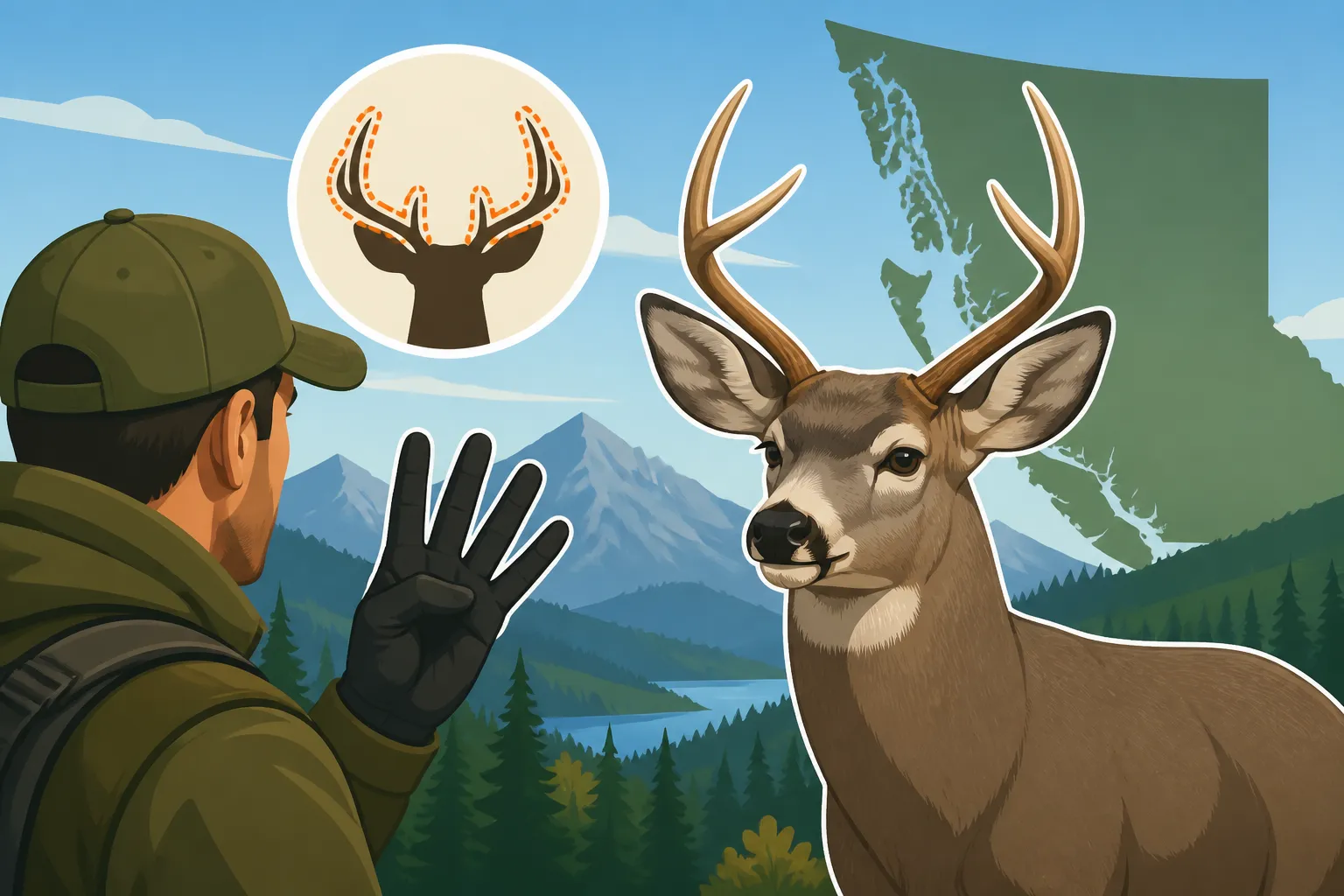
In British Columbia, when the regulations state "four-point or better" for a mule deer buck, it's not as simple as counting every single bump on its antlers. The definition is quite specific and often misunderstood, leading to honest mistakes if you're not careful. Generally, a legal four-point buck must have at least four tines, one inch or longer, on one side of its antlers, excluding the brow tines (the small tines that come off the main beam near the base).
Think of it this way: a mule deer's antlers typically "fork." You have the main beam, and then it forks into two, and those two forks might fork again. A true four-point means that on at least one side, you can clearly count four distinct tines, each measuring at least an inch in length from its tip to where it meets the main beam or another tine. The critical exclusion here is the brow tine, often called the G1. These are the shortest points coming off the main beam, closest to the deer's head. Regardless of their length, they do not count towards the four-point minimum in most BC regulations. This distinction is absolutely paramount. Without this clarity, a perfectly respectable 3×3 with brow tines might be mistakenly identified as a legal animal, when in reality, it falls short of the four-point criteria on either side. You can dive deeper into the specifics by understanding British Columbia's Four-Point Antler Restriction to ensure you're always on the right side of the law.
Why the Rule Exists
The four-point antler restriction, common in many jurisdictions for specific species like mule deer, isn't just an arbitrary hurdle to make hunting harder. It’s a carefully considered management tool designed to protect younger bucks and allow them to reach maturity, contributing to healthier herd demographics and a more balanced buck-to-doe ratio. By targeting older, more mature bucks, the rule ensures that a good portion of the younger male deer population has the chance to breed and pass on their genes before being harvested.
This strategy helps maintain a robust breeding population, which is crucial for the long-term sustainability of mule deer in regions like British Columbia's Interior. It also contributes to the quality of future hunting opportunities, as more bucks are allowed to grow larger antlers. It reflects a commitment to responsible wildlife stewardship, acknowledging that while hunting is a cherished tradition, it must always be conducted with conservation at its core. Protecting these younger animals allows them to contribute to the herd's vitality and grow into the impressive specimens we all hope to encounter.
Regional Variations and Exceptions
While the "four-point or better on one side, excluding brow tines" rule is a general guideline for mule deer in British Columbia, it's vital to remember that hunting regulations can, and do, vary significantly by Management Unit (MU) and even by specific season. What's legal in one area or during one timeframe might not be in another. For instance, some MUs might have "any buck" seasons for a limited period, allowing for the harvest of smaller deer, or specific Limited Entry Hunting (LEH) zones might have unique antler restrictions that differ from the general open season rules.
Always, and I mean always, consult the most current British Columbia Hunting and Trapping Synopsis before heading out. This is your bible for understanding the nuances of the regulations, including specific antler point requirements, season dates, and any special conditions that apply to the area you plan to hunt. Tools like GoHunt can be incredibly useful here, not just for scouting terrain but for quick access to regulation summaries overlaid on maps, helping you pinpoint specific rules for your chosen MU. Never assume that a rule you know from one hunt applies universally. Taking the time to read through the current synopsis and understand the regulations for your specific hunting area and time of year is the most important step in ensuring a legal and ethical hunt. This due diligence is paramount for anyone considering Mule Deer Hunting in British Columbia.
Key Characteristics of a Four-Point Mule Deer Buck
Mule deer antlers are distinct, famous for their "forked" appearance rather than the typical "points off a main beam" seen in whitetails. Understanding this unique growth pattern is crucial for accurately judging a legal four-point buck. It’s about more than just counting; it’s about knowing where to count.
The Main Beam and Tine Structure
A mule deer buck’s antlers generally grow in a symmetrical pattern, with a main beam that curves outward and then back, often parallel to the deer's head. The characteristic "forking" begins when the main beam splits into two primary points, often called the G2 and G3. Then, each of these primary points can fork again, creating secondary points (G4, G5, etc.). For a four-point mule deer, you're looking for this bifurcated growth pattern to extend at least twice on one side.
Imagine the main beam growing up and then splitting. That's your first fork. Then, each of those two new tines splits again. If this happens cleanly, you’ll have four distinct points originating from that main beam on that side. The measurement rule of at least one inch in length, and often longer than its width at the base, helps distinguish true points from small knobs or bumps. Pay close attention to the way the tines develop; it’s this unique pattern that sets mule deer apart and requires a specific approach to counting.
Identifying the Forks
This is where the rubber meets the road for field judging. For a mule deer, identifying the forks means tracing the antler structure from the base outwards. You'll typically have a main beam. Then, the first fork (the G2/G3 split) occurs, where the main beam divides into two significant tines. To be a four-point on that side, at least one of these two tines must then fork again.
So, if you trace the main beam, it forks. Let's say that creates two tines. If one of those two tines then forks again, resulting in two more tines, you'd effectively have three distinct tines from the first fork and one more from the second. This would equate to four points on that side (e.g., G2, G3, G4, G5, where G4 and G5 come off G3). Alternatively, a simpler way to visualize it for many mule deer is a "double-fork." The main beam splits into two, and each of those two splits again. If you can count four distinct, legal points coming off the main beam on one side, you likely have a legal buck. Remember, it’s about distinct points, not just the overall mass or width of the antler.
Brow Tines and Legal Interpretation
Let’s reiterate this because it’s a source of constant confusion and potential error: brow tines, those small, usually short points that project forward or slightly upward from the main beam very close to the deer's head, do not count towards the four-point minimum for mule deer in British Columbia. No matter how long or prominent they are, they are legally irrelevant for this specific antler restriction.
You might see a buck that looks impressive with long brow tines and three points (a 3×3) on each side, leading you to think, "four points per side, that's legal!" But if those "four points" include the brow tine, it's actually only a three-point buck on that side and therefore illegal to harvest under a four-point regulation. Always mentally, or even physically with your scope, block out those brow tines when counting. Focus solely on the tines that develop from the main beam further out, specifically the distinct forking structure. This clear understanding is fundamental to avoiding a costly mistake and upholding ethical hunting practices in BC.
Field Judging Techniques and Common Pitfalls
Successful field judging isn't about guesswork; it's a practiced skill that combines keen observation, the right tools, and an understanding of deer behavior. Especially when hunting in British Columbia's diverse terrain, from dense timber to expansive alpine basins, your ability to quickly and accurately judge a buck can be the difference between a successful, legal harvest and a missed opportunity—or worse, an illegal one.
Using Optics and Observation
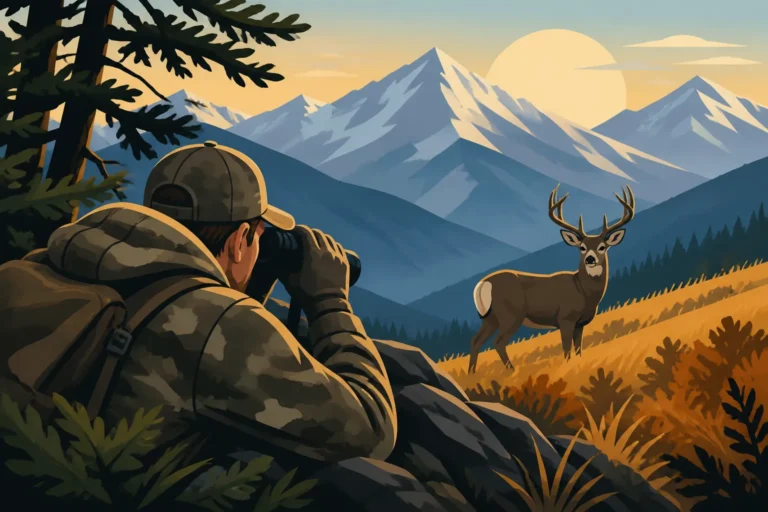
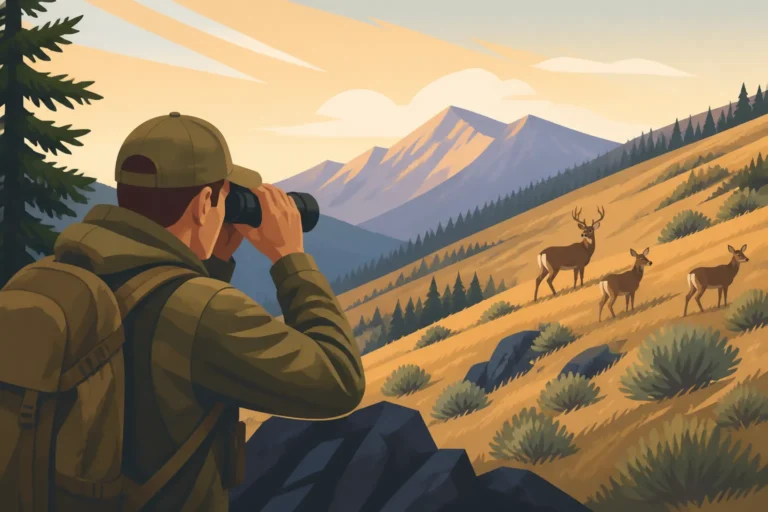
Good optics are your absolute best friend when judging antlers, especially at longer distances or in challenging light conditions. A quality pair of binoculars, like 10x42s, is indispensable for scanning and initially locating deer. But for detailed antler assessment, a spotting scope is often a game-changer. It allows you to dial in magnification and scrutinize every tine, confirming its length and whether it genuinely constitutes a legal point. When Glassing an Interior Hillside for Mule Deer, patience is key. Don't rush. Position yourself comfortably, brace your optics, and take your time.
When you spot a buck, don't immediately look at its rack. Observe its body language, how it moves, and try to get a clear, unobstructed view of its antlers from multiple angles. Mule deer often present broadside, then turn their head, offering different perspectives. Wait for the animal to turn its head to give you the best angle to count the points clearly. If the buck is moving through brush, you might need to wait for it to step into a clear opening. This calm, methodical approach significantly increases your chances of making an accurate judgment. Many experienced hunters use mapping applications like GoHunt to mark potential vantage points and practice glassing prior to the season, familiarizing themselves with the terrain and where deer might appear.
The "Tine-Length" Rule of Thumb
As mentioned, a legal point in British Columbia generally needs to be at least one inch long and longer than it is wide at its base. This "one-inch rule" is a common guideline, but it requires careful observation. When looking through your optics, try to mentally compare the length of a potential point to a known reference on the deer's body, or even to the diameter of its ear or eye, if you have a clear view and some experience. This takes practice, but it's an invaluable skill.
Sometimes, a tiny nub or a worn-down tine might look like a point from a distance, but upon closer inspection, it falls short of the one-inch minimum or isn't longer than it is wide. This is why high-magnification optics are so crucial. If you're using a spotting scope, you might even be able to discern the texture of the antler and the distinctness of the point more clearly. Always err on the side of caution. If you're having trouble confirming the length, it's safer to assume it doesn't meet the requirement rather than risking an illegal harvest.
Avoiding Common Mistakes
Mistakes in the field can be costly, both ethically and legally. One of the most common errors is miscounting due to brush or distance. A branch, a shadow, or simply the sheer distance can obscure tines or make small bumps appear larger. Always try to get the clearest view possible, even if it means repositioning yourself. Rushing the shot is another frequent pitfall; the excitement of seeing a buck can lead to hasty decisions. Take a breath, confirm your count, and ensure it's a legal animal before shouldering your rifle.
Confusing broken antlers with insufficient points can also happen. A buck might have broken off a tine, making it appear to be a three-point when it was originally a four-point. Unfortunately, a broken tine that no longer meets the legal definition means the buck is not legal for harvest under a four-point rule. Similarly, a buck might look "big" overall, with heavy beams and good mass, but technically only have three points on each side. Size and mass don't equate to point count. Finally, shooting at first light or last light without absolutely clear visibility is a gamble. While these are prime hunting times, if you can't definitively judge the antlers, hold off. The ethical hunter always prioritizes a clean, legal shot over an uncertain one. The Penalties for a Hunting Violation in British Columbia are severe, so it's always best to be sure.
Scenario-Based Practice and Confidence Building
You wouldn't head out on a long hike in British Columbia's steep country without training, and field judging a legal buck is no different. It’s a skill that improves with conscious effort and experience, building the confidence to make the right call when it truly counts.
Visualizing and Practicing
The best way to build confidence in field judging is through consistent practice, even outside of hunting season. Start by studying countless photos and videos of mule deer bucks. Look for examples of legal four-points, three-points, and even deer with irregular antler growth. Pay attention to how the tines branch, how they project from the main beam, and mentally count them, always excluding the brow tines. There are many online resources and hunting forums where hunters share photos and discuss judging.
Better yet, take your optics out during the off-season. Go for a drive or a hike in areas known for deer activity – be it Hunting an Interior Douglas Fir Bench or hunting a British Columbia burn. Spot deer (or even elk, which have a different antler structure but offer good practice for using optics) and practice judging their antlers as if it were opening day. Try to identify legal animals, non-legal ones, and animals that are difficult to judge. This hands-on, no-pressure practice will hone your eyes and reinforce the visual cues you need to look for. Even using virtual mapping tools like GoHunt or Using onX for British Columbia Crown Land to scout potential deer country can help you visualize the terrain and anticipate where you might need to make a judgment call.
Learning from Others
One of the greatest resources you have as a hunter is other hunters. Talk to seasoned veterans in your local rod and gun club or at your favourite hunting shop. Ask them about their experiences judging bucks, what challenges they’ve faced, and what tips they can share. Often, just hearing how someone else approaches the task can illuminate a new technique or perspective you hadn’t considered.
Consider joining a local conservation organization or attending workshops on deer biology or hunting ethics. Wildlife biologists or experienced conservation officers can offer invaluable insights into antler growth patterns and the exact legal interpretations of regulations. Participating in these communities not only enhances your judging skills but also connects you with the broader hunting community and its shared knowledge base. Don't be afraid to ask questions; we all started somewhere, and there's always something new to learn in the vast world of British Columbia hunting.
The Importance of Ethics
Ultimately, confidence in field judging isn't just about avoiding a fine; it's about upholding the highest ethical standards of hunting. When you are genuinely in doubt about a buck’s legality, the ethical choice is always to pass. It’s far better to walk away from a potential harvest than to make an illegal one. This principle is a cornerstone of responsible hunting and ensures that we respect the wildlife we pursue.
An illegal harvest can result in severe penalties, including hefty fines, loss of hunting privileges, and confiscation of equipment and game. More importantly, it can damage the reputation of hunters and undermine conservation efforts. Every hunter has a responsibility to know the regulations inside and out, and to apply them diligently and ethically in the field. When you are confident in your judgment, you honor the animal, the law, and the hunting tradition itself. This ethical approach is what truly defines a responsible hunter in British Columbia and contributes to the sustainable future of species like the mule deer. Remember, deer seasons vary widely, so always check British Columbia Deer Season Dates by Region before you head out.
| Antler Feature | Counts as a Point for 4-Point Rule (Mule Deer) | Does NOT Count as a Point | Notes |
|---|---|---|---|
| Tines | Yes (if >= 1 inch long & longer than wide) | No (if < 1 inch long or knob-like) | Must be a distinct projection from the beam or another tine. |
| Main Beam | No | Yes | The main structure from which tines grow. |
| Brow Tines (G1) | No | Yes | The first, shortest tines near the base of the main beam. |
| Forks | Each distinct tine resulting from a fork counts | N/A | Mule deer typically fork; count each resulting point. |
| Broken Tines | No (if broken below 1 inch length) | Yes (if broken and no longer meets criteria) | Must still meet the 1-inch length/width criteria if broken. |
Disclaimer
Please be aware that hunting regulations are subject to change. This guide is intended for informational purposes only and should not replace reading the official British Columbia Hunting and Trapping Synopsis. Always consult the most current synopsis published by the BC government before planning and undertaking any hunting activity. It is your responsibility as a hunter to know and adhere to all applicable laws and regulations.