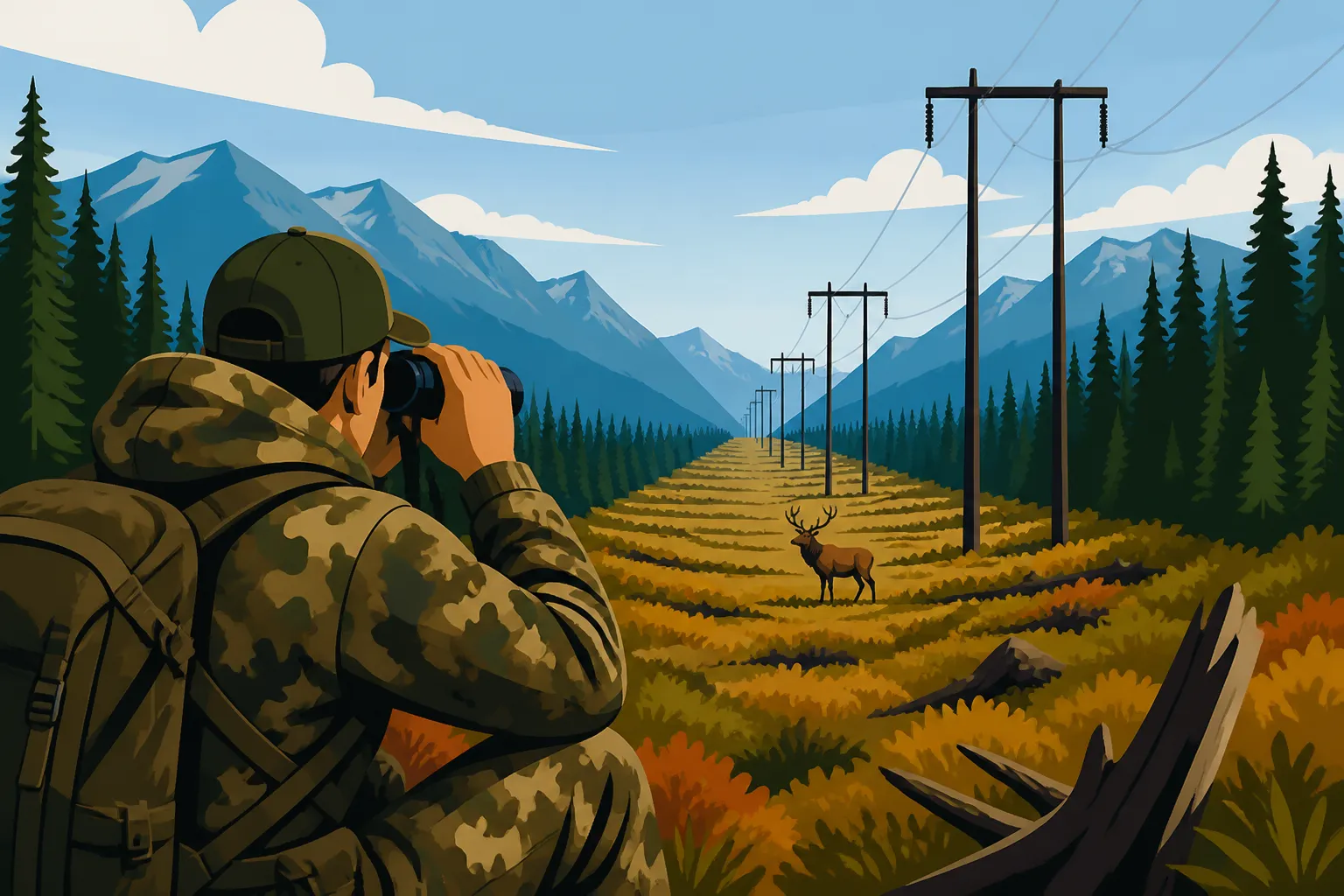
Hunting a Cleared Utility Corridor
For many hunters in British Columbia, the vastness of our wilderness can feel overwhelming. You spend hours poring over maps, trying to find that perfect spot, only to arrive and realize the terrain is impenetrable or the game sign is sparse. This guide is all about simplifying that search, focusing on a specific, often overlooked gem: the cleared utility corridor. We’re going to dive deep into how these linear clearings offer unique hunting opportunities and how you can make the most of them.
What Exactly is a Cleared Utility Corridor in British Columbia?
When we talk about cleared utility corridors in British Columbia, we're referring to those distinct, often straight-line swaths of land that have been cleared of dense forest to accommodate infrastructure like power lines, natural gas pipelines, or sometimes even major communication cables. These aren't naturally occurring features; they're man-made disruptions in the landscape, carved out to ensure clear passage and maintenance access for critical services. You'll see them spanning valleys, climbing hillsides, and sometimes even stretching for hundreds of kilometres across our diverse provincial terrain.
The immediate visual impact of these corridors is undeniable. They create a stark contrast to the surrounding forested areas, essentially forming long, linear "edges" that cut through otherwise continuous canopy. Depending on when they were last maintained, the vegetation within these corridors can vary wildly, from recently mowed grass and young shrubs to several-year-old growth of alders, willows, and various forbs. This cycle of disturbance and regrowth is precisely what makes them so interesting from a hunting perspective. They are permanent fixtures on the landscape, unlike temporary logging cutblocks, and their impact on local wildlife is both profound and consistent.
Understanding the Different Types of Utility Corridors
Not all utility corridors are created equal, and understanding their subtle differences can be key to a successful hunt. The most common types you’ll encounter in British Columbia are related to electrical transmission lines and natural gas pipelines.
Power line corridors, often referred to as "hydro lines," are characterized by their tall towers and the wide, open spaces beneath them. These clearings are maintained to prevent trees from growing too tall and interfering with the power lines. The width can vary significantly, from narrow, almost trail-like paths in older, less critical lines, to massive swaths hundreds of metres wide for major transmission grids. The ground cover usually consists of grasses, low-lying shrubs, and early successional plant species that are periodically mowed or chemically treated. This maintenance regime creates a constantly regenerating food source and ample open space. Many times, these corridors run parallel to or intersect with other access features, making it easier to plan your approach by integrating them with methods for Hunting British Columbia's Logging Road Network.
Pipeline corridors, on the other hand, typically have less overhead infrastructure, though you might see marker posts or access roads running alongside them. These clearings are maintained to allow for inspection, maintenance, and emergency access to underground pipelines carrying oil or natural gas. While still cleared of tall trees, the vegetation management might differ slightly from power lines, often promoting a slightly more diverse mix of grasses, brush, and small deciduous trees. The ground can be uneven where the pipe is buried, creating small berms or depressions that offer additional cover for animals. Both types, however, share the fundamental characteristic of being long, linear clearings that disrupt continuous forest cover, fundamentally altering game movement and feeding patterns.
The Edge Effect and Habitat Diversity
The real magic of utility corridors for hunters lies in what wildlife biologists call the "edge effect." This ecological principle states that areas where two distinct habitats meet—like a forest and a cleared corridor—tend to have a greater diversity and abundance of wildlife than either habitat type alone. And these corridors are all edge.
Think about it: the forest provides crucial cover, bedding areas, and mature food sources like mast crops or conifers. The cleared corridor, conversely, offers sunlight-rich open areas, promoting the growth of palatable browse, grasses, and berry bushes that forest animals absolutely love. This creates a perfect scenario where deer, elk, moose, and bears can feed in the open corridor, taking advantage of the rich vegetation, yet remain only a few steps away from the safety and concealment of the dense timber. For example, a mule deer might bed down in the thick Douglas fir adjacent to a power line, then emerge at first light or dusk to graze on the tender forbs growing in the sun-drenched clearing. This dynamic is a constant draw for game, especially during early morning and late evening hours, or when seasonal food sources become abundant within the corridor. Understanding this push and pull is crucial for anyone considering Hunting a Cleared Utility Corridor.
Moreover, the act of clearing and maintaining these corridors often disturbs the soil, promoting the growth of early successional plants that are highly nutritious for various game species. For instance, young alders and willows, which thrive in disturbed, sunny areas, are prime browse for moose and deer. Berry bushes like huckleberries, saskatoons, and blackberries often proliferate along these edges, attracting black bears in the late summer and fall. This patchwork of habitats—dense forest providing shelter, and open corridor providing food—creates a mosaic that can be incredibly productive, often more so than either the deep forest or a uniformly cleared area on its own.
Why Are Utility Corridors Great for Hunting in British Columbia?
Utility corridors aren't just unique landscape features; they are, quite frankly, fantastic places to hunt in British Columbia. They offer a combination of access, visibility, and habitat benefits that can significantly increase your odds of success. When you're trying to figure out where to focus your scouting efforts, especially in regions with extensive forest cover, these clearings should always be on your radar.
One of the biggest frustrations for hunters in BC's dense forests is the sheer lack of visibility. You can be in prime habitat, but if you can only see 20 yards, actually spotting an animal becomes a game of pure luck. Corridors solve this problem. They cut through the thick stuff, providing long lines of sight that simply don't exist elsewhere. This allows for effective spot-and-stalk tactics, giving you the advantage of seeing game before it sees you, which is particularly valuable when you're glassing an interior hillside for mule deer.
Natural Funnels for Game Movement
Animals, like people, often take the path of least resistance. A utility corridor, being a long, cleared lane through otherwise dense forest, naturally acts as a superhighway for wildlife. Deer, elk, moose, and bears will use these corridors to travel between bedding areas, feeding grounds, and water sources. Instead of crashing through thick timber, they'll often follow the open path, especially when they want to move quickly or avoid getting tangled in brush. This is particularly true in areas where the corridor offers an easier grade than the surrounding topography.
Imagine a moose moving from a low-lying willow flat to a higher feeding area; rather than fighting through tangled blowdown and thick regeneration, it's far more efficient to walk the relatively clear ground of a pipeline right-of-way. Or consider a blacktail buck cruising during the rut, looking for does. He’ll often follow these linear features, using them as travel routes, darting back and forth into the timber for cover but always sticking close to the open lane. This funneling effect makes game movement more predictable, allowing hunters to set up in strategic locations, anticipating where animals will emerge or pass through. It's like a natural drive-thru for game, and knowing where to wait makes all the difference.
Enhanced Visibility and Openings
Let's be honest, hunting in much of British Columbia's timber can feel like hunting blindfolded. The visibility is so limited that you might bump an animal at twenty yards before you even knew it was there. This is where utility corridors truly shine. They offer expansive, long-range views that are a precious commodity in our otherwise heavily forested province. You can often see for hundreds of metres, sometimes even a kilometre or more, down the length of a power line or pipeline right-of-way.
This enhanced visibility allows for effective glassing, letting you patiently scan the edges and clearings for movement without spooking game. If you've spent any time trying to Still-Hunting Second Growth for Blacktail, you know how challenging it is to spot game in that environment. Corridors provide the opposite experience. This also opens up opportunities for ethical longer-range shots, provided you've practiced and are confident in your abilities. Being able to see an animal at a distance gives you precious time to evaluate its size, decide if it's legal, and plan your approach or setup without immediate pressure. When you're scouting with mapping tools like GoHunt, you can easily identify these long, linear clearings and mentally mark prime glassing positions.
Food Sources and Regenerating Vegetation
Beyond serving as travel routes, utility corridors are often ecological hotspots due to their unique vegetation dynamics. Because they are regularly cleared of tall trees, sunlight floods the forest floor, stimulating the growth of sun-loving grasses, forbs, and deciduous shrubs. This early successional vegetation is often highly nutritious and palatable to herbivores.
Think of it as a giant linear food plot. Deer will browse on young aspen, willow, and various herbaceous plants. Elk will graze on grasses and tender shoots. Even bears are drawn to the berry bushes that frequently flourish along these sunny edges, gorging on huckleberries, raspberries, and saskatoons in late summer and fall. This constant cycle of disturbance and regrowth, whether from mowing, targeted herbicide use, or natural regeneration, ensures a continuous supply of fresh, desirable forage. Unlike a mature forest floor that might offer limited nutritional value, the corridor is a buffet. Many hunters specifically target these areas during times of the year when other food sources are scarce or less accessible, knowing that game will be drawn to the rich bounty within the corridor itself.
Effective Hunting Strategies for British Columbia Utility Corridors
Hunting utility corridors requires a slightly different approach than still-hunting thick timber or glassing vast alpine basins. While the principles of patience and observation remain paramount, the unique linear nature of these clearings calls for specific tactics to maximize your success. From how you approach to where you position yourself, understanding these strategies can turn a good hunting spot into a great one.
Remember, animals use these corridors, but they are also exposed in them. Their natural instinct will be to use the cover of the forest edge, darting into the open to feed or travel, and quickly retreating. Your strategy should capitalize on this predictable behaviour.
Spot-and-Stalk Techniques Along the Openings
Given the enhanced visibility that utility corridors offer, spot-and-stalk hunting becomes an incredibly effective strategy. This involves patiently glassing the open corridor and its edges from a concealed vantage point, identifying an animal, and then carefully planning and executing a stalk to get within shooting range. This is especially potent during the early morning and late evening hours when animals are most active and likely to be feeding in the open.
Start by finding a high point or a bend in the corridor that offers a wide, unobstructed view. Use quality optics—binoculars and a spotting scope are your best friends here. Systematically scan the entire length of the corridor you can see, paying close attention to the tree line where animals might be moving in or out of cover. Once you spot an animal, the real work begins. Evaluate the wind direction, terrain features that can provide cover for your approach, and the animal's behaviour. A successful stalk will often involve using the undulating ground, scattered brush, or even the shadows cast by the forest edge to remain undetected. If the corridor is particularly wide, don't be afraid to cross it quickly and then use the opposite treeline for cover during your approach. This strategy is highly effective for various species, but particularly for deer, like those found when Hunting Mule Deer in the Okanagan Breaks.
Ambush Hunting at Crossings and Pinch Points
While spot-and-stalk is great, sometimes an ambush is the superior tactic, especially if you've done your scouting and understand specific game trails. Utility corridors, despite being open, still have natural "pinch points" or preferred crossing locations that animals consistently use. These might be where the corridor crosses a ridge, dips into a drainage, or intersects with an established game trail or even a small creek. Animals will often stick to these predictable paths, offering prime opportunities for an ambush.
To identify these spots, spend some time walking the corridor, looking for heavy game sign—tracks, scat, rubbed trees, and established trails leading into and out of the timber. Pay attention to any topographical features that would naturally funnel animals to a specific crossing point. Once you've identified a promising location, set up downwind and with good cover, well before first light or in the mid-afternoon for an evening hunt. A small rise, a clump of thick brush, or even the base of a large tree can provide adequate concealment. The key is to be patient and silent, allowing the animals to move naturally into your effective range. This can be a very productive method for various species during different seasons, including during British Columbia's Hunting British Columbia's October Rifle Opener.
Using the Terrain to Your Advantage
The topography within and around utility corridors can be your greatest asset if you know how to read it. These clearings aren't always flat; they often follow the contours of the land, creating natural highs and lows, subtle berms from pipeline installations, or erosion channels. Each of these features can be used to your benefit.
When glassing, seek out the highest vantage points along the corridor that offer a commanding view. A small knoll, a rock outcropping, or even a steep side-hill can provide that crucial elevated perspective. Conversely, when stalking, use the lower spots, the dips, and the natural undulations of the corridor to break up your silhouette and stay hidden. If there are any slight berms or swales created by the buried pipeline, these can offer excellent low-profile cover for an approach. Additionally, consider how the corridor interacts with the surrounding natural terrain. Does it cross a saddle that animals would use anyway? Does it follow a natural game trail? Does it run along the edge of a particularly dense bedding area? All of these factors play into how game uses the corridor and how you can best position yourself. Platforms like GoHunt can be invaluable for analyzing topography and identifying these key features before you even step foot in the field, helping you to Scouting a British Columbia Management Unit effectively.
Navigating the Unique Challenges of Corridor Hunting
While utility corridors offer fantastic opportunities, they also come with a unique set of challenges. It's not always as simple as walking down the middle and spotting game. You need to be aware of safety considerations, understand access rules, and navigate the specific regulations that might apply. Being prepared for these aspects will ensure a safer, more responsible, and ultimately more successful hunting experience.
Safety Considerations and Public Perception
Hunting along utility corridors often means you're in closer proximity to human activity and infrastructure than you might be in deep wilderness. These corridors are regularly accessed by utility workers, maintenance crews, and sometimes even recreational users like hikers or ATV riders. This means heightened awareness is critical. Always identify your target and what lies beyond it. A backstop is paramount. There's also the presence of high-voltage lines (for power line corridors) and underground pipelines (for pipeline corridors) themselves. While these are usually well-marked, caution is always advised. Never touch downed lines and be aware of any signs indicating hazards.
Furthermore, hunting in areas that are visible from roads or inhabited areas can sometimes draw public scrutiny. It's essential to present yourself as a responsible, ethical hunter. Wear appropriate blaze orange, especially during rifle seasons, to make yourself visible to both other hunters and non-hunters. Be mindful of your actions, your shot placement, and how you handle harvested game. Maintaining a positive image of hunting is important, and being seen as respectful and safe in these more accessible areas helps tremendously. This also extends to always carrying your hunting licence and tags, and knowing the specifics of British Columbia's British Columbia's Four-Point Antler Rules if you're pursuing deer.
Access Restrictions and Ownership
Just because a utility corridor is cleared doesn't automatically mean it's open for public access or hunting. Utility corridors often traverse a patchwork of land ownership: Crown land, private industrial forest land, and even private individual properties. While hunting is generally permitted on Crown land, access rules can vary greatly on private lands, even if a utility company has an easement across it. Always assume private land is off-limits unless you have explicit permission.
It’s crucial to research the land ownership of the specific corridor sections you plan to hunt. Mapping tools like GoHunt, along with official government mapping services, are invaluable for this. They allow you to overlay property lines and identify where Crown land ends and private property begins. Some private timber companies, like Mosaic Forest Management on Vancouver Island, require permits for access even on their industrial forest lands. Ignoring these rules can lead to fines, trespassing charges, and damage to the reputation of hunters. Always confirm your access before you go, and never assume that a road or a corridor is public simply because it's there. Understanding how to navigate Finding Open Forest Roads in British Columbia can be a great starting point for gaining access to these corridors.
Regulations Specific to Corridors
British Columbia hunting regulations are complex, and while there aren't typically specific regulations just for utility corridors, their presence can intersect with other rules. For instance, proximity to roads and dwellings: there are often restrictions on discharging firearms within certain distances of highways, dwellings, or even active work camps. Since corridors can run close to such features, you need to be acutely aware of these limitations.
Additionally, some Management Units (MUs) or regions may have specific restrictions on vehicle use within corridors, even if they are on Crown land. You might find "No ATV" or "No Motorized Vehicle" signs, meaning you'll need to walk or use a non-motorized form of transport. Always consult the current British Columbia Hunting and Trapping Synopsis for the specific region and MU you intend to hunt. This annual publication is your bible for understanding season dates, bag limits, and any localized restrictions. For example, some wildlife management areas that may contain corridors could have their own unique rules about hunting pressure and species limits. Understanding the bigger picture of British Columbia's Management Units and Regions is a fundamental aspect of responsible hunting here.
Here's a quick reference table for common game animals you might encounter in BC's utility corridors:
| Species | Typical Corridor Use | Preferred Corridor Features | Best Hunting Method | Prime Season |
|---|---|---|---|---|
| Mule Deer | Travel between bedding & feeding, browse on regenerating forbs | Grassy openings, young aspen/willow, subtle dips for cover | Spot & stalk, Ambush at crossings | Fall (rut) |
| Blacktail Deer | Similar to mule deer, often hugging edges for cover | Thick regenerating brush at edges, moist clearings | Spot & stalk (especially in rain), still-hunting edges | Fall (rut) |
| Moose | Travel lanes, browse on willow & alder | Wet depressions, abundant willow/alder thickets, beaver ponds | Ambush (calling), still-hunting slow | Fall (rut) |
| Black Bear | Foraging for berries, travel, crossing open areas quickly | Berry patches (huckleberries, saskatoons), dense cover nearby | Spot & stalk (glassing open areas), ambush (near food) | Spring & Fall |
| Elk | Travel lanes, grazing on grasses | Open grassy sections, slight rises, timbered fingers for cover | Spot & stalk, ambush (especially during rut) | Fall (rut) |
This table serves as a general guide. Animal behaviour will always depend on specific local conditions, current food availability, and hunting pressure. Always be prepared for anything when you're out in the BC bush! And remember, while these corridors offer great access, always practice Bear Safety While Hunting in British Columbia.
Disclaimer
The information provided in this guide is for general informational purposes only and is not a substitute for consulting the official British Columbia Hunting and Trapping Synopsis. Regulations can change annually, and it is the hunter's sole responsibility to understand and adhere to all current federal, provincial, and local laws. Always prioritize safety and ethical hunting practices.