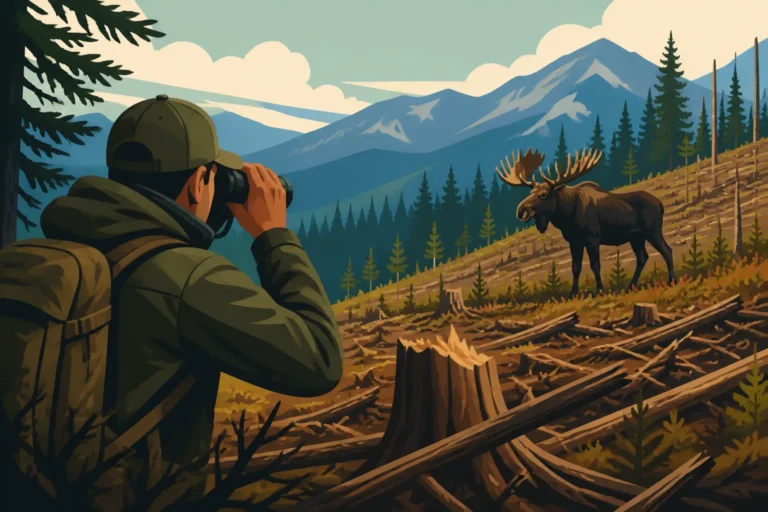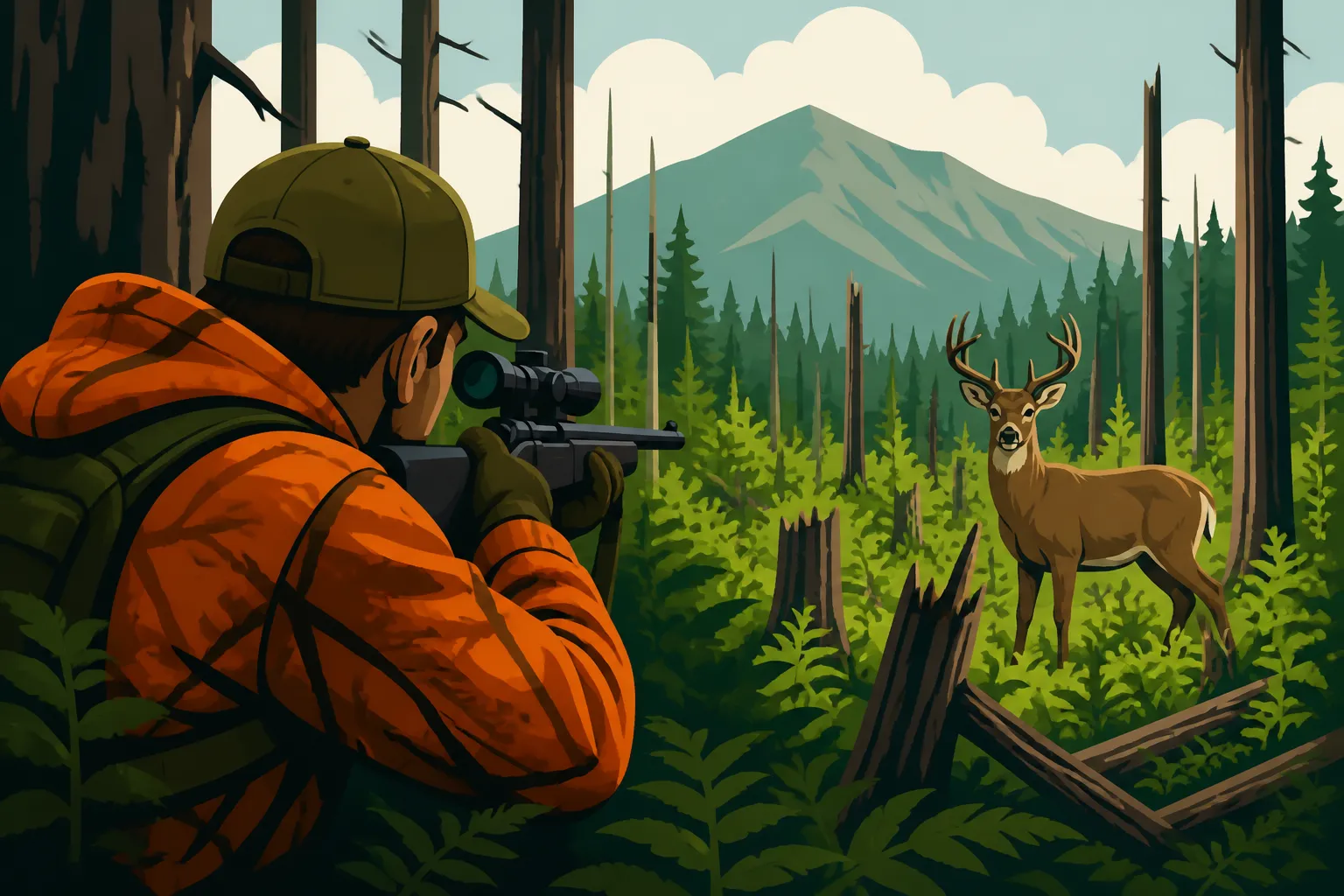
Hunting Vancouver Island Blacktail in Second Growth
Hunting Vancouver Island blacktail deer in second-growth timber is a whole different ballgame than chasing mule deer on a sagebrush flat or glassing open alpine basins. If you've ever found yourself struggling to see more than 20 yards, tangled in salal and devil's club, and wondering where all the deer are hiding, you know the frustration. This guide is dedicated to helping you unravel the mysteries of this dense, challenging, yet incredibly rewarding habitat, equipping you with the knowledge and tactics to consistently find and harvest blacktail bucks in British Columbia's coastal rainforest.
The Unique Challenge of Vancouver Island Second Growth
Vancouver Island is a mosaic of steep mountains, rugged coastline, and, significantly for hunters, vast tracts of timber in various stages of regeneration. While the majestic old-growth forests evoke a sense of grandeur, it's the "second growth" – forests that have been logged and are now regrowing – that holds the key to most blacktail hunting success. This landscape presents its own set of challenges, but also unique opportunities for those willing to learn its secrets.
Defining Second Growth and its Stages
Second growth isn't just one homogenous forest type; it's a dynamic environment that changes dramatically over decades. After the initial clearcutting, the land quickly regenerates. You might encounter brushy clearcuts that are only a few years old, where logging slash and pioneering plant species make for incredibly tough going. Then there are the pole stands, often 10-30 years old, where densely packed conifers create a veritable wall of green, shading out much of the understory and making visibility almost nonexistent. Further along, you'll find more mature second growth, perhaps 40-80 years old, where some thinning has occurred naturally or through silviculture, allowing light to penetrate and creating a more varied understory.
Each stage offers different conditions and challenges. Young clearcuts can be prime feeding areas, especially if native browse species like huckleberry and salal are thriving, but the sheer density of debris can make travel arduous. Pole stands, while seemingly impenetrable, can hold deer seeking thermal cover or escape routes. The more mature second growth, with its mixture of open pockets and dense sections, often provides the best balance of cover and forage for blacktail, creating perfect ambush opportunities. Understanding these stages is the first step in unlocking the puzzle.
Why Blacktail Deer Thrive Here
Blacktail deer are masters of camouflage and seclusion, perfectly adapted to the dense, often wet environments of coastal British Columbia. Unlike their mule deer cousins who prefer more open country where their keen eyesight and bounding escape tactics are advantageous, blacktail rely on thick cover for their survival. Second-growth timber, with its labyrinthine network of downed logs, dense underbrush, and interwoven coniferous branches, offers exactly what these deer need: security, thermal cover, and abundant browse.
The constant regeneration after logging ensures a continuous supply of nutritious forage. Young, tender shoots, a variety of shrubs, and fungi all thrive in the disturbed soil and increased sunlight. This creates a smorgasbord for blacktail throughout the year. They can easily melt into the shadows, making them incredibly difficult to spot, even at close range. Their smaller size and darker coat blend seamlessly with the forest floor and tree trunks. This reliance on cover means that a blacktail buck, even a large one, is rarely found out in the open, making hunters work hard to penetrate their domain. This unique adaptation is why focused efforts in second growth yield results, proving that these deer aren't merely surviving, but thriving.
Key Differences from Open Country or Old Growth
Hunting second-growth timber is a vastly different experience from anything else you might encounter. If you're used to glassing vast clear-cuts or open hillsides for deer, you'll need to fundamentally shift your approach. In open country, long-range optics and patience are king, allowing you to pick apart distant landscapes for movement or the tell-tale shape of an antler. Here, your effective range shrinks dramatically, often to just 20-50 yards.
Old-growth forests, while beautiful, typically have a very sparse understory due to the dense canopy blocking out sunlight. While deer might occasionally use the fringes or specific pockets, they generally don't offer the same rich food source or tangled security cover as second growth. In old growth, you might find deer moving through, but they rarely linger or bed deep within it. Second growth, however, is where blacktail eat, sleep, and breed. This means you’re not just looking for deer passing through; you're entering their home. Your senses of hearing and smell become far more important, as does the ability to move silently and deliberately through extremely difficult terrain. Forget long shots; expect close, fast encounters that demand quick reflexes and nerves of steel.
Understanding Blacktail Habits in the Timber
To consistently find blacktail in second growth, you have to think like them. Their daily routines are dictated by the need for food, cover, and safety. Understanding these patterns, especially how they interact with the unique environment of Vancouver Island's regrowing forests, is paramount to success.
Foraging and Preferred Browse in Dense Cover
Blacktail deer are primarily browsers, meaning they feed on leaves, twigs, and woody plants rather than grass. In the dense coastal second growth, their diet is incredibly varied and opportunistic. Key browse species include salal, huckleberry, fern fronds (especially sword fern), red huckleberry, salmonberry, and various mosses and lichens. They will also eagerly munch on new growth from conifers, especially cedar and hemlock, when it's available. During certain times of the year, particularly late summer and fall, mushrooms and other fungi can also become a significant food source.
Deer don't just randomly wander; they follow established trails through the thickest parts of the forest, often connecting pockets of preferred browse. These trails might be faint, but learning to spot them – a flattened area, rubbed bark, or droppings – is crucial. Pay close attention to areas where sunlight penetrates the canopy, creating more diverse and nutritious vegetation. These "edge" areas, whether they're along older clear-cuts, creek bottoms, or where different stages of second growth meet, are often hotspots for foraging blacktail. When you find an area with heavily browsed plants and fresh droppings, you know you're in a prime feeding zone.
Identifying Bedding and Escape Routes
Blacktail deer are constantly seeking security, and second-growth timber offers them an abundance of bedding options. They prefer dense cover that provides concealment from above and excellent visibility to their front. Beds are typically found on slight rises, under dense fir or hemlock boughs, or nestled against a downed log, always positioned so the deer can observe its downwind approach and detect any danger. In particularly wet weather, they might seek the driest, thickest spots they can find.
Their escape routes are often parallel to their bedding areas, utilizing the densest, most impenetrable parts of the forest. When jumped, a blacktail will typically dash for the thickest cover available, relying on their incredible agility and the sheer difficulty of human pursuit through the tangles. Learning to identify these escape routes, often well-worn tunnels through the undergrowth, can help you predict where a deer will go if spooked. Sometimes, a deer will circle back on its own tracks through these thickets, trying to get downwind of the perceived threat. This knowledge is essential when planning your approach or a follow-up if a shot is missed. Recognizing these patterns is key to Reading Blacktail Sign in Wet Ground.
The Elusive Rut in Second Growth
The blacktail rut on Vancouver Island typically peaks in late October and early November, and while it's a fantastic time to hunt, it's often more subtle than the dramatic open-country rutting activity of mule deer or whitetail. In second growth, the dense cover means you rarely see bucks chasing does across an open field. Instead, the rut is characterized by increased buck movement, scent marking, and seeking behaviour within the timber.
During the rut, bucks become less cautious, driven by the urge to find receptive does. They will rub their antlers on small trees and shrubs, creating scrapes and leaving visual and scent markers. These rubs and scrapes, found along trails or in small openings within the second growth, are clear indicators of buck activity. While bucks might be more vocal with grunts or bleats, especially if you're using calls, the primary indication of rut activity will be fresh sign and increased daylight movement in areas where you might not typically see them. Focusing your efforts near known doe bedding and feeding areas, especially those offering good cover, can be particularly effective during this period, as bucks will be cruising these locations. Knowing When the Blacktail Rut Peaks helps you plan your hunt.
Proven Strategies for Second Growth Blacktail
Hunting blacktail in dense second growth requires a blend of patience, stealth, and a willingness to work hard. The strategies that prove effective are often those that put you in close proximity to the deer without alerting them, capitalizing on their reliance on cover.
The Art of Still-Hunting Dense Timber
Still-hunting is perhaps the most effective, and certainly the most challenging, method for blacktail in second growth. It involves moving through the timber incredibly slowly and deliberately, taking only a few steps at a time, then pausing to observe, listen, and scan. This isn't about covering ground; it's about seeing the deer before it sees you. Think of it as a moving ambush.
The key to successful still-hunting lies in your senses. You're not just looking for a whole deer; you're looking for an ear flick, a patch of dark hair against a lighter background, the horizontal line of a back amidst vertical trees, or the movement of a tail. Use your binoculars to pick apart every shadow, every cluster of brush. Listen intently for rustling leaves, a twig snap, or the subtle sound of a hoof on the forest floor. Go for 10-20 minutes of absolute stillness for every 5-10 steps you take. Move into the wind or crosswind to keep your scent from blowing ahead. This method is physically and mentally demanding but can lead to incredibly rewarding, up-close encounters. Mastering this takes practice, but it's essential for Still-Hunting Second Growth for Blacktail.
Strategic Driving and Pushing Techniques
While still-hunting is excellent for solo hunters or small groups, driving or pushing can be highly effective when you have two or more hunters. This involves one or more "pushers" or "drivers" moving through a specific section of dense timber, attempting to push deer towards "standers" positioned strategically on the downwind side or along escape routes.
Effective driving requires careful planning. First, you need to understand the terrain and how deer will likely move when pushed. Identify natural funnels, ridges, creek bottoms, or the edges of dense stands where deer are likely to exit. Position standers in locations where they have good visibility, cover their scent, and can safely take a shot. The pushers should move slowly and consistently, making some noise but not running wildly, which can cause deer to blow out in unpredictable directions. Communication between pushers and standers, often using handheld radios, is critical for safety and coordination. Always prioritize safety, ensuring everyone knows where others are located and adhering to strict shooting lanes.
Patience with Stand Hunting and Calling
Stand hunting, typically associated with treestands, is less common in the dense, often sloped second growth of Vancouver Island. However, a modified version can be highly effective. This involves finding a strategic natural hide or ground blind overlooking a well-used game trail, a feeding area, or an intersection of escape routes. It requires patience and an intimate knowledge of a specific area.
Combining stand hunting with calling can significantly increase your odds. Blacktail deer respond well to various calls, especially during the rut. Fawn bleats, doe grunts, and even buck grunts can bring curious deer in close. The key is subtlety and realism. Don't overcall, and be prepared for a deer to come in silently, circling downwind to try and catch your scent. Set up your "stand" in an area with good shooting lanes, and ensure your scent is minimized. A good strategy is to find an area with fresh sign, position yourself quietly, and periodically use calls, especially in the early mornings or late evenings when deer are most active.
Essential Gear and Preparation
Hunting Vancouver Island's second-growth timber is demanding on both body and gear. The constant moisture, dense vegetation, and challenging terrain mean you need to be prepared with the right equipment to ensure comfort, safety, and success.
Footwear, Clothing, and Weather Readiness
The coastal rainforest is synonymous with rain. You will get wet, so good rain gear is non-negotiable. Invest in a high-quality waterproof and breathable jacket and pants. Look for materials like Gore-Tex or similar proprietary membranes. Layering is key: start with a moisture-wicking base layer, add an insulating mid-layer (fleece or synthetic down), and top it with your waterproof shell. Avoid cotton, which absorbs moisture and loses its insulating properties when wet. For headwear, a wide-brimmed hat or a waterproof cap will keep rain off your face.
Footwear is equally critical. Waterproof boots with aggressive tread are essential for navigating slippery roots, mossy rocks, and muddy trails. Look for boots with good ankle support, as the uneven terrain can easily lead to twists and sprains. Many hunters prefer rubber boots for their complete waterproofness in boggy areas, while others opt for sturdy leather or synthetic hiking boots with waterproof membranes. Whatever you choose, ensure they are well broken in to prevent blisters. Remember, dry feet are happy feet, and happy feet mean you can stay out longer. Hunting in British Columbia's Coastal Rain gives more insight into preparing for the weather.
Optics, Navigation, and Communication
While long-range glassing isn't the primary tactic here, quality optics are still vital. A good pair of 8x or 10x binoculars will help you pick apart dense cover at close range, looking for that tell-tale ear or patch of hide. Consider a pair with excellent low-light performance, as the canopy often makes the forest floor dim even on a sunny day. A rangefinder might be less critical for the typically short shots, but it's still useful for confirming distances in tricky terrain.
For navigation, a GPS unit or a reliable mapping app on your phone (like GoHunt, for instance, which is excellent for visualizing terrain and tracking your movements) is indispensable. The dense forest can disorient you quickly, and trails are often faint or non-existent. Always carry a compass and a physical map as a backup. Share your hunting plan with someone and consider carrying a satellite communication device (e.g., an InReach or Garmin Messenger) for emergencies, as cell service is spotty at best in many parts of the island. Knowing your precise location and being able to communicate it could be a lifesaver.
Firearms and Ammunition for Close Quarters
When hunting blacktail in dense second growth, shot distances are almost always short, typically under 100 yards, often much closer. This means you need a rifle and ammunition combination that offers quick handling, reliable knockdown power, and doesn't over-penetrate or suffer excessive bullet deflection from brush. Lever actions in calibers like .30-30 Winchester or .45-70 Government are traditional favorites for their compact size and rapid follow-up shots. Modern bolt-action rifles in popular deer calibers such as .308 Winchester, .270 Winchester, or even .30-06 Springfield are also excellent choices, provided they are relatively compact and maneuverable.
Bullet choice is important. You want a bullet that expands reliably at close range without fragmenting excessively. Good quality, controlled-expansion bullets are usually a solid choice. Avoid highly frangible bullets that might break up on light brush. A common misconception is that a heavier, slower bullet "busts through" brush better; in reality, any bullet can be deflected by even a small twig. Focus on placing your shot carefully, as close as possible to the vitals, and ensure your rifle is sighted in for the typical ranges you expect to encounter. Carry enough ammunition for your hunt, but remember that less is more in terms of weight when you're busting brush all day.
Navigating Access, Regulations, and Safety
Hunting on Vancouver Island, like anywhere in British Columbia, comes with its own set of rules and access considerations. Being prepared means understanding these nuances before you even leave home.
Understanding Private Forest Lands and Gates
Much of Vancouver Island's productive second-growth timber is located on private forest lands, owned by companies like TimberWest (now Mosaic Forest Management) and Western Forest Products. While these lands are privately owned, many of them offer public access for recreational users, including hunters, often through a permit system or by opening gates during specific seasons. It's crucial to research the access policies for the specific areas you plan to hunt.
Mosaic Forest Management, for example, operates an online permit system where you can purchase daily or annual access permits for their lands. Always check their website or other relevant platforms before heading out. Gates are a common feature on these roads; some are permanently locked, others open seasonally, and some require a permit code. Never block a gate, attempt to circumvent it, or trespass. Respecting these access rules is vital for ensuring continued hunter access. Understanding Private Forest Land Gates on Vancouver Island is crucial for planning.
Key Regulations and Antler Restrictions
British Columbia's hunting regulations are published annually in the Hunting & Trapping Synopsis. For blacktail deer on Vancouver Island, pay close attention to the specific Management Units (MUs) and their seasons. Vancouver Island deer seasons often run from September into December, with various archery, general open, and sometimes limited entry hunting (LEH) opportunities.
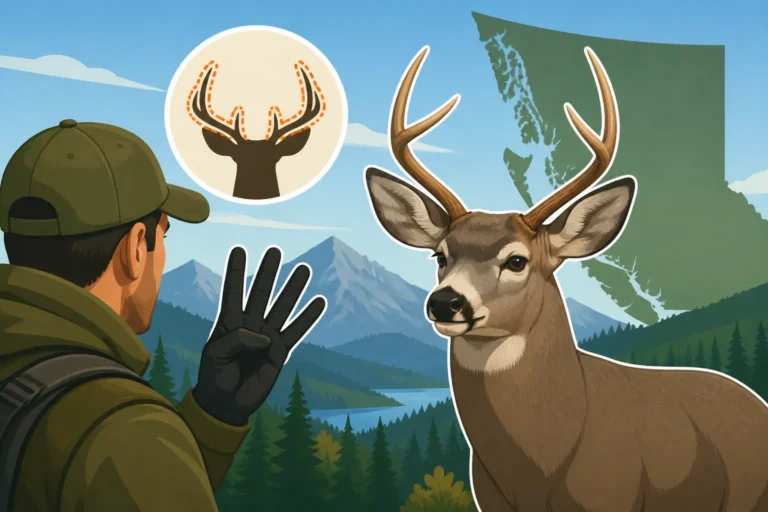
A significant regulation to be aware of is the "four-point antler restriction" common in many MUs. This means that a buck must have at least four points (tines) on one antler, excluding the brow tines, to be legal to harvest. This regulation is designed to protect younger bucks and allow them to mature. Always double-check the synopsis for the specific MU you're hunting to confirm antler restrictions and bag limits. Misidentifying an antler count can lead to serious fines and loss of hunting privileges. Additionally, be aware of any compulsory reporting requirements for harvested deer.
Prioritizing Safety in the Dense Forest
Safety should always be your top priority. Hunting in dense second growth presents several hazards:
- Navigation: It's easy to get lost. Always carry multiple navigation tools and know how to use them. Let someone know your detailed plans and expected return time.
- Uneven Terrain: Downed logs, deep holes, and slippery moss-covered rocks are everywhere. Watch your footing to prevent falls and injuries. A good first-aid kit is essential.
- Other Hunters: While often sparsely populated, you might encounter other hunters, especially on opening weekends. Wearing blaze orange is mandatory in many parts of BC during rifle seasons and is always a good idea for visibility in dense cover, especially on private lands where logging operations might also be active. Understand British Columbia Blaze Orange and Safety Rules.
- Wildlife: While grizzlies are not typically found on Vancouver Island, black bears and cougars are present. Carry bear spray and know how to use it. Make noise as you move through thick cover to avoid surprising an animal.
- Logging Operations: Active logging roads can be dangerous. Be aware of signage, use appropriate radio channels if required, and yield to logging trucks. Never assume a road is clear.
Hunting blacktail in Vancouver Island's second growth is an immersive and physically demanding pursuit. By understanding the habitat, the deer's behavior, employing proven tactics, preparing with the right gear, and adhering to safety and regulations, you'll be well on your way to a successful and rewarding experience in British Columbia's coastal rainforest.
| Strategy Type | Ideal Conditions | Required Skill Set | Pros | Cons |
|---|---|---|---|---|
| Still-Hunting | Thick cover, calm wind | Patience, stealth, keen observation, scent control | Highly effective for solo hunters, intimate encounters | Very slow, physically demanding, easy to get disoriented |
| Driving/Pushing | Multiple hunters, defined boundaries | Coordination, knowledge of deer escape routes | Can cover large areas, effective for flushing deer | Requires teamwork, safety concerns with multiple hunters, can push deer out of an area |
| Stand Hunting/Calling | Active game trails, feeding areas, rut | Patience, scent control, calling technique | Less physically demanding, can entice curious bucks | Requires long periods of stillness, dependent on deer movement, limited visibility |
Disclaimer
Hunting is an inherently risky activity. The information provided in this guide is for informational purposes only and should not be considered a substitute for personal research, professional training, or adherence to all local, provincial, and federal hunting regulations. Always prioritize safety, obtain the necessary licenses and permits, and respect wildlife and the environment. Conditions in the backcountry can change rapidly, and hunters are responsible for their own preparedness and decision-making.