Hunting a Coastal Second Growth Block
Hunting a coastal second-growth block in British Columbia can feel like stepping into a labyrinth. The dense, regenerating timber, often choked with devil's club, salmonberry, and salal, can be incredibly frustrating to navigate, leaving many hunters feeling defeated by the sheer impenetrable nature of it all. But for those willing to embrace the challenge, these very blocks hold some of the best opportunities for elusive coastal blacktail deer and even bears. This guide will help you decode this unique environment, offering strategies to turn those frustrating tangles into productive hunting grounds.
Understanding the Coastal Second Growth Environment
When we talk about hunting a "second-growth block" on the British Columbia coast, we're not just talking about any old woods. We're referring to areas that have been previously logged, often decades ago, and are now in various stages of regeneration. This isn't the ancient, towering old-growth timber, nor is it the freshly cleared land of a recent cutblock. It's a world unto itself, dense with new life, and presents a very specific set of conditions that influence how game animals live and how we as hunters need to adapt.
What Defines "Second Growth" on the Coast?
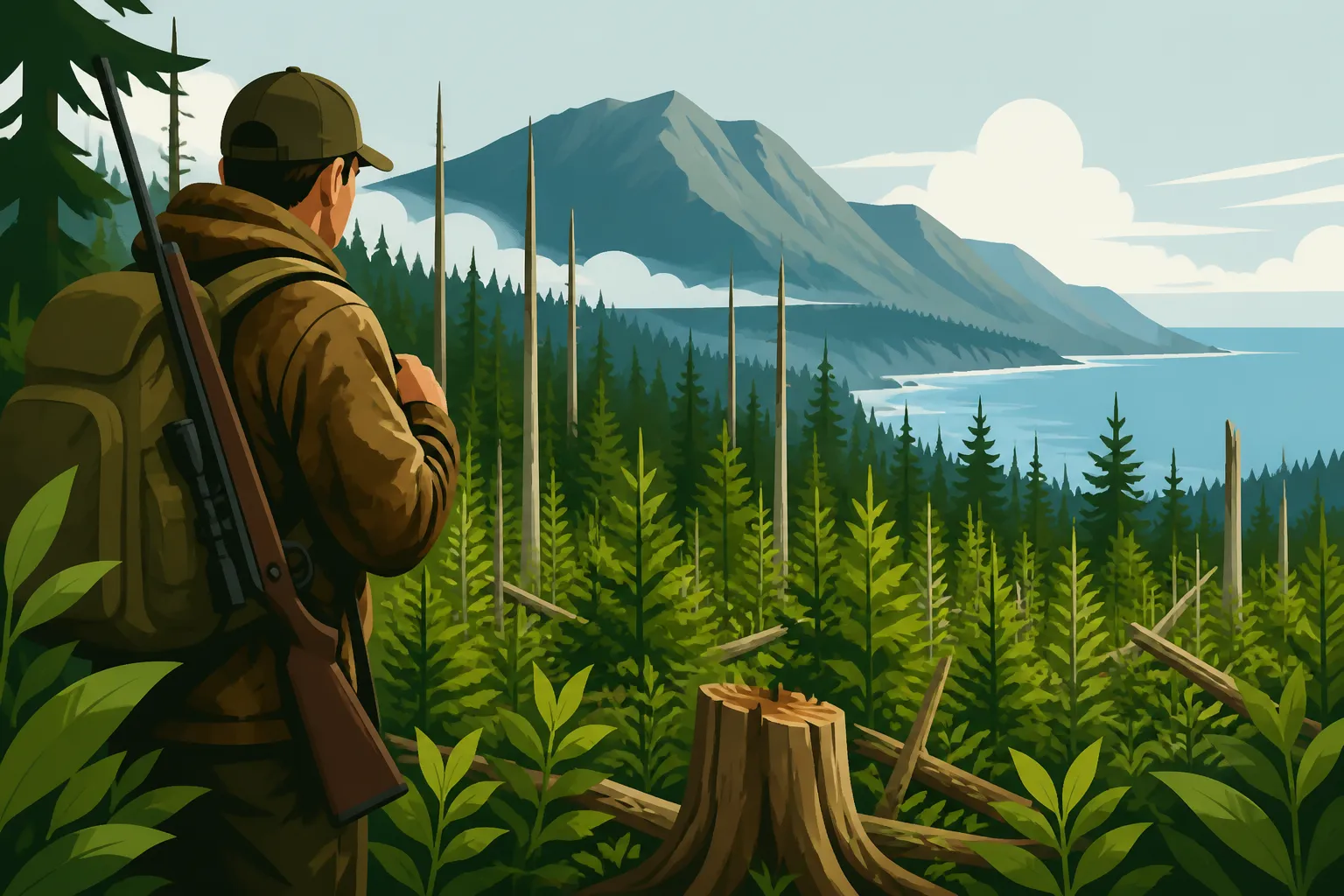
Coastal second growth is characterized by its remarkable density and often relentless understory. Imagine a mosaic of regenerating conifers like hemlock, cedar, and Douglas fir, all competing for sunlight, growing incredibly close together. Beneath this burgeoning canopy, you'll find a thick carpet of vegetation: ferns, salal, huckleberry, and the infamous devil's club, whose thorny stalks seem to reach out and grab you at every turn. Visibility can be extremely limited, often to mere yards, which forces a completely different approach than hunting in more open country. The ground itself is often uneven, riddled with fallen logs, stumps, and hidden depressions, all made slick by the constant coastal rain.
These blocks can range from relatively young stands, perhaps 15-30 years post-logging, where the trees are still fairly small but the brush is at its most impenetrable, to more mature second growth, where the canopy has started to close in, shading out some of the understory and creating slightly more open ground underneath. Each stage presents different opportunities and challenges. The younger, thicker stuff often holds more deer, but they can be incredibly hard to spot and even harder to extract. Knowing the age and history of a particular block, if you can glean that information from old logging maps or aerial photography, can provide valuable clues.
Why Animals Seek Out Second Growth
Despite its difficulty for hunters, second growth is a haven for many coastal game animals, particularly black-tailed deer and black bears. For blacktail, it's a perfect blend of food and cover. The young, regenerating browse, such as huckleberry, willow, and various forbs, provides an abundant food source, especially in the clearings, along the edges, and where sunlight penetrates the canopy. More importantly, the sheer density of the vegetation offers unparalleled security. A blacktail can simply vanish into the thicket, completely hidden from view, making them incredibly difficult to find and even more challenging to get a shot at.
Black bears also frequent these areas, drawn by the same rich forage. They'll spend hours foraging for berries in the summer and fall, and the dense cover provides excellent bedding areas and escape routes. You might find them grubbing for roots or tearing apart old stumps in search of insects. Even Roosevelt elk, though less common in pure second-growth blocks, will utilize the edges and more open sections for browsing and escape cover. The thick timber also offers protection from the elements, especially during the cold, wet winters that are typical of the British Columbia coast, making these areas critical habitat for survival.
The Unique Challenges and Rewards of this Habitat
Hunting second growth isn't for the faint of heart, but the rewards can be substantial. The primary challenge is, without a doubt, the visibility and terrain. Moving quietly is a monumental task, as every step sends twigs snapping and leaves rustling. The constant moisture means mossy rocks and slick logs are a persistent hazard, demanding careful foot placement. Navigation can also be tricky; with limited sightlines, it's easy to become disoriented, even with GPS. This is where tools like onX Hunt truly shine, helping you stay oriented on the landscape and understand property boundaries and logging road networks.
However, the rewards are often big. The very nature of second growth means that animals feel safe and are less prone to being pushed out of an area quickly. Mature blacktail bucks, in particular, are masters of living in these dense, tangled zones, often only moving short distances when disturbed, preferring to sneak deeper into cover rather than bolt across open ground. Success in second growth often means getting incredibly close to your quarry, leading to intense, close-quarters encounters that are hard to replicate in other environments. There’s a profound satisfaction in outsmarting an animal in such a challenging landscape, and it often leads to a deeper appreciation for the cunning and adaptability of coastal game.
Deciphering the Signs and Patterns of Coastal Game
Successfully hunting coastal second growth is less about covering vast distances and more about reading the subtle clues the animals leave behind. In a world of limited visibility, your eyes and ears become critical tools for piecing together the story of what's happening around you. Understanding how deer and bears use this dense habitat, and how their patterns shift with the weather and seasons, will dramatically increase your chances of success.
Reading Deer and Bear Sign in Dense Terrain
In second growth, finding fresh sign is paramount. Look for trails, not wide, well-worn paths, but subtle indentations in the undergrowth or disturbed leaves. These trails often funnel animals along the path of least resistance – perhaps around a particularly thick patch of devil's club, through a slightly more open corridor, or along the base of a small ridge. Deer droppings, freshly nibbled browse, and rub lines on small trees are all indicators of recent activity. Pay close attention to the freshness of the sign; coastal rain can quickly wash away scent and visual cues, so a shiny, dark dropping or a freshly chewed twig tells you an animal was very recently in the area.
For bears, look for overturned rocks, torn-up logs, and claw marks on trees, particularly on cedars. In berry season, mashed berries and scat full of seeds are undeniable proof of a bear's presence. Since visibility is so poor, relying on your nose can also be surprisingly effective. The distinct smell of a bear, or even a recent bed, can sometimes carry in the damp coastal air. Remember that game in this dense environment is often moving slowly, browsing as they go. If you find fresh sign, slow down even further. Reading Blacktail Sign in Wet Ground is an art form in itself, and it’s a skill that pays dividends in this type of habitat.
Key Topographical Features to Focus On
Even in a seemingly uniform block of dense timber, certain topographical features act as natural magnets for game. Look for subtle changes in elevation, like small benches, saddles, or gentle slopes that offer a slight advantage in visibility or shelter. Creek bottoms and drainage channels, even if dry, often provide slightly easier travel routes and can hold thicker, more palatable browse. These low-lying areas also tend to hold moisture, supporting lusher vegetation that animals prefer. Ridges, no matter how small, can serve as travel corridors or bedding areas, especially if they offer some thermal advantage or a slight breeze to keep insects at bay.
The edges of the second-growth block are always prime hunting grounds. This includes the transition zones where the thick young growth meets a mature timber stand, a recent clearcut, or an old logging road. These edges offer both the security of the dense cover and access to more open feeding areas or travel routes. Hunting a British Columbia Island Clearcut Edge often involves focusing on these exact boundary areas, where deer will pop out to feed in the early morning or late evening. Similarly, south-facing slopes, which receive more sunlight, will often have earlier green-up in spring and remain snow-free longer in winter, making them attractive to deer seeking warmth and early forage.
Impact of Weather and Season on Animal Movement
Coastal weather, dominated by rain, fog, and mild temperatures, significantly influences animal movement. During heavy rain, deer and bears often seek out the densest cover available, or will move to the lee side of ridges for shelter. They may become less active, bedding down for extended periods. However, immediately after a rain shower, when the woods are still damp but the sun might be peeking through, can be an excellent time to hunt. The wet ground dampens your footsteps, and animals often emerge to feed. Fog, while challenging for visibility, can also work in your favour, muffling sound and allowing for closer approaches.
Seasonally, the dynamics shift. In early fall, with abundant food sources, animals might be spread out, making them harder to pattern. As the rut approaches for blacktail (typically late October into November), bucks become more active, moving more frequently in search of does. This is when patience and persistence in thick cover can truly pay off. When the Blacktail Rut Peaks is a critical time to be in the woods. Bears, on the other hand, will be hyper-focused on feeding in late summer and fall, building up fat reserves for winter, so focusing on berry patches or areas with good mast crops is key. In winter, deeper snow will push animals to lower elevations and into more sheltered areas within the second growth.
Effective Hunting Strategies for Second Growth Blocks
Hunting second-growth blocks on the British Columbia coast demands a different playbook than hunting open country or even mature timber. It's a game of inches, extreme patience, and meticulous movement. Forget covering miles quickly; here, success is measured in yards gained and minutes spent observing.
The Art of Still-Hunting and Slow Movement
The most effective strategy in coastal second growth is often still-hunting. This isn't just walking slowly; it's a deliberate, almost meditative process of moving a few steps, then stopping for several minutes to observe, listen, and scan every detail of your surroundings. Think of it as hunting at a snail's pace. You might only cover a few hundred yards in an hour, but those few hundred yards are covered with intense focus. The goal is to move so slowly and deliberately that you detect the animal before it detects you, or even to bump an animal just enough that it moves a short distance, allowing you to intercept it as it tries to sneak away. Still-Hunting Second Growth for Blacktail is a masterclass in this technique.
When you move, try to place each footfall softly, testing the ground for hidden twigs or uneven surfaces. Utilize natural sounds like rustling wind or falling rain to mask your movement. Your eyes should be constantly scanning for the smallest detail: an antler tip, a horizontal line in a vertical world, the flick of an ear, or an unnatural patch of dark hair. Often, it's not a whole animal you see first, but just a part of one, or a subtle movement. With such limited visibility, you need to be constantly ready for a quick, close-range shot. This method is exhausting, both physically and mentally, but it forces you to become hyper-aware of your environment.
Utilizing Edges, Clearings, and Transition Zones
While the general density of second growth is its defining characteristic, it's the breaks and transitions within it that often provide the best opportunities. As mentioned, the exterior edges where second growth meets a different habitat type (old growth, clearcut, road) are high-traffic areas. However, look for internal edges too: where a particularly thick patch of regeneration meets a slightly more open area, a logging road spur, or an old skid trail. These internal corridors, even faint ones, are often used as travel routes by game.
Small clearings, whether natural openings, old log landings, or areas where the canopy has been damaged, are also key. These spots allow sunlight to reach the forest floor, promoting richer browse and creating natural feeding areas. These clearings are excellent places to sit and watch, especially during prime feeding times in the morning and evening. Similarly, where the second growth transitions into a small stand of mature timber, or a riparian zone along a creek, these are choke points that funnel animals and provide both food and cover. Spend extra time systematically working these zones. The animals are there; it's just a matter of uncovering them.
Essential Gear and Navigation for the Tangled Woods
Your gear choices for coastal second-growth hunting are critical. Forget heavy, cumbersome equipment. You need lightweight, durable, and above all, waterproof gear. A high-quality rain suit is non-negotiable, as you'll be constantly pushing through wet brush. Good waterproof boots with excellent ankle support are essential for navigating the uneven, slick terrain. A chest harness for your binoculars or rangefinder keeps them accessible and prevents them from snagging on brush.
Navigation is paramount. A reliable GPS unit or a smartphone with a mapping app like onX Hunt or GoHunt is invaluable. These apps allow you to mark your vehicle, track your path, and see detailed topographical maps, making it much harder to get lost in the dense, featureless forest. Always carry a compass and a physical map as a backup, and know how to use them. A small, bright flagging tape roll can be useful for marking your blood trail or a particularly dense section you want to revisit. Remember, even short excursions into these blocks can feel disorienting very quickly, so good navigational tools and skills are truly lifesavers.
| Aspect | Coastal Second Growth Tactics | Open Country/Mature Timber Tactics |
|---|---|---|
| Movement Pace | Extremely slow, still-hunting focused | Faster, covering more ground |
| Visibility | Very limited (yards) | Moderate to high (dozens-hundreds of yards) |
| Primary Sense Used | Hearing, smell, minute observation | Sight, spotting at distance |
| Navigation | Crucial, GPS/map essential for orientation | Easier, landmarks often visible |
| Shot Opportunities | Close-range, fast, through openings | Longer range, more time to set up |
| Gear Focus | Waterproof, durable, lightweight, navigation | Optics, rifle accuracy, comfort |
| Animal Behavior | Sneaky, holds tight, uses dense cover | May run further, more visible |
Navigating Safety and Logistics in the Coastal Jungle
The British Columbia coast, with its rugged terrain, unpredictable weather, and abundant wildlife, presents specific safety and logistical considerations for hunters. Being prepared for these eventualities is not just a good idea; it's absolutely essential for a safe and successful hunt in second-growth blocks.
Preparing for British Columbia's Wet and Wild Conditions
British Columbia's coast is synonymous with rain. You should always expect it, even if the forecast promises sunshine. Layers are your best friend: a good wicking base layer, an insulating mid-layer (fleece or synthetic down), and a truly waterproof and breathable outer shell. Your outer layer will be constantly rubbing against wet brush, so durability is key. Carry extra dry socks, gloves, and a warm hat, even in your daypack. Staying dry is critical to staying warm and preventing hypothermia, which can set in surprisingly quickly if you're stationary for too long in damp conditions. Hunting British Columbia's Coastal Rain means being ready for anything the weather throws at you.
Beyond personal warmth, consider how the wet environment affects your gear. Protect electronics in waterproof bags. Your rifle or bow should be maintained to withstand moisture; a light coat of oil on metal parts can prevent rust, and wiping down your scope lenses is a constant battle. Remember that visibility can change instantly with fog rolling in or a heavy downpour, so always know your escape routes and be prepared to hunker down if conditions become too dangerous to move or shoot safely.
Best Practices for Bear Safety and Awareness
The British Columbia coast is bear country, home to both black bears and grizzly bears. While grizzly populations are more concentrated inland and in the north, they can be present in coastal areas. It's crucial to understand the difference and practice robust bear safety protocols. Assume any bear sign could be from a grizzly. Carry bear spray and know how to use it – practice deploying it from your hip or chest harness. Having it instantly accessible is far more important than having it in your pack.
Make noise as you move through dense areas, especially around blind corners, dense berry patches, or near salmon streams, to avoid surprising a bear. Travel with a partner if possible. Be acutely aware of your surroundings, constantly scanning for fresh tracks, scat, or sounds. If you encounter a bear, especially a grizzly, know the appropriate response (usually making yourself look big, speaking calmly, and slowly backing away, unless it's an attack, in which case you fight back with everything you have). What to Do If You See a Grizzly is essential reading for anyone hunting in BC. When handling game meat, process it quickly and get it elevated or secured away from camp to avoid attracting bears.
Packing Out Your Harvest from Difficult Terrain
If you're fortunate enough to harvest an animal in a second-growth block, the real work often begins with the pack-out. This is where the challenges of dense brush, uneven terrain, and slick conditions truly test your resolve. Plan your approach before you pull the trigger if possible. What's the easiest way to get the animal out? Is there an old skid trail or an open drainage nearby? In many cases, you'll need to bone out the animal and make multiple trips. Getting Meat Out of Steep British Columbia Country often involves this kind of strategic thinking.
A sturdy frame pack is invaluable for carrying heavy loads through the brush. Consider a game cart only if you are absolutely certain there's a relatively clear path, as they can be more hindrance than help in truly dense, tangled areas. Having a reliable hunting partner is a massive advantage for sharing the load and navigating the difficult terrain. Always have a plan for keeping your meat cool, especially in the mild coastal temperatures. Proper field dressing and quartering will be crucial for managing the meat in the field and getting it back to your vehicle in good condition.
Disclaimer
This article is for general informational purposes only and does not constitute professional advice. Laws, prices and regulations vary by location and change over time. Consult a qualified professional for guidance on your specific situation.