What Logging Does to Deer Winter Range
It's no secret that logging has shaped the landscape of British Columbia. For those of us who spend countless hours chasing deer through its mountains and valleys, the sight of a fresh cutblock or a busy logging road can stir a mix of emotions. Understanding how these activities truly impact the places deer call home, especially during those harsh winter months, is absolutely crucial for any serious hunter. This guide will take a deep dive into how logging affects deer winter range, offering insights into both the challenges and the unexpected opportunities it can create.
The Critical Role of Winter Range for Deer in British Columbia
Deer, whether they're the big-bodied mule deer of the Interior or the elusive blacktail of the coast, face immense challenges during British Columbia's winters. Deep snow, freezing temperatures, and scarce forage can push these animals to their limits. Their survival often hinges on their ability to find and utilize suitable winter range – areas that offer refuge and sustenance when conditions are at their worst.
What Defines Quality Winter Range?
Think about what you'd need if you were trying to survive a harsh BC winter with minimal gear. You'd want shelter from the wind and snow, and some consistent food sources. Deer aren't much different. For them, quality winter range typically means lower elevation areas, often on south-facing slopes, that receive more sunlight and shed snow faster. Critically, these areas usually boast mature coniferous forests, like Douglas fir or cedar, with a dense canopy. This canopy acts like a giant umbrella, intercepting snowfall and creating shallower snow depths on the forest floor, making it easier for deer to move and forage.
Beyond just shallower snow, these older forests often have specific understory vegetation that deer rely on. Lichens, certain shrubs, and even fallen needles can provide crucial browse when other food sources are buried. The thermal cover offered by these dense stands is also vital, providing a windbreak that allows deer to conserve energy, something they desperately need to make it through the lean months. Imagine being able to hunker down in a relatively calm, warmer spot when a blizzard is raging outside – that's what these winter ranges offer. You might read more about why these areas are so important in articles discussing Why Mule Deer Move to Winter Range or Hunting Blacktail in British Columbia's Coastal Rain.
Why Deer Depend So Heavily on These Areas
Deer don't just prefer winter range; they depend on it for survival. When snow gets too deep – say, over 40-50 cm for an extended period – it becomes incredibly energy-intensive for them to move. They start burning through their fat reserves at an alarming rate. If they can't access areas with shallower snow, their chances of making it through to spring plummet. These prime winter ranges act as bottlenecks in their annual migration. In some areas, virtually the entire deer population from a broad summer range will funnel into a relatively small wintering area.
This concentration of deer in specific areas means that the quality and availability of that habitat are paramount. A severe winter coupled with a degraded winter range can lead to significant population declines. Furthermore, these critical habitats are often close to human development, valley bottoms, or accessible terrain, making them particularly vulnerable to disturbance and habitat alteration, including logging. The decisions made about land use in these sensitive zones have long-lasting consequences for deer herds, sometimes affecting them for generations.
Immediate and Short-Term Logging Impacts on Deer Winter Range
When the chainsaws start and the heavy machinery moves in, the impacts on deer winter range are immediate and often dramatic. For a hunter, seeing a vibrant forest suddenly become a stark clearcut can feel disheartening, and for good reason. These changes reshape the landscape in ways that can be both detrimental and, surprisingly, occasionally beneficial in the short term.
Habitat Loss and Fragmentation
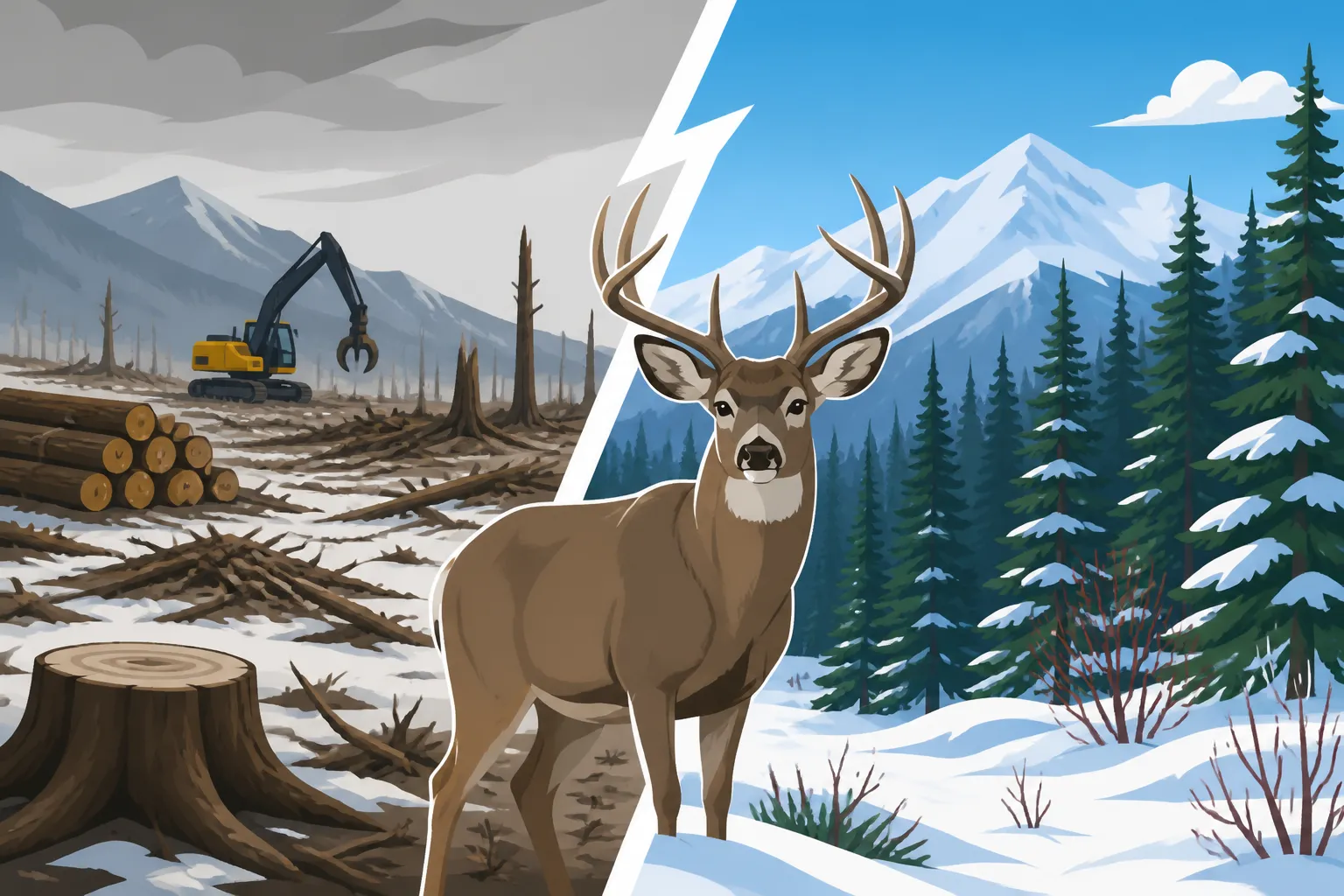
The most obvious and direct impact of logging on winter range is the outright loss of the mature forest canopy. When an area of critical winter range is clearcut, that thermal cover and snow interception capability vanish. Deer that relied on that specific patch of woods are displaced. This isn't just about losing a few trees; it's about eliminating the very conditions that allowed deer to survive severe weather. They are forced to move to adjacent, often already occupied, winter ranges, increasing competition for resources or pushing them into less suitable areas where they are more exposed to predators and harsher elements.
Logging operations can also lead to habitat fragmentation. Instead of one large, continuous block of winter range, you might end up with several smaller, isolated patches separated by clearcuts, roads, or active logging areas. This makes it harder for deer to move safely between feeding and bedding areas, increases their exposure to human activity, and can disrupt traditional migration corridors. Deer are creatures of habit, and forcing them to alter those habits, especially during the stressful winter months, puts them at a significant disadvantage.
Increased Access and Pressure
Another crucial short-term impact of logging, especially relevant for hunters, is the creation of new access. Logging roads, while essential for timber extraction, open up previously remote or hard-to-reach areas. This can be a double-edged sword. On one hand, it can create opportunities for hunters to explore new territory and potentially access deer in areas that were once wilderness. On the other, it undeniably increases hunting pressure on deer populations, particularly in accessible winter ranges where deer are already concentrated and vulnerable.
This increased access means more vehicles, more human scent, and more noise, which can displace deer even further from their preferred wintering spots. When deer are already struggling to conserve energy, constant disturbance can be devastating. As an ethical hunter, it's vital to be aware of the pressure logging roads can bring and to adapt your strategies accordingly. Tools like GoHunt can sometimes help identify areas with recent logging activity that might have new road networks, but also remind you to consider the added pressure. Learning about Finding Open Forest Roads in British Columbia can be a valuable asset here, but with responsibility.
The Evolving Landscape: Long-Term Effects of Logging on Deer Habitat
While the immediate impacts of logging can be stark, the forest doesn't stay barren forever. Over time, clearcuts begin to regenerate, and the landscape evolves, presenting both new challenges and unexpected opportunities for deer and the hunters who pursue them. It's a complex dance between destruction and regrowth, where patience and understanding are key.
Habitat Succession and New Opportunities
After a clearcut, the sun finally hits the forest floor, stimulating a burst of new growth. For the first few years, this might look like a tangle of pioneer species – grasses, fireweed, and deciduous shrubs like willow and alder. This early successional habitat, while lacking the thermal cover of mature forests, provides an abundance of tender browse. Deer absolutely love this stuff. Imagine a grocery store that's suddenly stocked with all their favourite foods! So, while they've lost their sheltering canopy, they've gained a smorgasbord of nutrient-rich forage.
As the forest continues to regenerate, often around 5-15 years post-logging, the conifer saplings begin to grow taller, creating dense "dog-hair" stands. These stands, while too thick for easy travel, can provide some thermal cover and visual security. Beyond that, strategically placed clearcuts, especially smaller ones or those that feather into existing mature timber, can create an ideal mosaic of habitat. Deer can browse in the younger, regenerating areas and then quickly retreat into the thermal and hiding cover of the uncut forest, particularly on the edges. Understanding these nuances is crucial, as you can see when Hunting a Recent Cutblock in Its Third Year or Hunting a British Columbia Island Clearcut Edge.
However, the complete regeneration of a mature, winter-range-quality forest takes decades, if not centuries. So while early successional stages offer food, they don't replace the deep snow protection of old growth, leaving deer vulnerable to severe winters for a long time.
Shifts in Deer Behavior and Distribution
Logging fundamentally alters how deer use the landscape, leading to observable shifts in their behaviour and distribution. In areas with extensive clearcutting, deer might adapt by utilizing smaller, remaining patches of mature timber as "islands" of refuge within a sea of regenerating forest. Their home ranges might expand as they search for sufficient food and cover, or they might become more nomadic. Hunters often notice deer gravitating towards the edges of cutblocks, where they can feed on the new growth but still be close to thicker cover for escape.
Coastal blacktail deer, for example, are masters at using the various stages of logged areas. They'll browse in younger clearcuts but quickly duck into the thick, second-growth timber or unlogged pockets when disturbed. Still-Hunting Second Growth for Blacktail becomes a highly effective strategy in these conditions. Mule deer in the Interior might move to higher elevations to find unlogged pockets or adjust their winter migration routes if traditional pathways are disrupted. These shifts demand that hunters become more adaptable, spending time scouting and using tools like GoHunt to understand current timber activities and adapt to these changing deer patterns.
Managing Logging for Deer: Mitigation and Enhancement Strategies
While logging certainly presents challenges, forest management practices have evolved significantly, and there are conscious efforts to mitigate negative impacts and even enhance deer habitat. As hunters, understanding these strategies can help us appreciate the complexities of land management and even guide our own scouting efforts.
Sustainable Forestry Practices
Modern forestry often incorporates practices designed to minimize harm to wildlife, including deer. This might include leaving specific patches of mature timber as "winter range reserves" or "wildlife tree patches" within a larger cutblock. These reserves provide crucial thermal cover and escape routes. Instead of massive clearcuts, some operations employ selective logging or smaller patch cuts, which create a more diverse habitat mosaic, offering both food and cover closer together. These techniques aim to simulate natural disturbance patterns, like small wildfires or windthrow, which historically created diverse habitats.
Another approach is to manage the road network. While new roads might be built during active logging, some are "deactivated" afterwards, meaning they are pulled back, revegetated, and blocked off to vehicles. This helps reduce long-term human access and pressure on deer, allowing them to utilize these areas with less disturbance. Some areas are specifically managed for their deer winter range values, with forestry plans tailored to protect and enhance these critical habitats, often in collaboration with wildlife biologists.
Scouting and Adapting to Logged Areas
For the persistent hunter, logged areas, despite their initial appearance, can offer incredible opportunities if you know how to read the landscape. You have to think like a deer: where will they find food, and where will they find security?
Table: Deer Use of Logged Areas by Regeneration Stage
| Regeneration Stage | General Characteristics | Deer Use (Food) | Deer Use (Cover) | Hunting Strategy Notes |
|---|---|---|---|---|
| 0-5 Years | Recently cut, abundant sun, pioneer growth | High browse value (grasses, shrubs, forbs) | Minimal thermal/hiding cover; depends on adjacent timber | Focus on edges, early morning/late evening feeding. Glass from afar. |
| 5-15 Years | Dense young conifers, thick brush | Moderate browse (as canopy closes), some edges | Excellent hiding cover, limited thermal cover | Still-hunt thickets cautiously, look for trails entering/exiting. |
| 15-30 Years | Taller conifers, some canopy closure | Decreasing browse, but good edge opportunities | Improving thermal and hiding cover | Look for natural openings, travel corridors within stands. |
| 30+ Years | Approaching mature forest conditions | Browse depends on understory, good mast crop (if hardwoods) | Good thermal and hiding cover | Hunt as mature timber, look for preferred browse patches. |
Scouting becomes more important than ever. Instead of just looking for thick timber, you're now looking for the combination of security cover (often remaining mature timber, even small patches, or very dense young growth) and abundant forage (the regenerating clearcuts). Using mapping tools like GoHunt can be invaluable here. You can often see recent cutblocks, forest service roads (active and deactivated), and topographical features that might indicate prime deer habitat, even after logging. This allows you to plan your approach, identifying potential escape routes for deer and strategic vantage points for yourself.
Always remember that deer, particularly during winter, will prioritize survival. This means finding the path of least resistance through snow, conserving energy by utilizing thermal cover, and accessing consistent food sources. Logged areas, while challenging, become part of a larger, dynamic ecosystem that requires hunters to be adaptable, patient, and above all, respectful of the ever-changing British Columbia wilderness. Getting out there and putting boots on the ground to understand Scouting a British Columbia Management Unit Online after logging can really change your perspective on these areas.
Disclaimer
This article is for general informational purposes only and does not constitute professional advice. Laws, prices and regulations vary by location and change over time. Consult a qualified professional for guidance on your specific situation.