Fall Bear Season Dates by Region
The crisp air of a British Columbia autumn calls to many of us, but when it comes to fall bear hunting, figuring out exactly when and where you can head out can feel like deciphering a secret code. Between varied regional dates, specific management unit rules, and the ever-present need to consult the current regulations synopsis, it's easy to get frustrated. This comprehensive guide is here to break down the complexities of British Columbia's fall black bear season dates by region, helping you plan your hunt with confidence and clarity.
Deciphering British Columbia's Hunting Regions and Fall Bear Seasons
British Columbia is a vast and diverse province, and its hunting regulations reflect that incredible geographical variety. What's legal and open in the lush rainforests of the Coast might be entirely different from the arid grasslands of the Okanagan or the sprawling wilderness of the Peace Region. Understanding these distinctions is the first critical step for any hunter looking to pursue black bears in the fall.
Understanding the Regional Map of British Columbia
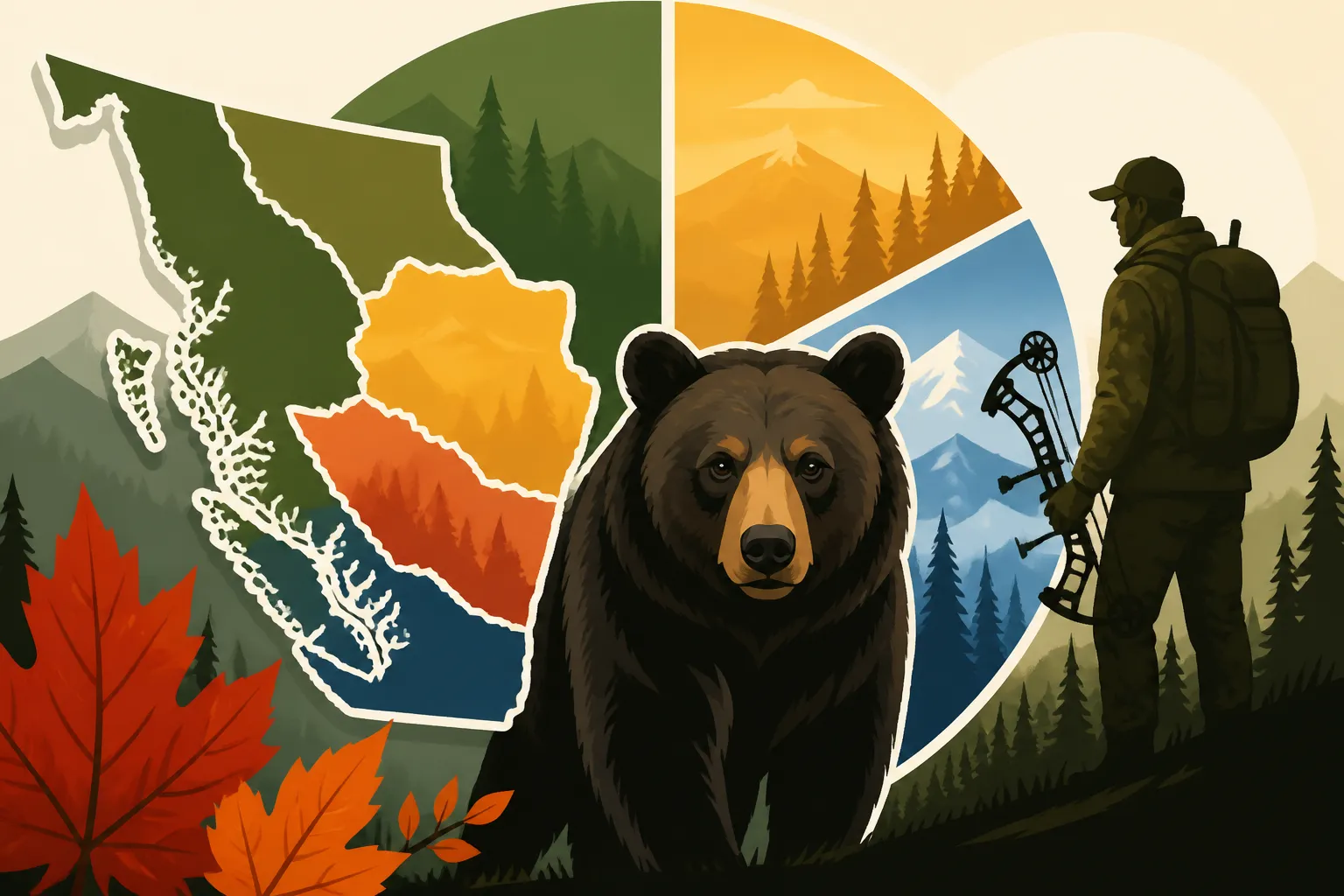
The province is divided into nine distinct administrative hunting regions, each with its own unique characteristics, species populations, and often, varying season dates. These regions aren't just lines on a map; they represent significant ecological and climatic differences that directly impact when bears are active, what they're feeding on, and ultimately, when hunting seasons are set. For instance, coastal regions experience milder, wetter falls, often with salmon runs drawing bears to river systems, while the northern interior might see early snows pushing bears to lower elevations for persistent berry crops. Getting familiar with these regions is crucial for understanding the nuances of the regulations. You can dive deeper into how these areas are structured by exploring British Columbia's Management Units and Regions.
The General Framework for Fall Black Bear Seasons
Generally, fall black bear seasons in British Columbia are quite generous, often opening in early September and extending through to late October or even into November in some areas. This extended period reflects the black bear's need to fatten up before hibernation, making them active and visible as they forage for abundant fall food sources. However, these dates are not universal. Each region, and sometimes specific Management Units (MUs) within a region, will have slightly different start and end dates. This means that a "fall bear hunt" could be a very different experience depending on whether you're chasing bears along a berry-laden clearcut in the Cariboo in September, or watching a creek for salmon-fattened bears on Vancouver Island in October. Always remember that while general trends exist, the official British Columbia Bear Season Dates as published in the current regulations synopsis are your ultimate authority.
Detailed Fall Black Bear Season Dates by Region
Now, let's get into the nitty-gritty of the fall black bear season dates across British Columbia's diverse landscapes. It's imperative to always consult the most current British Columbia Hunting and Trapping Regulations Synopsis, as dates can be adjusted. However, these details provide a solid general overview of what you can expect in each area.
West Coast and Southern Interior Seasons (Regions 1, 2, 9)
Region 1: Vancouver Island
On Vancouver Island, which covers the entire island and adjacent smaller islands, the fall black bear season typically opens in early September and often runs straight through to early December. This is a remarkably long season, allowing ample opportunity to hunt these coastal bruins. What makes Vancouver Island unique are its dense temperate rainforests and abundant salmon runs in the fall. Bears here are often found along logging roads, in clearcuts, and near river systems as salmon begin their spawn. This means late-season hunting can be very productive if you're prepared for the notorious coastal rain. Expect to see What a Coastal Black Bear Weighs on the larger side here due to the rich food sources.
Region 2: Lower Mainland
The Lower Mainland region, encompassing the Fraser Valley and surrounding areas, generally sees fall black bear seasons opening in September and continuing through to late November or early December, similar to Vancouver Island. While population density is higher in some parts, there are still significant hunting opportunities in the backcountry areas. Access points into the Coast Mountains and up into the Fraser Canyon offer prime habitat. Hunters often focus on areas with ample berry crops earlier in the fall and then shift to higher elevations or remote valleys as temperatures drop.
Region 9: Okanagan
Moving into the dry interior, Region 9 (Okanagan) offers a different experience. Fall black bear seasons here commonly open around September 1st and conclude by October 31st or November 15th, depending on the specific Management Unit. The landscape is characterized by sagebrush flats, ponderosa pine forests, and steep mountainsides. Bears in the Okanagan are often found on berry-laden slopes and timbered draws. Early season hunts might focus on higher elevations where huckleberries are ripe, while later in the fall, bears might be found closer to agricultural edges or lower elevation food sources before denning. Using tools like GoHunt to identify these varied habitats and plan your approach is incredibly helpful in this diverse region.
Central and Eastern Interior Seasons (Regions 3, 4, 5)
Region 3: Thompson
The Thompson region typically has fall black bear seasons running from September 1st to October 31st. This area, with its mix of grasslands, forests, and subalpine terrain, presents diverse hunting grounds. Bears here will be gorging on berries like huckleberries and saskatoons, which often grow prolifically on burned slopes and open timber stands. Hunting a Burn on a South Slope can be productive, as new growth after a fire creates excellent forage. The varied elevations mean hunters can follow the ripening of different food sources throughout the fall.
Region 4: Kootenay
In the Kootenays, fall black bear season dates typically mirror much of the interior, running from September 1st to October 31st or sometimes November 15th in specific MUs. This region is renowned for its rugged mountains, dense forests, and abundant wildlife. Bears are often found in clearcuts, along forest service roads, and in subalpine basins, especially in areas with chokecherry and huckleberry patches. Hunters often focus on Hunting a Kootenay Creek Draw or steep, timbered hillsides where bears frequent. Always be prepared for changing mountain weather and the potential for early snow, which can shift bear patterns rapidly.
Region 5: Cariboo
The vast Cariboo region also generally has fall black bear seasons from September 1st to October 31st, though some areas may extend into mid-November. The Cariboo is known for its rolling hills, vast forests, and numerous lakes and rivers. Bears are widespread and will be actively feeding on a variety of berries and other vegetation. Hunting Fall Bears on British Columbia Berry Slopes is a classic strategy here. Logging roads provide excellent access, and glassing clearcuts or old burns can be highly effective. The sheer size of this region offers endless opportunities for hunters willing to explore.
Northern Regions: Skeena, Omineca, and Peace (Regions 6, 7, 8)
Region 6: Skeena
The Skeena region, covering a huge swath of northwestern British Columbia, often has fall black bear seasons from September 1st through October 31st, though some specific areas, particularly those with strong salmon runs, might see seasons extend later into November. This region is characterized by dramatic mountains, vast river systems, and a mix of coastal and interior climates. Bears are plentiful, and their activity will be heavily influenced by salmon spawning in the major river systems like the Skeena itself. Access often involves extensive travel on Hunting British Columbia's Logging Road Network or even jet boat access on rivers.
Region 7: Omineca
In the Omineca region, located in the central interior, fall black bear seasons typically run from September 1st to October 31st. This region is truly wild, offering incredible backcountry hunting opportunities. Bears here are found throughout the diverse forest landscapes, from vast spruce and pine stands to more open country created by past fires or logging. Similar to other interior regions, bears will be focused on berry crops and other vegetation to put on weight. The challenge often lies in accessing remote areas and covering significant ground, making good scouting and mapping tools like GoHunt particularly valuable.
Region 8: Peace
The Peace Region, British Columbia's northeastern agricultural and boreal forest landscape, generally has a fall black bear season that starts around September 1st and can run as late as November 30th in many MUs. This long season gives hunters ample time. Bears in the Peace are often found along the edges of agricultural fields, in the dense bush, and near river bottoms. They will be feeding on grains, berries, and other vegetation, taking advantage of the rich land. Hunting a Peace Country Grain Field can be a particularly productive strategy in the later parts of the season. Hunters should be prepared for colder temperatures and potential early snowfalls as winter approaches in this northern region.
| Region No. | Region Name | General Fall Black Bear Season Dates (Approx.) | Key Factors Affecting Hunt |
|---|---|---|---|
| 1 | Vancouver Island | Early Sept – Early Dec | Salmon runs, dense rainforest, logging roads |
| 2 | Lower Mainland | Early Sept – Late Nov/Early Dec | Mountain backcountry, varied terrain |
| 3 | Thompson | Sept 1 – Oct 31 | Grasslands, forests, subalpine, berry crops |
| 4 | Kootenay | Sept 1 – Oct 31 / Nov 15 | Rugged mountains, forests, clearcuts |
| 5 | Cariboo | Sept 1 – Oct 31 / Mid-Nov | Rolling hills, vast forests, abundant berries |
| 6 | Skeena | Sept 1 – Oct 31 / Late Nov | Major river systems, salmon, remote access |
| 7 | Omineca | Sept 1 – Oct 31 | Wild backcountry, diverse forests |
| 8 | Peace | Sept 1 – Nov 30 | Agricultural edges, boreal forest, bush |
| 9 | Okanagan | Sept 1 – Oct 31 / Nov 15 | Dry interior, sagebrush, steep slopes |
Note: These dates are general and approximate. Always refer to the most current British Columbia Hunting and Trapping Regulations Synopsis for precise and up-to-date information for your specific Management Unit.
Key Influencers on Fall Bear Activity and Successful Hunting
Knowing the dates is one thing, but truly understanding bear behavior in the fall is what puts you in a position to be successful. Bears aren't clockwork; their movements and feeding patterns are heavily dictated by the environment.
The Feast of Fall: Seasonal Food Sources
As summer fades into autumn, black bears enter a critical phase known as hyperphagia, where they consume enormous amounts of calories to build up fat reserves for hibernation. This drives their entire existence in the fall. You'll find them relentlessly searching for calorie-rich foods. In many parts of British Columbia, this means berries: huckleberries, blueberries, saskatoons, chokecherries, and devil's club berries are all prime attractants. Hunting Fall Bears on British Columbia Berry Slopes is a time-honored strategy.
On the coast and near major river systems, salmon runs become an irresistible magnet. Bears will stake out spawning channels, gorging on protein and fat-rich fish. If you're hunting in areas like the Skeena or coastal regions, knowing when and where salmon are spawning is critical intelligence. In other areas, particularly where deciduous trees are present, acorns, beechnuts, or even specific grasses can become important late-season food sources. Pay attention to what's available and fresh in your chosen hunting area; it will tell you where the bears are likely to be.
Adapting to the Weather: How Conditions Affect Bear Movement
Weather, especially in the variable climate of British Columbia, plays a huge role in fall bear activity. A warm, dry fall might keep bears active longer and higher in elevation, continuing to forage for berries. Conversely, an early cold snap or significant snowfall can rapidly push bears down to lower elevations, or even send them into hibernation earlier than expected.
Heavy rains, common on the coast, might reduce visibility but also wash fresh food down draws, concentrating bears. In the interior, consistent dry weather can make bears more nocturnal, seeking shade during the day. Keeping a close eye on the long-range forecast for your hunting area is just as important as knowing the season dates. These weather windows can dictate when and where you should focus your efforts, making the difference between seeing a lot of sign and actually seeing a bear.
Strategic Scouting and Locating Bears
Effective fall bear hunting relies heavily on scouting, both pre-season and in the field. Digital tools like GoHunt can be incredibly powerful for identifying potential habitat before you even leave home. You can analyze topography, look for old burns, recent clearcuts, or areas with dense berry patches. Overlaying management unit maps with satellite imagery allows you to pinpoint promising locations.
Once in the field, look for fresh sign: scat, overturned rocks, rubbed trees, and fresh tracks. Black bears often follow predictable travel routes between bedding areas and food sources. Glassing Logging Roads for Spring Bears is a tactic that works just as well in the fall; focusing on open areas like clearcuts, avalanche chutes, and the edges of burns, especially in the early morning and late evening, can reveal bears out feeding. Understanding Hunting British Columbia's Logging Road Network is key to accessing these areas, but remember that many bears will retreat into denser cover during the day.
Essential Preparations for Your British Columbia Fall Bear Hunt
A successful and safe fall bear hunt goes beyond just knowing the dates. It involves thorough preparation, understanding the rules, and being equipped for the unpredictable British Columbia wilderness.
Navigating Licensing and the Current Regulations Synopsis
Before anything else, ensure you have your valid British Columbia hunting licence and the appropriate species tags. For black bears, you'll need a black bear species licence. You can learn more about the costs and processes for acquiring these by checking British Columbia Hunting Licences and Fees and Black Bear Species Licence Cost. It's not enough to just buy them; you must understand the rules that govern their use, including bag limits and any compulsory reporting requirements.
Always, and I mean always, carry a copy of the current British Columbia Hunting and Trapping Regulations Synopsis for the relevant year, both physically and digitally. Regulations can change, and specific Management Units often have unique restrictions or special conditions. Don't rely solely on what you read online; the official synopsis is the law. Pay close attention to definitions of legal hunting methods, shooting hours, and any restrictions on baiting or hunting with dogs in your chosen MU.
Critical Gear, Field Dressing, and Bear Safety Essentials
British Columbia is wild country, and going into the field unprepared can quickly turn a dream hunt into a nightmare. For fall bear hunting, durable, weather-appropriate clothing is essential, especially if you're venturing into the coastal regions where rain is a constant companion. Good quality optics – binoculars and a spotting scope – are indispensable for Glassing an Interior Hillside for Mule Deer which is a tactic that works just as well for bears from a distance, allowing you to identify a legal animal without disturbing it.
Crucially, bear safety is paramount. You're sharing their home, and even black bears can be dangerous, particularly sows with cubs or habituated bears. Always carry bear spray, know how to use it, and have it readily accessible. If hunting in areas where grizzlies might be present (check What British Columbia's Grizzlies Are Densest), this becomes even more critical. Understanding Bear Safety While Hunting in British Columbia is not just a suggestion; it's a non-negotiable part of hunting here.
When you're successful, proper field dressing and meat care are vital. Fall temperatures can still be warm in early season, so swiftly processing the animal and Cooling a Bear Hide in Warm Weather is essential to prevent spoilage. You'll need sturdy game bags, a sharp knife, and potentially a way to hang the meat to cool. And of course, always have an emergency plan in place, including Emergency Planning in British Columbia's Backcountry, especially if you're heading into remote areas. Tell someone where you're going and when you expect to return, and consider carrying a satellite messenger for communication outside of cell service.
Disclaimer
The information provided in this guide is for general informational purposes only and is not a substitute for the official British Columbia Hunting and Trapping Regulations Synopsis. Hunting regulations, season dates, and legal requirements are subject to change without notice. It is the responsibility of every hunter to consult and comply with the most current official regulations published by the Government of British Columbia and the Canadian federal government. Failure to do so may result in fines, penalties, or loss of hunting privileges. Always hunt safely and ethically.