Cell Service on a British Columbia Hunt
You're packing for your British Columbia hunting adventure, dreaming of crisp mountain air, a grand bull elk, or a stalking black bear. You've got your rifle, your boots, your camp gear, and of course, your trusty cell phone. It's second nature to assume you'll have a signal, right? But here's the hard truth: much of British Columbia's incredible hunting country is a vast, wild expanse where cell service is a rare luxury, not a given. This guide will walk you through the realities of cell service on a BC hunt, why you can't rely on it, and crucially, what reliable communication alternatives you absolutely need to consider for your safety and peace of mind.
The Harsh Reality of Cell Service in British Columbia's Backcountry
Stepping into British Columbia's wild places is stepping away from the daily grind, and for many, that includes the constant buzz of connectivity. The pristine wilderness that makes BC such a hunting paradise is precisely what makes cell service an illusion in most areas.
Why Cell Towers Don't Reach Most Hunting Areas
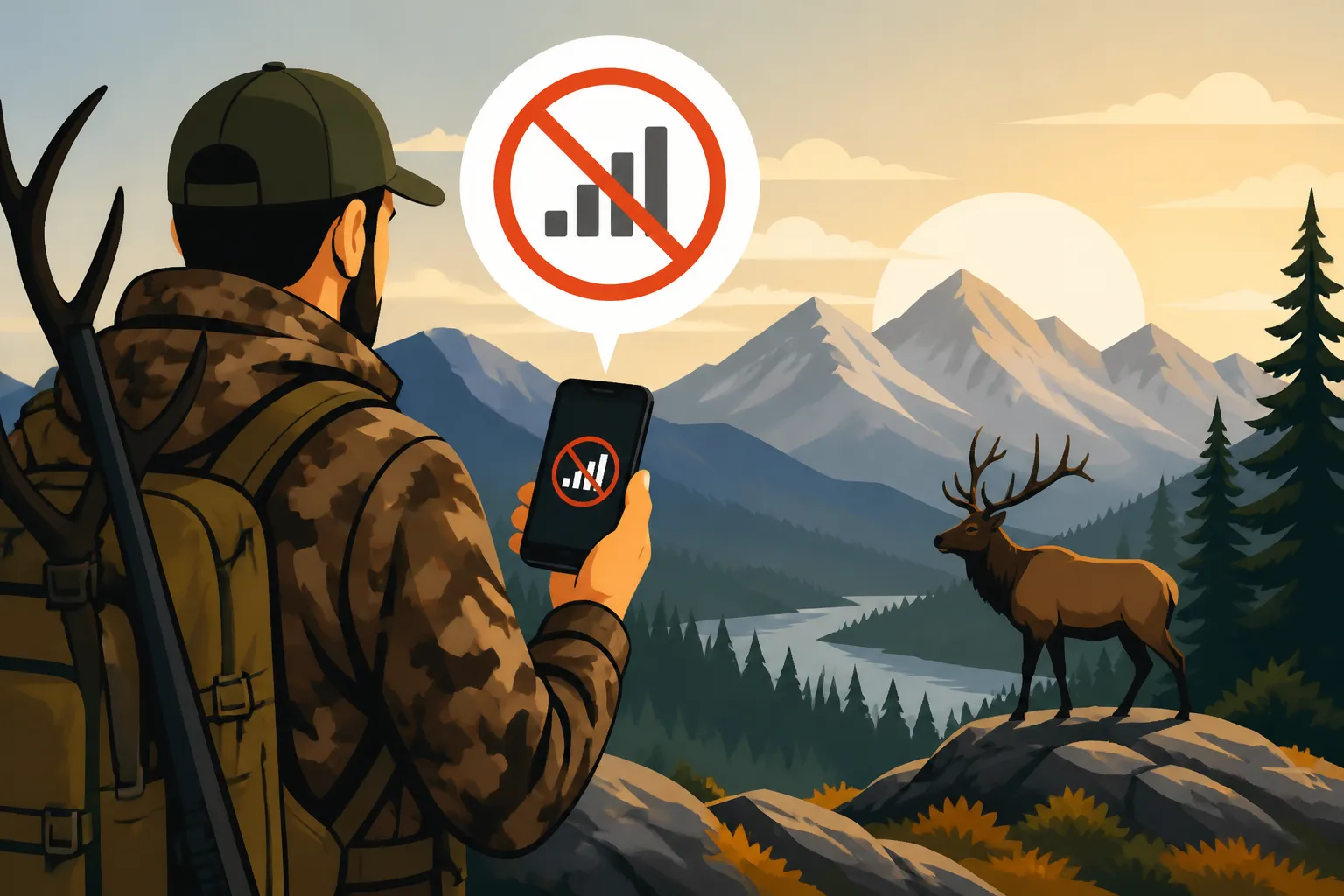
Imagine the rugged terrain of British Columbia: towering mountain ranges, deep river valleys, dense evergreen forests stretching for hundreds of kilometres, and vast, undulating plateaus. Building and maintaining cell towers in such remote, sparsely populated areas simply isn't economically viable for telecommunications companies. There aren't enough residents or daily users to justify the immense cost of infrastructure, power, and maintenance. So, while you might cruise down a major highway like Highway 97 or Highway 16 and have intermittent service, the moment you turn off onto a gravel logging road or head into the mountains, that familiar signal strength indicator will quickly drop to zero bars. It’s a stark reminder that you're truly in the wild, and your phone, at that point, is just a camera and a flashlight.
Think about the sheer scale of the province. Vast tracts of the Cariboo, Omineca, Skeena, and Peace Regions are simply too remote. Even within more populated areas like the Kootenays or parts of Vancouver Island, once you push past the small towns and into the interior valleys or higher elevations, the signal vanishes. It's not just a matter of being far from a tower; the physical landscape itself, with its steep ridges and dense timber, acts as a natural barrier, blocking radio waves. You might find a spot on an exposed ridge that catches a weak signal, but relying on that one specific spot for communication is a recipe for frustration, especially when time is critical.
Where You Might Get a Signal And Where You Definitely Won't
Generally speaking, you'll find the most consistent cell service in and around major population centres and along the main, well-travelled highways. Places like the Okanagan Valley, the Fraser Valley, and the immediate outskirts of cities like Kamloops, Prince George, and Cranbrook will usually have decent coverage. As you venture further afield, the service becomes spotty, often limited to specific valley bottoms or higher elevations with a direct line of sight to a distant tower.
However, the moment you dive into typical hunting grounds, especially those accessed via British Columbia's Logging Road Network, or if you're venturing into true backcountry for something like Backpacking Into British Columbia Sheep Country or Hunting Mountain Goat on British Columbia Rock, assume you'll have no service whatsoever. This includes most of the vast Crown land accessible by forest service roads, the remote river drainages, and pretty much any area more than a few kilometers from a paved highway or a small town. Even areas that seem somewhat accessible on a map, like portions of the Thompson Grasslands or the Cariboo Plateau, can have surprisingly large communication blackouts. Planning your trip requires accepting this reality and building a communication plan around it, rather than hoping for a lucky bar of signal.
The Dangers of Relying on Cell Service Alone
It’s easy to get complacent in our connected world, but in British Columbia’s wilderness, assuming your phone will save you can have serious, even life-threatening, consequences.
Emergency Preparedness Without a Signal
Imagine you're miles into a remote cutblock, focused on Hunting a Recent Cutblock in Its Third Year, when your hunting partner slips on a wet log and breaks an ankle. Or your truck, parked deep down a deactivated logging road, won't start after a cold night. Perhaps you’ve taken a wrong turn on an unfamiliar trail system while hunting a British Columbia management unit and are now hopelessly turned around as darkness approaches. These aren't just hypothetical scenarios; they happen to hunters every season. Without cell service, your primary lifeline to emergency services (911) is completely cut. You can't call for an ambulance, a tow truck, or Search and Rescue.
In such situations, what might be a minor inconvenience in the city transforms into a critical survival situation. A broken ankle means someone has to walk out for help, potentially covering many kilometres over challenging terrain, or you're stuck waiting, hoping someone else stumbles upon you. A dead vehicle battery means you're stranded, possibly in freezing temperatures, far from any shelter or supplies. Getting lost in dense forest or thick fog, especially when Navigating Fog on a British Columbia Coast Hunt, can quickly lead to hypothermia or disorientation without the ability to call for guidance. This is why Emergency Planning in British Columbia's Backcountry is absolutely paramount and must include robust communication alternatives.
Communication Gaps with Family and Friends
Beyond emergencies, the simple inability to connect with loved ones can cause immense anxiety for those back home. When you’ve told your spouse you’ll check in daily, and then three days go by with no word, their imagination can run wild. They might assume the worst and trigger an unnecessary search, diverting valuable resources. Or, conversely, they might think you're simply enjoying the peace and quiet, unaware that you're genuinely in trouble.
Having a communication plan that extends beyond hopeful cell service alleviates this stress for everyone. It means you can send a quick "all clear" message or let them know your ETA has changed. This isn't just about politeness; it's about responsibility and ensuring that unnecessary worry doesn't escalate into a false alarm, which can also burden Search and Rescue teams. A simple daily check-in, even if just a pre-arranged message, provides immense comfort to those waiting at home.
Reliable Communication Alternatives for Your British Columbia Hunt
Since relying on your cell phone is a gamble, especially for big game hunting in British Columbia, it's vital to invest in proven, reliable communication tools. These devices are designed for the very situations where cell service fails.
Satellite Messengers and GPS Devices
These compact devices are rapidly becoming standard kit for any serious backcountry hunter in British Columbia. Brands like Garmin inReach or Zoleo are popular choices, and for good reason. They operate on satellite networks, meaning they work virtually anywhere on earth, regardless of cell tower proximity.
- How They Work: Satellite messengers allow for two-way text messaging with any cell phone number or email address, sending your location coordinates along with your message. Many also have mapping capabilities, allowing you to track your progress, mark waypoints, and navigate, which is especially useful when Hunting British Columbia's Alpine in September. Crucially, they all feature a dedicated SOS button that, when activated, connects you directly to a 24/7 global emergency response centre. This centre coordinates with local Search and Rescue agencies, providing them with your exact location and the details of your emergency, allowing for a targeted and efficient response.
- Pros: Highly reliable global coverage, two-way communication for detailed messages, GPS navigation and tracking, and a critical SOS function. They're relatively affordable compared to satellite phones and have long battery lives.
- Cons: Messages can be slower than text messages (sometimes taking a few minutes to transmit), monthly or annual subscription plans are required, and typing longer messages can be cumbersome on small keypads (though many pair with smartphones for easier typing). They are primarily for text-based communication, not voice calls. For anyone venturing into remote areas, a device for Satellite Communication on a Remote Hunt is arguably the most important piece of gear you can carry.
Satellite Phones: When and Why They Make Sense
While more of an investment, a satellite phone offers the ultimate in global communication reliability. Unlike messengers, they allow for actual voice conversations, just like a regular phone call, but routed through satellites orbiting the Earth.
- When They Make Sense: Satellite phones are a strong consideration for very remote, extended trips where constant, real-time voice communication is paramount, or for groups where coordination is complex. They are often carried by professional guides and outfitters who might be operating deep in the Northern Rockies for a Hunting Stone's Sheep in the Far North trip, or in very isolated areas for Moose Hunting British Columbia's Interior. If you're planning a multi-week expedition into truly undeveloped wilderness, or if quick verbal communication is absolutely critical for your specific hunting scenario or medical needs, a satellite phone could be worth the higher cost.
- Pros: Instantaneous voice communication, direct contact with emergency services if needed, global coverage for reliable contact.
- Cons: Significantly more expensive to buy and operate than satellite messengers, bulky, require line of sight to a satellite, and can have substantial per-minute call charges. For most recreational hunters, a satellite messenger provides more than sufficient capability for emergency and check-in purposes without the hefty price tag.
Two-Way Radios and FRS/GMRS: Short-Range Solutions
For communication within your immediate hunting party, especially when you might spread out a bit in dense timber or across a large drainage, two-way radios (FRS/GMRS handhelds) are invaluable.
- How They Work: These radios operate on short-range frequencies, allowing line-of-sight communication between individuals or small groups. They are perfect for staying in touch when you're glassing different sides of a valley, working a clearcut, or stalking an animal.
- Limitations: Their range is highly dependent on terrain. In dense forest or steep canyons, their effective range can be drastically reduced, sometimes to less than a kilometre. In open country, they might reach several kilometres. They are not a substitute for satellite communication for long-range emergency calls. They simply facilitate group coordination.
- Best Uses: Ideal for keeping tabs on hunting partners, coordinating a stalk, or setting up a retrieve. For example, if you’re Still-Hunting Second Growth for Blacktail with a partner, these radios allow you to whisper updates without spooking game. They’re a cheap and effective tool for internal group communication and an important part of a complete What to Bring on a British Columbia Guided Hunt list, even if an outfitter provides satellite gear.
| Communication Method | Range | Primary Use | Emergency SOS | Cost (Device + Plan) | Best For |
|---|---|---|---|---|---|
| Cell Phone | Limited | Daily calls/texts | Yes (when signal) | Low (existing plan) | Urban areas, main highways |
| Satellite Messenger | Global | Two-way text, GPS | Yes | Moderate | Backcountry check-ins, emergencies, navigation |
| Satellite Phone | Global | Two-way voice | Yes | High | Extended remote expeditions, critical voice needs |
| Two-Way Radio (FRS/GMRS) | Short-range (line-of-sight) | Group comms | No | Low (no plan) | In-group coordination, short-distance safety |
Planning for Communication Blackouts on Your British Columbia Adventure
Given the unreliable nature of cell service, proactive planning is crucial. Don't wait until you're stranded to figure out your communication strategy.
Pre-Trip Communication Strategy
Before you even leave home, establish a clear communication plan with everyone involved, both in your hunting party and your emergency contacts back home.
- Leave a Detailed Itinerary: Provide family or a trusted friend with your exact route, planned hunting areas (including specific British Columbia's Management Units and Regions), vehicle details, and expected return dates. Include names and contact information for everyone in your party. If you don't check in by a predetermined time, they know to initiate a search or contact authorities.
- Establish Check-in Protocols: If you have a satellite messenger, agree on daily check-in times or frequencies. A simple "all good" message at the end of each day can save a lot of worry. Discuss what constitutes an "emergency" message versus a general update.
- Emergency Contact List: Ensure everyone in your party has a physical copy of emergency contacts, including local authorities (Conservation Officer Service RAPP line if applicable), outfitters (if guided), and family members. Don't rely on your phone's contacts list, as your phone might be dead or lost.
- Research Remote Areas: If you're planning on Hunting a British Columbia Wildlife Management Area or a particularly remote section of Crown land, specifically research any known cell signal hot spots (if they exist) but always plan as if there will be none. Consulting with outfitters listed on platforms like BookYourHunt can sometimes provide insights into communication options in their specific territories, though most will tell you to bring your own satellite comms.
Essential Gear Beyond Communication Devices
While communication devices are vital, they're just one piece of a comprehensive backcountry safety kit. You need to be self-sufficient if a communication device fails or if help is delayed.
- Physical Maps and Compass: This cannot be stressed enough. Digital maps on your phone or GPS device are great, but batteries die, and screens can break. Always carry a detailed, waterproof physical map of your hunting area and know how to use it with a compass. Practice navigating with them before your trip. Being able to read a British Columbia MU Map without relying on a screen is a fundamental skill.
- First-Aid Kit: A comprehensive first-aid kit, tailored to the remoteness and duration of your trip, is non-negotiable. Include pain relievers, bandages, antiseptic wipes, blister treatment, and any personal medications. Knowing basic wilderness first aid can be a lifesaver.
- Survival Kit: Even on a "day hunt," carry essential survival items: fire-starting tools, a whistle, emergency shelter (tarp or space blanket), a knife, water purification tablets/filter, and high-energy snacks. You never know when a simple stumble could turn into an unexpected overnight stay.
- Navigation Apps and Chargers: While not a primary tool, offline mapping apps like Avenza or Gaia GPS on your smartphone, pre-loaded with your hunting area, can be incredibly helpful if your phone has power. Carry a robust power bank or solar charger to keep these devices, and your satellite messenger, topped up.
Understanding British Columbia's Terrain and Its Impact
British Columbia's diverse geography plays a huge role in communication reliability. From the dense, wet coastal rainforests to the arid interior mountains and the vast northern wilderness, each presents unique challenges.
- Mountain Ranges: The Coast Mountains, the Rockies, and the various interior ranges create significant "shadows" where signals simply can't penetrate. Even if you're relatively close to a tower, a mountain between you and it will block any signal. Often, gaining elevation on a ridge or saddle might give you a fleeting signal, but these spots are unpredictable.
- Dense Forests: British Columbia is heavily forested. Thick stands of mature timber, especially in coastal old growth or dense spruce and pine forests, absorb and scatter radio waves, severely reducing cell signal penetration. You might be just a few kilometres from a major road, but the forest acts like a Faraday cage.
- Deep Valleys and Canyons: Hunting in river bottoms or steep canyons, like those found in the Fraser Canyon or many Kootenay creek draws, almost guarantees a complete lack of cell service. The steep walls effectively block out any overhead satellite signals or distant cell tower broadcasts. When Hunting British Columbia's Kootenay Valleys or any other low-lying area, always assume you'll be in a communication blackout.
Being prepared means respecting this landscape. It means understanding that the beauty and wildness that draw us to hunt in British Columbia are also the very elements that isolate us from modern conveniences like cell service. Plan accordingly, carry reliable alternatives, and you'll ensure your adventure is not only successful but also safe.
Disclaimer
This article is for general informational purposes only and does not constitute professional advice. Laws, prices and regulations vary by location and change over time. Consult a qualified professional for guidance on your specific situation.