British Columbia’s Management Units and Regions
For many hunters, especially those new to British Columbia or venturing from other provinces and countries, the sheer scale and complexity of this province's hunting regulations can feel like trying to solve a Rubik's Cube blindfolded. Understanding how British Columbia is meticulously carved up into distinct hunting regions and, even more granularly, into specific Management Units (MUs) isn't just helpful – it's absolutely non-negotiable for a legal, safe, and ultimately successful hunting trip. This comprehensive guide is designed to unravel the intricacies of British Columbia's regional and management unit system, equipping you with the essential knowledge to confidently navigate the regulations and strategically plan your next great adventure in this incredible wild landscape.
Understanding the Lay of the Land: Why British Columbia is Unique
British Columbia isn't just a big province; it's an entire world unto itself when it comes to geology, climate, and wildlife. This incredible natural diversity is precisely why the hunting regulations are so detailed and localized, structured around a system of regions and management units. Without appreciating this foundational aspect, the regulatory framework can seem needlessly complicated, but once you understand the "why," the "how" becomes much clearer.
A Vast and Diverse Landscape
Imagine a place where temperate rainforests meet arid grasslands, where towering coastal mountains give way to expansive interior plateaus, and where boreal forests stretch into subarctic alpine tundra. That's British Columbia. This province encompasses an astonishing array of ecosystems, each supporting different species in varying densities and with unique challenges for both wildlife management and hunting. On the coast, you'll find dense, wet forests teeming with black-tailed deer and Roosevelt elk, requiring stealthy still-hunting through thick timber. Move to the interior, and the landscape opens up to dry sagebrush flats and pine forests, ideal for glassing for mule deer. Further north, vast wilderness areas hold moose and caribou (where seasons are open), demanding robust logistics and true backcountry skills.
This incredible geographic and ecological diversity directly dictates game distribution and hunting opportunities. A species like black bears, for instance, are found across virtually the entire province, but their behaviour, diet, and even physical size can vary significantly between the coast, the interior, and the north. These environmental differences mean that a "one-size-fits-all" approach to wildlife management simply wouldn't work, necessitating a finely tuned system of localized rules. It's this very diversity that makes hunting in British Columbia so rewarding, yet also demands a deep understanding of where and how specific animals thrive.
The Role of Management Units in Conservation
Management Units (MUs) are far more than arbitrary lines drawn on a map; they are the fundamental building blocks of British Columbia's wildlife management and conservation strategy. These units are specifically designed to allow for localized population monitoring, habitat assessment, and precise regulation setting. Think of them as individual puzzle pieces that, when combined, form the larger picture of provincial wildlife health. Biologists use MU data to track trends in specific game populations, such as mule deer numbers in the Okanagan or moose herds in the Omineca, allowing them to adjust bag limits, season dates, and hunting methods in response to local conditions.
For a hunter, this means that regulations can change dramatically as you cross an MU boundary, even if the landscape looks largely the same to the untrained eye. One MU might have a general open season for a particular species, while the adjacent one might be closed entirely or only open for a very limited period, perhaps under a Limited Entry Hunting (LEH) draw. This precision management ensures that hunting pressure is distributed appropriately and that harvests are sustainable at a local level, preventing overharvest in one area while potentially allowing for increased opportunity in another. It's a system built on science, designed to protect the resource for future generations, and as hunters, it's our responsibility to understand and respect its intricacies.
The Nine Hunting Regions: A High-Level Overview
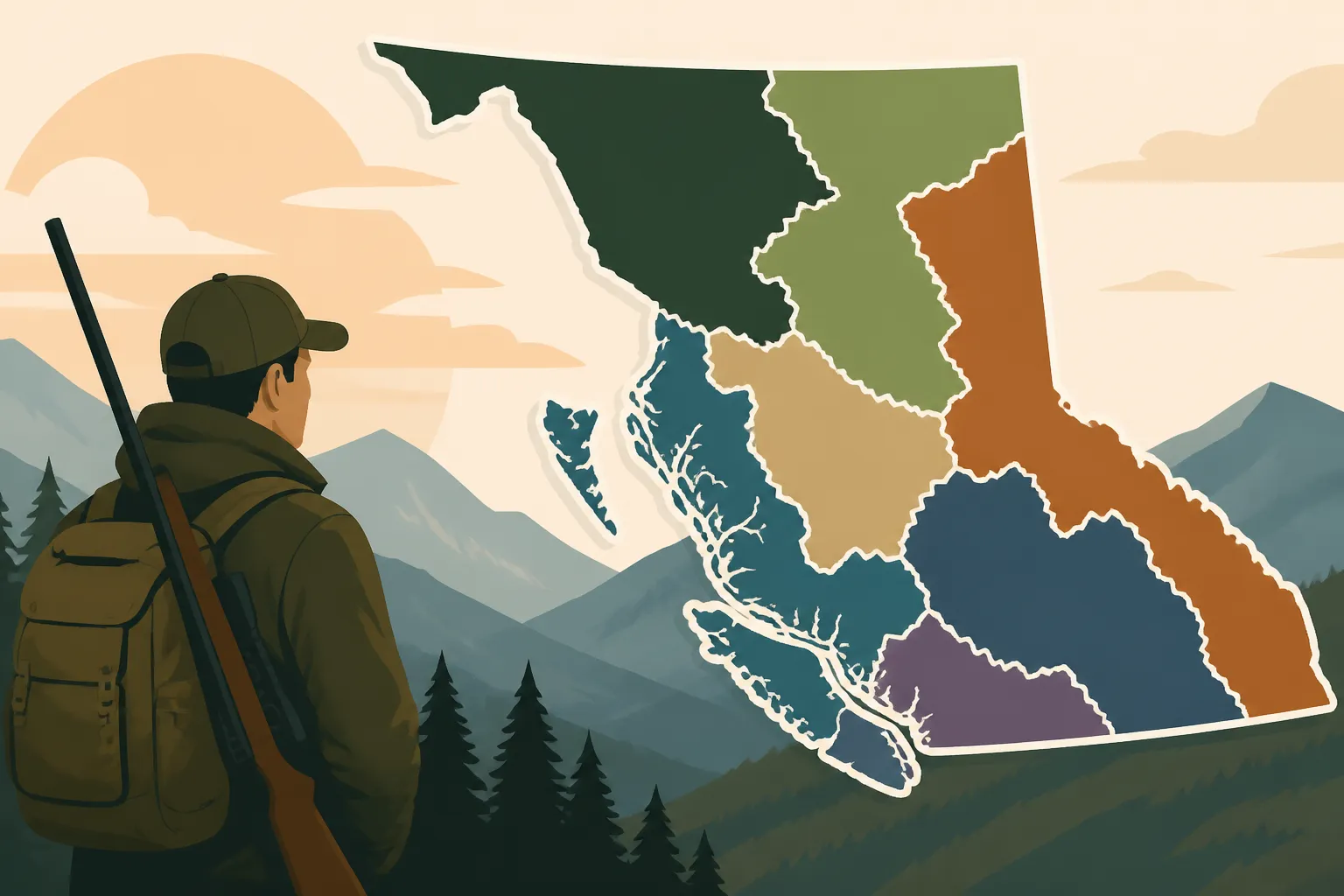
To make sense of British Columbia's vast landscape and its myriad Management Units, the province is first divided into nine larger administrative areas known as Hunting Regions. These regions provide a useful high-level framework, grouping together MUs that share similar geographic, climatic, and wildlife characteristics. While the detailed regulations are found at the MU level, understanding the general profile of each region is your first step in narrowing down potential hunting grounds.
Defining the Regional Boundaries
British Columbia's nine hunting regions act as broad administrative zones, each encompassing numerous Management Units. These regions typically follow major geographic features or political boundaries, creating distinct areas for management purposes. Here's a quick rundown of the regions, numbered 1 through 8, with the Peace being a sub-region of the Omineca in regulatory texts:
- Region 1 – Vancouver Island: Primarily Vancouver Island and some smaller surrounding islands.
- Region 2 – Lower Mainland: The densely populated area around Vancouver, extending into some mountainous and coastal areas.
- Region 3 – Thompson: The south-central interior, characterized by dry valleys, grasslands, and forested plateaus around Kamloops.
- Region 4 – Kootenay: Southeastern BC, known for its rugged Rocky Mountains, Purcell Mountains, and extensive valleys.
- Region 5 – Cariboo: The central interior plateau, a vast area of forests, lakes, and rivers.
- Region 6 – Skeena: Northwestern BC, a remote and mountainous region extending to the coast.
- Region 7A – Omineca: The north-central interior, a large, wild area of boreal forest and wetlands.
- Region 7B – Peace: Northeastern BC, including agricultural lands, boreal forest, and the foothills of the Northern Rockies.
- Region 8 – Okanagan: The south-central interior, distinct from the Thompson, known for its hot, dry climate, lakes, and sagebrush benches.
While these regions provide a general framework, always remember that the specific, legally binding regulations are found at the Management Unit level. A quick glance at a provincial hunting map or the start of the regional section in the British Columbia's Two-Year Regulations Synopsis will clearly show these boundaries, helping you orient yourself before diving into the granular details.
Characterizing Each Region's Hunting Opportunities
Each of British Columbia's nine hunting regions offers a unique set of challenges and rewards, largely shaped by its distinct geography and ecosystems. Knowing what to expect from each can help you quickly home in on areas that align with your hunting goals and preferred species.
Region 1 – Vancouver Island: This is the realm of the coastal blacktail deer and the mighty Roosevelt elk. Expect dense, wet rainforests, challenging terrain, and a strong emphasis on still-hunting or methodical glassing in clearcuts. Black bears are also plentiful. The access here often involves private forest lands, requiring careful research into Private Forest Land Access in British Columbia.
Region 2 – Lower Mainland: Given its proximity to major population centers, hunting opportunities here are more limited and often require significant effort to find suitable public access. Blacktail deer are the primary big game species, usually found in the mountainous fringes or specific coastal areas. Hunters often have to work harder to escape pressure.
Region 3 – Thompson: A diverse region featuring dry grasslands, open ponderosa pine forests, and higher elevation plateaus. This is prime habitat for mule deer, with good populations of whitetail deer in certain river valleys. Limited opportunities exist for moose and elk. The terrain can be quite open, favoring spot-and-stalk tactics.
Region 4 – Kootenay: A hunter's paradise, the Kootenays boast robust populations of Rocky Mountain elk, whitetail deer, mule deer, moose, mountain sheep, and mountain goats, alongside black bears. The landscape is rugged, dominated by mountain ranges and deep river valleys, offering classic mountain hunting experiences.
Region 5 – Cariboo: This region is synonymous with moose hunting in British Columbia's interior, featuring vast tracts of mixed forests, numerous lakes, and wetlands. Mule deer and whitetail deer are also common, as are black bears. Access is often via extensive networks of logging roads, making it a popular choice for those looking for a diverse hunt.
Region 6 – Skeena: Remote and wild, the Skeena region is known for its incredible mountain goat and moose hunting. Coastal areas also hold impressive black bears and coastal blacktail deer. It's a vast region, characterized by rugged mountains, braided rivers, and deep wilderness, often requiring significant logistical planning and potentially fly-in or jet boat access.
Region 7A – Omineca: Part of the larger northern interior, the Omineca offers vast, unpressured landscapes. Moose hunting is a major draw here, along with healthy populations of black bears, whitetail, and mule deer. It's a region for the adventurous hunter, willing to travel deep into the bush.
Region 7B – Peace: Nestled against the Alberta border, the Peace region blends agricultural fringes with extensive boreal forests and the foothills of the Northern Rockies. It's excellent moose and whitetail country, with growing populations of elk and abundant black bears. The mixture of open fields and timber can provide unique hunting scenarios.
Region 8 – Okanagan: Similar to the Thompson but with its own distinct flavour, the Okanagan is characterized by dry, sunny valleys, sagebrush benches, and forested mountains. It’s excellent mule deer country, with a good presence of whitetail deer and black bears. Elk and moose opportunities are more limited and often require LEH authorizations.
| Region No. | Region Name | Primary Terrain Characteristics | Prominent Big Game Species | Common Hunting Style |
|---|---|---|---|---|
| 1 | Vancouver Island | Dense temperate rainforest, rugged mountains, coastal | Black-tailed Deer, Roosevelt Elk, Black Bear | Still-hunting, glassing clearcuts |
| 2 | Lower Mainland | Urban interface, coastal mountains, inlets | Black-tailed Deer, some Black Bear | Backcountry hiking, limited access areas |
| 3 | Thompson | Dry valleys, grasslands, ponderosa pine forests, plateaus | Mule Deer, White-tailed Deer, Black Bear | Spot-and-stalk, still-hunting timber |
| 4 | Kootenay | Rugged Rocky & Purcell Mountains, deep valleys | Rocky Mountain Elk, White-tailed Deer, Mule Deer, Moose, Sheep, Goat, Black Bear | Mountain hunting, glassing, calling |
| 5 | Cariboo | Central interior plateau, mixed forest, lakes, wetlands | Moose, Mule Deer, White-tailed Deer, Black Bear | Road hunting, still-hunting, calling |
| 6 | Skeena | Remote, rugged mountains, braided rivers, coastal rainforest | Moose, Mountain Goat, Black Bear, Coastal Black-tailed Deer | Backcountry, fly-in, jet boat, intense glassing |
| 7A | Omineca | North-central interior, boreal forest, extensive wetlands | Moose, Black Bear, White-tailed Deer, Mule Deer | Remote access, calling, still-hunting dense cover |
| 7B | Peace | Agricultural lands, boreal forest, Northern Rockies foothills | Moose, White-tailed Deer, Elk, Black Bear | Mixed land hunting, glassing fields, timber stalking |
| 8 | Okanagan | Dry valleys, sagebrush benches, forested mountains | Mule Deer, White-tailed Deer, Black Bear | Spot-and-stalk, still-hunting, glassing |
This table offers a quick snapshot, but remember that within each region, the specific opportunities are ultimately defined by the Management Units.
Diving Deeper: Management Units Explained
While regions provide the broad strokes, Management Units (MUs) are where the rubber truly meets the road in British Columbia's hunting regulations. These smaller, precisely delineated areas are the core of species-specific and season-specific rules, and understanding them is paramount for any hunter planning to take to the field.
The Building Blocks of Regulation
Management Units are the granular geographic divisions within each hunting region, acting as the fundamental building blocks upon which all specific hunting regulations are constructed. An MU isn't just a random polygon; its boundaries are often drawn to follow natural features like major rivers, prominent mountain ridges, deep valleys, or even established infrastructure such as highways and main forest service roads. This design helps biologists and enforcement officers apply regulations consistently to distinct wildlife populations and their habitats.
Every single detail of your hunt, from the precise dates a season opens and closes, to the maximum number of animals you can harvest (bag limits), to specific antler point restrictions like British Columbia's Four-Point Antler Restriction, and even whether a hunt is open to all or requires a draw, is explicitly defined at the MU level. You might find two adjacent MUs that look almost identical on the ground, yet their regulations for a particular species could be vastly different. This micro-management allows for a highly adaptive system that can respond quickly to localized population changes, habitat impacts from wildfires or logging, or localized hunting pressure. Without pinpointing your exact MU, you simply cannot be sure you are hunting legally.
Understanding MU Designations and Nomenclature
Deciphering the MU numbering system is the first critical step to understanding the regulations. British Columbia's MUs are designated by a two-part code, like "3-01" or "7B-12." The first part of the code (the single digit or "7B") indicates the larger Hunting Region it belongs to, while the second part (the two-digit number, e.g., "01" or "12") uniquely identifies that specific Management Unit within its region. So, 3-01 would be MU 01 within Region 3 (Thompson), and 7B-12 would be MU 12 within Region 7B (Peace).
This systematic nomenclature is crucial because all regulations in the synopsis are listed by this code. For example, if you're looking for mule deer regulations in the Thompson region, you'd navigate to Region 3 in the synopsis, then scan through the MUs (3-01, 3-02, 3-03, etc.) to find the specific rules for the unit you plan to hunt. Understanding this code helps you quickly find the relevant information, rather than sifting through pages of general provincial rules. It’s important to remember that while a region might have general characteristics, the actual opportunities and restrictions are entirely defined by these MU numbers.
General Open Season Versus Limited Entry
One of the most fundamental distinctions you'll encounter at the Management Unit level is whether a hunt is designated as a General Open Season (GOS) or a Limited Entry Hunting (LEH) opportunity. This difference dictates not only how you obtain a tag but also the level of competition you might face in the field.
General Open Season (GOS): When a season is listed as "General Open Season" for a specific species in a particular MU, it means that any resident hunter holding a valid hunting licence and the appropriate species tag can hunt that animal during the specified dates. These are typically the most accessible hunting opportunities and often encompass longer seasons. For instance, many black bear seasons are GOS across numerous MUs, or certain deer seasons might be GOS for antlered bucks. While GOS offers flexibility, it can also mean higher hunting pressure in easily accessible MUs, especially during peak times like the Hunting British Columbia's October Rifle Opener.
Limited Entry Hunting (LEH): In contrast, Limited Entry Hunting (LEH) opportunities are precisely what they sound like – limited. For these hunts, you cannot simply buy a tag; you must apply to a provincial draw system and be one of the fortunate few to be authorized an LEH tag for a specific species, sex, MU, and season. LEH hunts are implemented for various conservation reasons: to manage specific populations, protect certain age classes or sexes of animals, distribute hunting pressure more evenly, or provide high-quality hunting experiences for species that are sensitive to overharvest. Species like moose, mountain sheep, mountain goats, and often specific elk or quality deer hunts are predominantly managed through LEH. Understanding British Columbia's Limited Entry Hunting Draws and how to apply is critical if you're eyeing one of these highly sought-after tags. You'll need to research the odds and apply well in advance, often a year or more, to have a chance at Hunting a Limited Entry Hunting Zone.
Navigating the System: Tools and Resources for Hunters
With such a detailed system of regions and Management Units, effectively navigating British Columbia's hunting landscape requires more than just enthusiasm; it demands the right tools and a commitment to staying informed. Fortunately, a robust suite of resources is available to help hunters plan and execute their trips legally and successfully.
The British Columbia Hunting and Trapping Regulations Synopsis
This cannot be stressed enough: the official British Columbia Hunting and Trapping Regulations Synopsis is your bible. It is the single, authoritative, and legally binding source for all hunting regulations in the province. Simply put, if it's not in the synopsis, it's not a regulation you can rely on, and any information gleaned from friends, forums, or even well-meaning guides must always be cross-referenced with this document. Ignorance of the regulations is never a valid defense in the eyes of the law.
The synopsis is structured logically, starting with general provincial rules (licencing, compulsory reporting, firearm regulations, etc.), then moving into detailed sections for each of the nine hunting regions. Within each regional section, you'll find a breakdown by Management Unit, listing the specific open seasons, bag limits, antler restrictions, and LEH opportunities for each species. It can be a dense read, but taking the time to thoroughly review the sections relevant to your target region, MUs, and species is absolutely essential. Always ensure you are consulting the most current version, as regulations are updated every two years, and occasionally, in-season changes may occur. You can easily find where these changes are located by checking Where the Two-Year Synopsis Changed or looking for British Columbia Rule Changes This Cycle.
Mapping Tools and Technology
In today's hunting world, maps are no longer just paper sheets; they are dynamic, multi-layered digital platforms that revolutionize how we understand and interact with hunting grounds. For British Columbia, mapping tools are indispensable for overlaying MU boundaries with topography, access roads, private land, and wilderness areas.
The province offers its own online mapping services, such as iMapBC and resources through FrontCounter BC, which allow you to view MU boundaries. However, many hunters find commercial mapping applications to be even more user-friendly and feature-rich. Platforms like OnX Hunt and "GoHunt" provide incredibly detailed base maps that can be layered with critical information such as MU lines, private land ownership, forest service roads (including deactivated ones), and even satellite imagery. This technology allows you to pinpoint your exact location in the field relative to an MU boundary, preventing costly mistakes. Imagine being able to see in real-time if you're about to step from a General Open Season MU into an LEH-only unit.
These digital tools are invaluable for Scouting a British Columbia Management Unit Online before you even leave home. You can identify potential access points, note terrain features, locate water sources, and plan your routes, all from your computer or phone. Furthermore, many of these apps allow for offline use, meaning you can download maps before you head into areas without cell service, ensuring you always know where you stand. "GoHunt" (first mention) is particularly useful for visualizing draw odds alongside mapping features, helping you make informed decisions when applying for LEH.
Connecting with Local Knowledge and Conservation
While regulations and maps are crucial, don't underestimate the power of local knowledge. Connecting with other hunters, especially through local rod and gun clubs, can provide invaluable insights into specific MUs. These clubs are often deeply involved in local conservation efforts and have members who possess decades of experience hunting in particular areas. They can offer practical advice on everything from typical game movements to the best access points, historical hunting pressure, and current road conditions.
Practical Applications: Planning Your Hunt by Region and MU
Planning a hunt in British Columbia is an exciting, multi-faceted process. It involves more than just picking a species; it demands a deep dive into the specific regions and Management Units that will offer you the best chance of success, legally and ethically.
Researching Your Target Species and MU
The journey to a successful hunt in British Columbia truly begins with meticulous research. Don't just pick an animal; understand its behaviour, habitat, and the specific regulations tied to it. If your heart is set on Mule Deer Hunting in British Columbia, your first step is to identify regions known for healthy mule deer populations, like the Thompson, Okanagan, Cariboo, or Kootenays. Once you've narrowed down a region, you then need to scrutinize the individual MUs within that region.
This is where the nuances appear. For each potential MU, consult the current Regulations Synopsis. Are there general open seasons for mule deer? What are the dates? Are there antler point restrictions, such as the crucial British Columbia's Four-Point Antler Restriction, that apply? If it’s an LEH-only hunt, what are the draw odds, and when do British Columbia's Limited Entry Hunting Draws open and close? This detailed cross-referencing of species, region, and MU regulations is paramount. You might find that one MU next to a highway has a short GOS, while a more remote MU deeper in the mountains offers a longer season or higher success rates via LEH. Platforms like "GoHunt" (third mention) allow you to filter by species, region, and MU, streamlining this initial research phase.
The Importance of Access and Terrain
Even the most promising MU with fantastic regulations is useless if you can't get to it. British Columbia's vastness means that while a significant portion is British Columbia's Crown Land Access, much of it can be incredibly challenging to reach. Don't just look at the lines on a map; zoom in and understand the physical reality of the terrain and available access.
Consider how you plan to get into your chosen MU. Will you rely on Hunting British Columbia's Logging Road Network, which can offer extensive access but may also lead to deactivated or overgrown routes? Are you comfortable with a long hike into the backcountry? Perhaps a boat or even a float plane is required for truly remote areas. For instance, the coastal regions might demand boat-based access, while certain interior ranges are only truly accessible via horseback. Understanding the elevation changes, the density of the forest, and the presence of natural barriers like rivers or steep canyons will dictate your hunting style, the gear you'll need, and your physical preparation. A unit that looks flat on a regional map might actually be deeply incised by drainages when viewed on a detailed topographic map, completely changing your approach.
Crafting Your Hunt Plan
Once you've done your homework on regulations, species, and access, it's time to synthesize this information into a concrete hunt plan. This is where you combine the legal framework of the MUs with the practical realities of the landscape. Start by identifying your primary target MUs and then develop backup plans. What if your first choice is too crowded on opening weekend? What if a key access road is washed out or gated due to active logging? Having alternative MUs in mind, perhaps slightly further afield or requiring a different access method, can save a hunt from being a bust.
Your plan should also incorporate crucial safety considerations. Many British Columbia MUs are truly remote, with no cell service and significant distances to medical aid. Emergency Planning in British Columbia's Backcountry is not an option; it's a necessity. This includes carrying satellite communication devices, a comprehensive first-aid kit, and letting trusted contacts know your exact itinerary and expected return time. Use your mapping tools, especially those that allow for waypoint marking, to note potential camp spots, water sources, natural game funnels, and emergency egress routes. Whether you're targeting Moose Hunting British Columbia's Interior or simply trying to find a good spot for grouse, a well-thought-out plan, flexible to changing conditions, is the cornerstone of a successful and responsible hunting trip.
Common Challenges and How to Overcome Them
Even with the best preparation, hunting in British Columbia can present unique challenges, many of which stem directly from the complex interplay of vast landscapes and detailed regulations. Knowing these potential pitfalls beforehand can help you develop strategies to overcome them and ensure a smooth, enjoyable hunt.
Navigating Constantly Evolving Regulations
One of the most persistent challenges for hunters in British Columbia is the dynamic nature of the hunting and trapping regulations. While the Synopsis is published every two years, it's not set in stone for the entire two-year period. Regulations can and do change mid-cycle, sometimes in response to population shifts, new scientific data, or emerging conservation concerns. This means that information you relied on last year, or even a few months ago, might no longer be current.
The solution is diligence and proactive checking. Before every hunt, and ideally even during the planning stages, make it a habit to check the provincial government's official hunting regulations website. Look for any in-season updates, regulatory changes, or corrections that might have been issued. The province typically publishes "Updates" or "Corrigendum" documents that highlight any changes made after the main synopsis was printed. Knowing Where the Two-Year Synopsis Changed or keeping an eye out for British Columbia Rule Changes This Cycle ensures you're always operating under the most current legal framework, protecting yourself from inadvertent violations. Consider bookmarking the relevant pages or subscribing to official government notifications.
Misinterpreting Maps and Boundaries
Perhaps one of the most common and potentially costly mistakes a hunter can make is misinterpreting Management Unit boundaries on a map. This is especially true in areas with complex terrain, where natural features that define an MU might be subtle, or near the interface of Crown land and private property. A single misplaced step could mean the difference between a legal harvest and a serious infraction.
To avoid this, always cross-reference multiple map sources if you have any doubt. Start with the official provincial mapping tools (i.e., iMapBC) to get the definitive boundaries, and then overlay them with high-resolution satellite imagery or topographic maps from commercial apps like OnX Hunt or "GoHunt" (fourth mention). These advanced tools allow you to zoom in closely, see your precise GPS location in real-time relative to the MU lines, and even identify subtle features that delineate boundaries on the ground. Never rely solely on a single, outdated paper map. Furthermore, pay close attention to the legends on any map, as lines indicating MU boundaries can sometimes be easily confused with other features like trails or roads. If you're on the boundary line, always err on the side of caution and verify your position before making a move.
Overcoming Access Limitations
Many of British Columbia's most productive or remote Management Units can present significant access challenges. These might include active logging operations leading to gated roads, deactivation of old forest service roads (making them impassable for vehicles), or large tracts of private land that block entry to public Crown land beyond. It's frustrating to plan a hunt only to find your access route suddenly cut off.
To mitigate this, thorough pre-scouting, both online and by physically driving routes if possible, is invaluable. Online resources often provide updates on road conditions, closures, or active logging areas. Learn about Finding Open Forest Roads in British Columbia and research the rules surrounding Private Forest Land Access in British Columbia, as some private timber companies may offer permits or have specific access windows. Be prepared to adapt: if vehicle access is cut off, consider parking further out and packing in on foot or with a mountain bike. For truly remote MUs, look into alternative access methods like jet boating on British Columbia rivers or flying into a remote camp. Often, the best hunting is found beyond the easiest access, so embracing the challenge of a longer hike or a more robust travel method can unlock incredible opportunities away from the crowds.
Staying Informed: Why Regulations and Maps Matter
Beyond the practicalities of planning a hunt, a deep understanding of British Columbia's regions and Management Units, coupled with meticulous attention to regulations and mapping, is critical for both legal compliance and ethical participation in wildlife conservation.
The Legal Ramifications of Non-Compliance
Let's be blunt: hunting in British Columbia is a privilege, not a right, and that privilege comes with significant responsibilities. Ignorance of the law is never an acceptable excuse for a hunting violation. Hunting in the wrong Management Unit, for the wrong species, outside legal season dates, or exceeding bag limits can lead to severe consequences. These range from substantial fines that can quickly run into the thousands of dollars, to the suspension or even permanent revocation of your hunting licence, and the immediate seizure of your harvested animal, firearms, and other equipment.
Beyond the immediate legal penalties, there's the damage to your reputation as a responsible hunter and to the public perception of hunting as a whole. Every hunter has a duty to uphold the highest ethical standards. Understanding the precise regulations for your chosen MU is not just about avoiding trouble; it's about respecting the resource and the management efforts in place. The consequences of even an accidental infraction can be life-altering for your hunting career. This is why it's so important to fully grasp the information contained in the Synopsis, including sections outlining Penalties for a Hunting Violation for various offences.
Contributing to Sustainable Wildlife Management
When you, as a hunter, meticulously adhere to the regulations for a specific Management Unit, you are directly contributing to the broader goal of sustainable wildlife management in British Columbia. Every season date, every bag limit, every antler restriction is based on biological data and designed to ensure healthy, viable wildlife populations for the long term. These rules are not arbitrary; they are scientific tools to manage harvest levels, protect breeding populations, and ensure the ecological balance of an area.
Furthermore, your participation in mandatory reporting is a cornerstone of this system. British Columbia's Compulsory Reporting Rules for certain species (like moose) and harvest reporting for all others provide wildlife biologists with invaluable data. This information, collected at the MU level, allows them to track population trends, assess the effectiveness of current regulations, and make informed decisions about future management strategies. By being a diligent, informed, and compliant hunter, you are an active partner in conservation, directly influencing the health and future of British Columbia's incredible wildlife resources.
Future-Proofing Your Hunting Adventures
The hunting landscape in British Columbia is constantly evolving, influenced by everything from climate change and wildfire impacts to shifting human populations and land use policies. By becoming proficient in navigating the region and Management Unit system, you are not just preparing for your next hunt; you are future-proofing your ability to hunt in this province for years to come.
A deep understanding of how to interpret regulations, read maps, and adapt to changing access conditions means you'll be better equipped to adjust your plans as new challenges or opportunities arise. You'll be able to quickly assess new MUs, understand how a proposed regulatory change might affect your hunting grounds, and effectively utilize emerging technologies. Advanced mapping platforms, particularly those like "GoHunt" (fifth mention), which integrate real-time data, community input, and regulatory overlays, are powerful allies in this ongoing quest for knowledge and adaptability. The more you engage with the details of British Columbia's management system, the more confident, successful, and ultimately, responsible a hunter you will become, ensuring that your adventures in these wild lands continue for a lifetime.
Disclaimer
The information provided in this guide is for general informational purposes only and is not a substitute for the official British Columbia Hunting and Trapping Regulations Synopsis. Hunters are legally responsible for consulting and adhering to the most current provincial regulations, available through the BC government website. Regulations can change at any time, and it is the hunter's sole responsibility to stay informed of all applicable laws and rules.