Colour Phases in British Columbia Black Bears
Oh, the classic black bear! You'd think the name says it all, wouldn't you? But if you've spent any time hunting in British Columbia, you know that "black bear" is often more of a species name than a colour description. It can be incredibly frustrating, standing there with your binoculars, trying to figure out if that beautiful cinnamon-coloured animal is truly a black bear or something else entirely, especially when the stakes are so high for legal and ethical hunting. This guide is here to walk you through the amazing spectrum of black bear colours you'll encounter in BC, offering practical tips for identification and, most importantly, how to differentiate them from grizzlies.
More Than Just Black: The Spectrum of Black Bear Colours in BC
When you hear "black bear," the image that usually springs to mind is a sleek, dark animal. And while pure black is certainly the most common colour phase, British Columbia's black bears (scientific name Ursus americanus) are far from monochromatic. Our province is a mosaic of habitats, and with that comes an incredible diversity in the appearance of these fascinating creatures. It's truly a sight to behold, from the darkest ebony to a pale, almost white, hue.
Why the Variety? Genetics and Habitat
The primary driver behind the kaleidoscope of black bear colours is simple: genetics. Just like humans have different hair and eye colours, bears have genes that dictate the pigment in their fur. A single litter of cubs, born to the same sow, can exhibit a range of colours, from black to brown to blonde, illustrating the genetic lottery at play. These colour genes are passed down through generations, leading to regional variations in the prevalence of certain phases. For instance, while black bears are found across the province, you might see more browns or blondes in specific interior regions, whereas the coastal rainforests tend to produce a higher percentage of the classic black phase. It’s all still the same species, though; a brown black bear is no different genetically from a black black bear beyond that specific colour gene.
While genetics are the core, habitat can play a subtle, secondary role in how we perceive these colours. For instance, bears in arid, sun-drenched regions might have fur that appears lighter due to sun bleaching over time, or their diet might influence the sheen and health of their coat. A bear gorging on salmon, as often happens in coastal regions, might have a richer, shinier coat than one primarily foraging on berries and roots in a drier interior setting. These environmental factors don't change the underlying genetic colour, but they can certainly influence its presentation, making field identification even more of a delightful challenge.
Common Colour Phases You'll Encounter
Let's break down the most common colour phases you're likely to spot while hunting in British Columbia. Understanding these variations is the first step in successful identification.
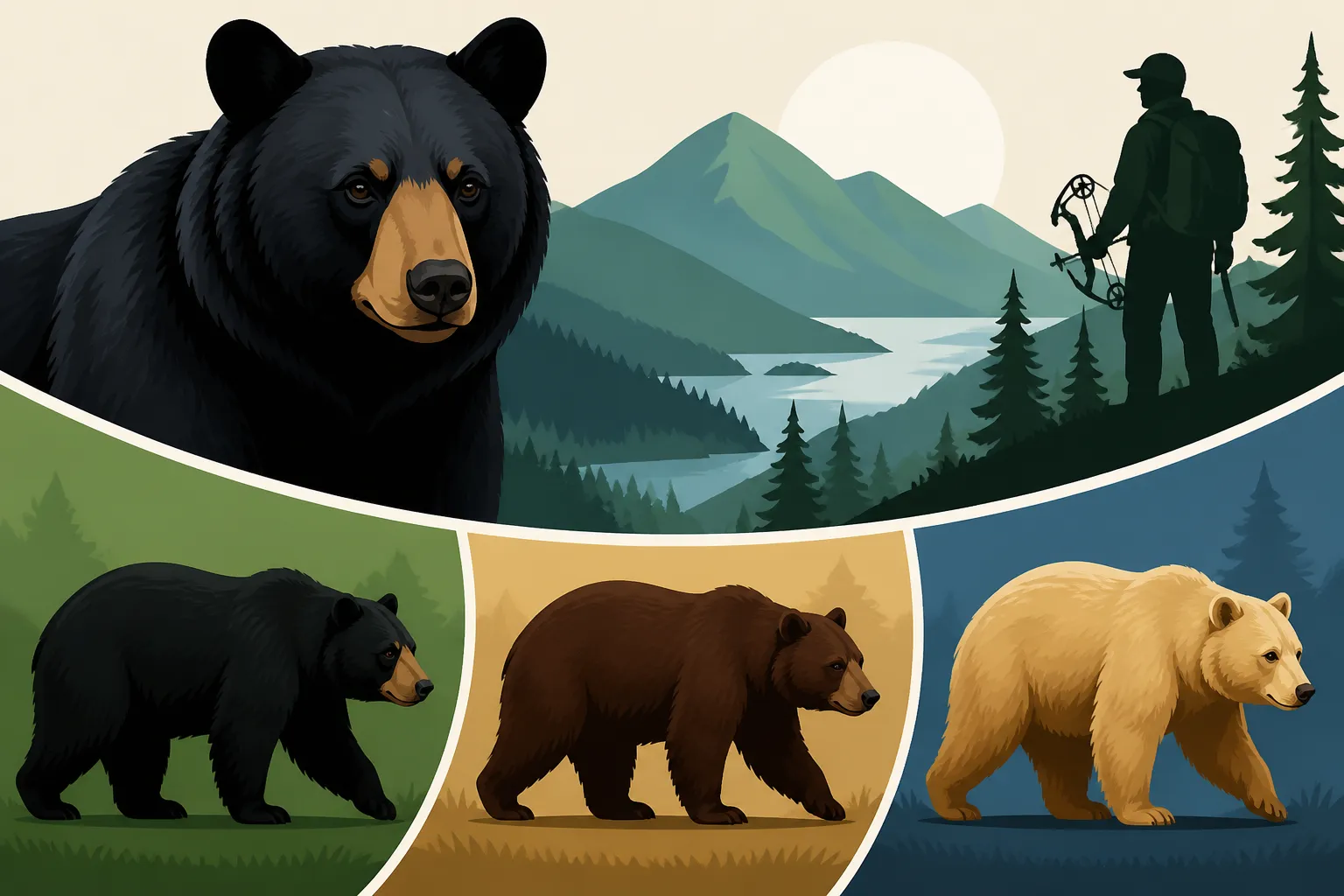
- Classic Black: This is, as the name suggests, the most common. These bears have uniformly dark, often glossy, black fur. They might have a small white chest blaze, which is a common, though not universal, marking on black bears regardless of their primary colour. You'll find these everywhere, from the deep coastal forests to the interior mountains.
- Chocolate/Dark Brown: These bears range from a very dark, rich chocolate brown to a medium brown. In certain lighting, a dark brown bear can easily be mistaken for black, so paying close attention to the undertones in good light is key. They often have lighter muzzle hairs and sometimes lighter fur on their flanks or belly.
- Cinnamon: A truly beautiful phase, cinnamon bears are a reddish-brown, often quite vibrant, resembling the spice they're named after. They can vary in intensity, from a deep rust to a lighter, almost copper hue. These are particularly common in parts of the interior plateau and the Rocky Mountain regions.
- Blonde/Yellow: These are perhaps the most striking and often the most confusing. Blonde bears can range from a very pale straw yellow to a creamy white. When you see one, your first thought might not even be "bear," let alone "black bear," which is where the real identification challenge comes in. These lighter phases are less common than black or brown but are found throughout the province.
Beyond these common phases, British Columbia is also home to some truly unique variations. There are occasional reports of "blue" or "glacier" bears, which have a silvery-blue coat, primarily found in the far northern coastal areas. And, of course, there's the iconic Kermode bear, or "Spirit Bear," a subspecies of black bear with naturally white fur, found predominantly on Princess Royal and Gribbell Islands. It's a truly spectacular animal, but it's crucial to remember that The Kermode Bear and Why It Is Protected. Its unique genetic mutation makes it an animal that is strictly off-limits for hunting. Seeing any of these rare phases is a truly special moment in the wilderness.
Identifying Colour Phases: Practical Tips for Hunters
Distinguishing between these colour phases, and more importantly, separating them from other bear species, can be tricky. It requires patience, good equipment, and a keen eye. As hunters, it's our responsibility to make positive identification before pulling the trigger, not just for ethical reasons but also for strict legal compliance. A moment of doubt can lead to a lifetime of regret, so let's explore how to sharpen your identification skills.
Lighting and Environmental Factors
One of the biggest culprits in misidentification is often not the bear itself, but the conditions under which you're viewing it. What looks like a deep, dark black bear in the shadows of a timber stand at dawn might reveal itself to be a rich chocolate brown once the sun hits it. Conversely, a light-coloured bear in bright, direct sunlight might appear washed out and harder to discern. The time of day significantly impacts how light reflects off fur. Early morning and late evening often cast long shadows and offer softer light, which can mute or intensify colours in unpredictable ways. Midday sun, while bright, can sometimes create glare or flatten perceived colours.
The surrounding environment also plays a huge role. A blonde bear against a backdrop of sun-baked grasses or bleached logs might blend in almost perfectly, appearing less distinct than if it were moving across a fresh green clearcut. Wet fur, whether from rain or a swim in a lake, tends to appear darker and slicker, often making lighter bears look much darker than they truly are. As the fur dries, its true colour will emerge. Snow cover, autumn leaves, and dense forest can all trick the eye, making it essential to observe the animal as it moves through different environments and lighting conditions if possible. Always consider the context, because your eyes can play tricks on you out there in the wild.
Binoculars and Spotting Scopes: Your Best Friends
Seriously, folks, your optics are your absolute best friends in the field when it comes to bear identification. Don't skimp here. High-quality binoculars and a spotting scope are indispensable tools that will let you sit back, relax, and truly observe the animal before making any critical decisions. It's not about just getting a glimpse; it's about prolonged, detailed observation that allows you to confidently assess its features, especially when you're dealing with the subtle nuances of colour. A good pair of 10x binoculars is your starting point, allowing you to quickly find and assess an animal. But for those truly critical identifications, especially at longer distances, a spotting scope (like those you might research on GoHunt, which often highlights gear reviews) becomes invaluable.
When you've got a bear in your sights, take your time. Don't rush. Look for subtle variations in coat colour – is it uniformly black, or can you see hints of brown or red when the light catches it just right? Pay attention to the fur around the muzzle, ears, and flanks; these areas often show the truest underlying colour. Sometimes a bear will have lighter guard hairs that give a "frosted" appearance, even if the undercoat is dark. With a spotting scope, you can even pick out individual hair shafts, which helps immensely. If you're using a tool like GoHunt to scout an area, you might even find anecdotal reports or photos from other hunters indicating what colour phases are more common in a specific management unit, which can mentally prepare you, but nothing beats real-time, in-field observation through quality glass.
The Critical Distinction: Black Bears vs. Grizzlies
This is where the rubber meets the road. In British Columbia, the grizzly bear hunt is closed. This isn't just a suggestion; it's a strict legal mandate. Mistaking a grizzly for a black bear carries severe legal penalties, not to mention the profound ethical breach. Beyond that, misidentifying a bear can put your own safety, and that of your hunting partners, at serious risk. Grizzlies are a different beast, literally, and understanding the differences is paramount for any hunter in BC. The anxiety around this particular identification can be palpable, especially for newer hunters, and it’s a valid concern given how similar some brown-phase black bears can appear to grizzlies at first glance. Grizzly Bears in British Columbia Today are magnificent, powerful animals, and our conservation efforts rely on correct identification in the field.
Why This Matters Immensely for Safety and Legality
Imagine the scenario: you're glassing a distant hillside, and you spot a large, brownish bear. Your heart starts to pound. Is it a huge chocolate-phase black bear, or is it a grizzly? The difference impacts everything. Legally, shooting a grizzly is a major offense, resulting in hefty fines, loss of hunting privileges, and potentially even jail time. Ethically, it's an unforgivable mistake, undermining conservation efforts and disrespecting the animal. From a safety perspective, understanding the nuances of bear behaviour is also critical. While both species can be dangerous, grizzlies are generally larger, more powerful, and can react differently to human encounters than black bears. This is particularly true when a sow has cubs, a situation where any bear can be incredibly defensive. What to Do If You See a Grizzly is essential knowledge for anyone recreating in BC's wilderness, whether hunting or not. The responsibility lies squarely on the hunter to be 100% certain of their target.
Key Anatomical Features Beyond Colour
Since colour alone is an unreliable indicator, we must rely on anatomical features. These are the "tells" that will give you the answer, regardless of whether the bear is black, brown, blonde, or cinnamon.
- Shoulder Hump: This is often the most talked-about and clearest indicator. Grizzlies typically have a pronounced muscular hump between their shoulders. Black bears, even large ones, will have a relatively flat or gently sloping back in this area. It's where the powerful muscles that give grizzlies their digging prowess are concentrated. Take a moment to watch the bear walk or stand, as the hump will be evident.
- Facial Profile: Look at the shape of the bear's face from the side. Grizzlies tend to have a "dished" or concave facial profile, with a dip between their eyes and the end of their nose. Black bears, on the other hand, usually have a straighter, more "roman" nose profile, often appearing more pointed or dog-like in comparison.
- Ears: This can be subtle but is often helpful. Black bears generally have relatively larger, more prominent ears that are often more pointed and erect compared to their head size. Grizzly bears usually have smaller, more rounded ears that appear almost too small for their massive heads.
- Claws: If you get a clear view of the paws (perhaps through a spotting scope as the bear is digging), this is a definitive identifier. Grizzlies have very long, relatively straight claws designed for digging. Black bears have shorter, more curved claws, better suited for climbing trees.
- Size: While a big black bear can certainly be larger than a small grizzly, generally speaking, grizzlies are much larger and more robust animals. They tend to be heavier-bodied, with thicker necks and broader heads. A very large black bear might be mistaken for a small grizzly based on size alone, which is why relying on multiple features is crucial.
- Tracks: If you find tracks, grizzlies typically have a more prominent, larger front paw track with the toe pads aligned in a relatively straight line, and claw marks usually appear well ahead of the toe pads. Black bear tracks often show a more curved alignment of the toe pads, and the claw marks are typically closer to or even overlapping the toe pads.
Behavioural Cues and Habitat Overlap
While anatomical features are primary, behavioural cues can sometimes offer additional hints, though these are less reliable as standalone identifiers. Black bears are generally more agile climbers than grizzlies, often scaling trees to escape perceived threats or forage. If you see a bear quickly scampering up a tree, it's almost certainly a black bear. Grizzlies, while capable, are less inclined to climb trees, especially adults, due to their size and claw structure.
Grizzlies also tend to be more dominant and can be more aggressive, especially when defending food sources or cubs. However, any bear, regardless of species, can be defensive if surprised or threatened, so never rely on behaviour as your sole identification method. It's just a piece of the puzzle. What's more, there's significant overlap in the habitats of black bears and grizzlies across British Columbia. You might find both species foraging in the same berry patches, along the same river bottoms, or in the same high alpine meadows. Knowing that a region has a healthy grizzly population, which you might research using a tool like GoHunt to explore specific management units, should put you on high alert to apply extra scrutiny to any bear sighting. Hunting British Columbia's Alpine in September or Hunting a Salmon Stream for Bears are prime examples of scenarios where both species might be present, demanding meticulous identification.
Hunting Considerations and Ethics
Knowing your target animal inside and out is not just good practice; it's a cornerstone of ethical hunting. When it comes to black bears and their diverse colour phases in British Columbia, this knowledge becomes even more critical due to the presence of grizzly bears. Every hunter carries a profound responsibility to uphold conservation principles and ensure a clean, legal harvest.
Ethical Decision-Making in the Field
The golden rule here, and one that cannot be stressed enough, is: if in doubt, don't shoot. It sounds simple, but in the heat of the moment, with adrenaline pumping, it can be tough to stick to. This is where preparation and discipline come in. Before you even head into the field, commit to this rule. Understand that passing on an animal because you aren't 100% certain of its identity or legality is not a failure; it's a mark of respect and a sign of a truly ethical hunter. Taking sufficient time for positive identification means not just a quick glance through the scope, but patient observation. Watch the bear move, get different angles, and scrutinize every anatomical feature. Judging a Boar From a Sow With Cubs is another crucial ethical consideration that often relies on prolonged observation, especially with varying colour phases that might obscure typical size cues.
It's also about knowing your backdrop. Never take a shot if you can't clearly see what's beyond your target. This is critical for safety but also for identification. A bear's features can be masked by brush or a confusing background, making identification even harder. Wait for a clear, unobstructed view where you can confidently identify the species and, if applicable, the sex and size, before even considering a shot. Remember, hunting isn't about harvesting at all costs; it's about making deliberate, informed, and ethical decisions every step of the way. Bear Safety While Hunting in British Columbia extends to your ethical decision-making regarding shot placement and target identification.
Trophy Care for Different Colour Phases
Once you've made a successful and ethical harvest, the journey of respecting the animal continues with proper trophy care. The different colour phases of black bears offer unique challenges and considerations, particularly if you plan to get the hide tanned or mounted. A rich black hide is classic, but a vibrant cinnamon or striking blonde hide can make for an exceptionally beautiful and unique trophy.
For any hide, especially in British Columbia's often variable weather, rapid cooling is paramount. This is even more crucial in the British Columbia Spring Bear Season Dates or Fall Bear Season Dates by Region if you're hunting during warmer periods. The sooner you can get the hide off the animal and cooled down, the better its chances of preserving its quality and preventing hair slippage. For blonde or lighter-coloured hides, cleanliness is also key. Dirt, blood, and debris can stain lighter fur more noticeably, so meticulous cleaning in the field becomes even more important. Skinning and Caring for a Bear Hide correctly, paying attention to thoroughly fleshing it out and salting it, is critical for any colour phase, but perhaps even more so for those unique hues you want to preserve perfectly. Consider carrying extra bags or a clean tarp to protect lighter hides during the pack-out, especially from muddy or bloody contact. If you're Hunting Bears on a Coastal Estuary in May, the damp, warm conditions make quick and thorough hide care absolutely essential. Cooling a Bear Hide in Warm Weather requires extra effort and planning, but it's worth it to ensure your unique trophy is preserved.
| Feature | Black Bear (Ursus americanus) | Grizzly Bear (Ursus arctos horribilis) |
|---|---|---|
| Colour Phases | Black, brown, chocolate, cinnamon, blonde, white (Kermode) | Typically brown, blonde, or grizzled grey; often with lighter tips |
| Shoulder Hump | Absent or very slight slope | Prominent, muscular hump |
| Facial Profile | Straighter, more "roman" nose; often pointed muzzle | "Dished" or concave profile; broad head, short snout |
| Ears | Relatively larger, more prominent, often pointed | Relatively smaller, more rounded, often less conspicuous |
| Claws (Front) | Shorter, more curved; suited for climbing | Longer, straighter; suited for digging |
| Rump | Typically higher than shoulders | Rump usually lower than pronounced shoulder hump |
| Size | Generally smaller, but can be large (up to What a Coastal Black Bear Weighs and more) | Generally larger and more robust |
| Behaviour | More prone to climbing trees when startled | Less likely to climb trees; can be more aggressive |
Disclaimer
This article is for general informational purposes only and does not constitute professional advice. Laws, prices and regulations vary by location and change over time. Consult a qualified professional for guidance on your specific situation.