British Columbia’s Record Stone’s Sheep
For many hunters, the dream of a record-book animal feels almost unreachable, a whisper of legend in the remote wilderness. When it comes to Stone's sheep in British Columbia, that dream takes on an even more mythical quality, given the incredible challenge and rarity of these magnificent animals. This guide will take a deep dive into what makes a Stone's sheep a true record, exploring the factors that contribute to their immense horn growth, the remote corners of B.C. where they roam, and the dedication required to even glimpse such a trophy.
Understanding British Columbia's Stone's Sheep
The Stone's sheep is a subspecies of thinhorn sheep, an iconic symbol of British Columbia's vast northern mountains. They embody the wild, untamed spirit of the province's highest peaks, and their pursuit is often considered the pinnacle of North American mountain hunting. For those who seek them, it's about far more than just the horns; it's about the journey, the rugged landscapes, and the sheer grit required to hunt them.
What is a Stone's Sheep?
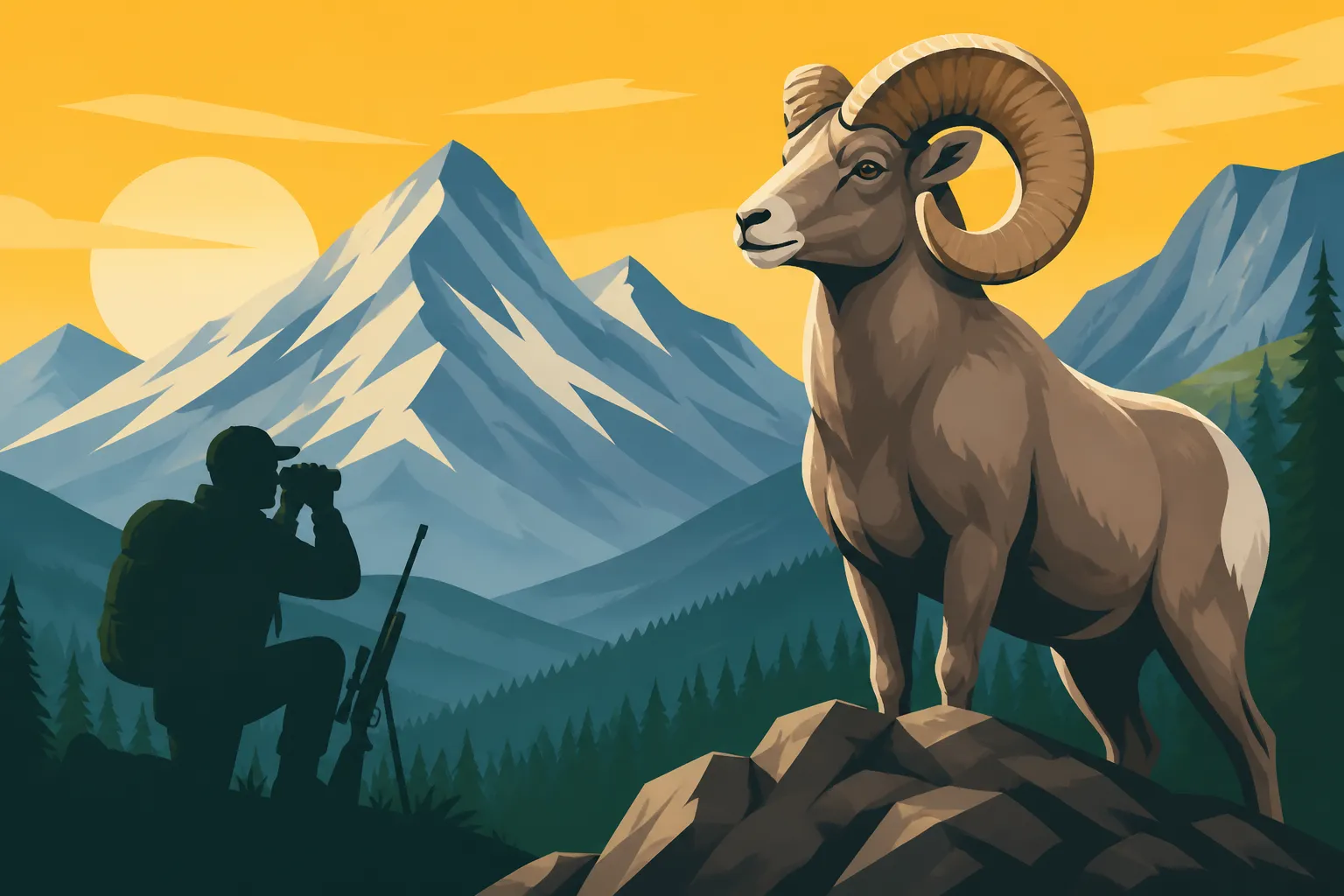
Stone's sheep are distinguished by their beautiful dark brown bodies, often appearing almost black, with white patches on their rump, belly, and the backs of their legs. Unlike their pure white Dall's sheep cousins, Stone's sheep carry a darker coat that provides excellent camouflage against the dark volcanic rock and timberline shadows of their northern ranges. Their horns are a striking yellowish-brown, sweeping back and outward in impressive arcs, often ending in heavy, broomed tips from years of battling other rams. You can delve deeper into what makes these animals unique by reading Stone's Sheep in Northern British Columbia.
These sheep typically inhabit the mountainous regions of northern British Columbia, extending into the Yukon. They thrive in rugged, high-alpine terrain, spending their summers feeding on lush alpine vegetation in meadows far above timberline. As winter approaches, they descend to wind-swept ridges and south-facing slopes, where snow accumulation is less, allowing them to access sparse forage. Their adaptability to extreme conditions and reliance on vast, undisturbed wilderness are key to their survival and growth.
The sheer scale of their habitat means that populations are often dispersed, and finding them requires extensive glassing and traversing challenging terrain. This constant movement, driven by forage availability and predator evasion, builds strength and resilience in the sheep, contributing to their overall health and horn development. Recognizing the difference between a Stone's and a Fannin sheep (a hybrid of Dall's and Stone's) can sometimes be a challenge, further highlighting the unique characteristics of a pure Stone's ram. For those interested in the slight variations, exploring What a Fannin Sheep Looks Like can offer more insight.
The Allure of Stone's Sheep in British Columbia
There's a reason why Stone's sheep draw hunters from all over the globe, often commanding the highest prices for guided hunts and requiring years of saving and planning. It's not just the beauty of the animal itself, but the immense challenge of the hunt. These sheep live in some of the most remote, unforgiving, and breathtaking landscapes imaginable, often requiring fly-in access, horseback travel, or grueling backpack hunts deep into the backcountry. The combination of physical exertion, mental fortitude, and the elusive nature of the animal creates an experience unlike any other.
The wild spaces they inhabit are truly spectacular. Imagine vast, untouched valleys, jagged peaks that scrape the sky, and alpine meadows painted with wildflowers in summer, all under an endless northern sky. These are places where you feel utterly insignificant, yet profoundly alive. The pursuit of Stone's sheep connects you to these primal landscapes in a way that few other activities can. It's a true test of one's will, endurance, and hunting prowess, pushing individuals to their limits both physically and mentally. This deep connection to the wild is often Why Stone's Sheep Draw Hunters Worldwide is a topic of such interest.
Beyond the physical demands, there's the intellectual challenge of finding and approaching these animals. Stone's sheep have incredible eyesight and inhabit terrain that offers them countless escape routes and vantage points. A successful hunt requires meticulous scouting, patient glassing, and an understanding of sheep behavior, wind, and topography that only comes with experience. It’s a chess match played out on a grand scale, where every move must be calculated and every mistake can cost you dearly.
The Quest for British Columbia's Record Stone's Sheep
The very phrase "record Stone's sheep" conjures images of massive, heavy horns that tell a story of immense age, harsh winters survived, and genetic superiority. But what exactly qualifies a ram for such esteemed status, and what makes these particular animals so special?
What Defines a "Record" Ram?
When hunters talk about "record" animals, they are almost universally referring to those recognized by official scoring organizations like Boone & Crockett Club or Pope & Young Club. For Stone's sheep, especially those taken with a rifle, Boone & Crockett is the primary standard. These organizations use a rigorous, standardized system to measure horns, allowing for objective comparison across different animals and time periods. It's a scientific way to celebrate exceptional trophies and the conservation efforts that produce them.
The Boone & Crockett scoring system for thinhorn sheep primarily measures four key aspects of the horns: the length of each horn, the circumferences taken at quarter points along each horn, and the greatest spread. Each measurement contributes to a final score, with deductions made for any asymmetries between the left and right horns. A minimum score is required for an animal to be considered for the "Awards" book, and an even higher score for the "All-Time" record book. Understanding these criteria is crucial for anyone dreaming of a true giant. You can learn more about the specifics in Scoring a Ram for the Record Book.
For a Stone's ram to achieve record-book status, it needs exceptional horn length, but more importantly, it needs incredible mass. The circumferences taken at the base and along the length of the horn contribute significantly to the total score. A ram with very heavy bases and good retention of that mass through its length will often outscore a longer-horned ram that lacks girth. This emphasis on mass reflects the animal's age and overall health, as older, well-nourished rams tend to carry more mass.
| Scoring Component | Description | Impact on Score |
|---|---|---|
| Length of Horn | Measured along the outer curve from tip to base. | Directly adds to the overall score. |
| Circumference 1 (Base) | Measured around the horn at its base. | Critical for overall mass; heavy bases are key. |
| Circumference 2 | Measured at 1/4 point of horn length. | Contributes significantly to mass score. |
| Circumference 3 | Measured at 1/2 point of horn length. | Important for maintaining mass throughout the horn. |
| Circumference 4 | Measured at 3/4 point of horn length. | Further contributes to mass, especially on long horns. |
| Greatest Spread | Widest measurement between the main beams, perpendicular to the skull. | Adds to the overall score, but less significant than length/mass. |
| Deductions | Assessed for differences in corresponding measurements between horns. | Reduces final score; symmetry is rewarded. |
Historic Giants and Notable Rams
British Columbia has a storied history of producing truly monumental Stone's sheep, rams that stand as testaments to the province's incredible wilderness and wildlife management. These historic giants often come from areas of exceptional habitat quality, where rams can live to old age, develop immense horn growth, and face minimal human disturbance. Stories of these legendary rams fuel the aspirations of hunters for generations, driving them to explore the most remote corners of the province. Many use platforms like GoHunt to research potential areas or historical harvest data, hoping to find patterns in where these magnificent creatures thrive.
A record-book ram isn't just about raw size; it's about character. The deeply fluted horns, the heavy broomed tips, the sheer weight in your hands – these are the attributes that tell a story of survival and dominance. These rams often reach 10-14 years of age, sometimes even more, surviving numerous harsh winters and countless encounters with predators. Each growth ring on their horns marks a year, a visual biography of their life in the unforgiving alpine. It's a reminder that their "record" status is a culmination of environmental factors, genetics, and sheer will to survive.
The pursuit of these animals is deeply intertwined with the ethics of fair chase and conservation. Hunters who pursue Stone's sheep are often passionate advocates for wilderness preservation, understanding that the existence of such animals depends entirely on protecting their habitat. Each harvest of a truly old, mature ram contributes data to wildlife management efforts, helping biologists understand population dynamics and ensure the health of the herds for future generations. This is part of the compulsory reporting that is essential for species like sheep, which you can learn more about in British Columbia's Compulsory Reporting Rules.
Factors Contributing to Record-Book Potential
Achieving truly exceptional horn growth in Stone's sheep is a complex interplay of several crucial factors. It’s not just one thing, but a perfect storm of environmental conditions, genetic predisposition, and the sheer luck of a ram avoiding predators and disease long enough to reach prime old age.
Habitat and Genetics
The adage "you can't grow a big ram on poor ground" holds true for Stone's sheep. High-quality habitat is paramount. This means abundant and nutritious forage throughout the spring and summer, allowing rams to pack on weight and divert energy towards horn growth. Areas with diverse alpine meadows, rich mineral licks, and a variety of browse contribute to robust health and skeletal development, which directly impacts horn size. Good water sources are also vital, especially during dry spells in the alpine.
Genetic potential plays an undeniable role. Just like in any species, some individual sheep are simply predisposed to growing larger, heavier horns due to their inherited traits. While habitat can influence the expression of these genes, the underlying blueprint for massive horns must be present. Conservation efforts, including careful management of hunting quotas, aim to allow a healthy proportion of older rams to breed, passing on these desirable traits to future generations. This natural selection, coupled with limited human interference, helps maintain the genetic integrity for growing record-class animals.
Remoteness is often a hidden factor within habitat quality. Truly remote areas tend to have lower hunting pressure, allowing more rams to reach older age classes. These untouched landscapes also typically suffer less from human encroachment, habitat fragmentation, and industrial activity, preserving the pristine conditions necessary for sheep to thrive without undue stress. Places that are difficult to access via roads or easily scouted routes often become bastions for these older, bigger rams. British Columbia's Wild Sheep and Where They Live highlights the specific geographical areas where these factors often converge.
Age, Weather, and Luck
Perhaps the most critical factor for a record-book ram is age. Horn growth continues throughout a ram's life, though the rate slows down considerably after its prime. For a ram to develop those truly massive, heavy bases and long lengths, it needs to live to an advanced age – often 10 years or more. This means surviving harsh winters, evading predators like wolves and grizzlies, and avoiding disease. A ram that makes it to 12 or 14 years old will have horns that tell a long and epic story of survival.
Weather patterns significantly impact a ram's ability to grow large horns. Mild winters, with less deep snow and earlier thaws, allow sheep to maintain better body condition through the lean months. This means they start the spring growing season in a stronger state, with more resources to allocate to horn development. Conversely, a series of severe winters can take a heavy toll on populations and limit horn growth, even for genetically superior animals. Extended periods of drought in the summer can also negatively impact forage quality, affecting a ram's ability to maximize its growth potential.
Ultimately, luck plays a massive role in the quest for a record Stone's sheep. You can scout diligently, hunt the best areas, and apply for years in hopes of drawing a coveted tag, but there's no guarantee. Being in the right place at the right time, when an old ram presents an ethical shot opportunity, often comes down to pure chance. Many experienced sheep hunters speak of the immense effort required, with only a handful of successful encounters with truly exceptional rams over a lifetime. This is why tools like GoHunt are so popular, helping hunters stack the odds in their favor through extensive data and mapping, but the element of luck remains ever-present.
Where British Columbia's Record Stone's Sheep Are Found
British Columbia is synonymous with outstanding sheep hunting, and certain regions are particularly renowned for producing exceptional Stone's rams. These are often vast, wild, and incredibly remote areas that provide the ideal conditions for sheep to not only survive but to truly flourish and grow to their maximum potential.
Remote Northern Regions
The vast, rugged expanses of northern British Columbia are the heartland of Stone's sheep, and consequently, the prime territory for record-book rams. Specifically, regions like the Cassiar Mountains, the Spatsizi Plateau, and the mountains around Atlin are consistently mentioned when discussing the largest Stone's sheep ever taken. These areas share common characteristics: immense tracts of untouched wilderness, challenging access, and a healthy balance of predators and prey. The sheer scale of the landscape means sheep populations are less concentrated, and older, wiser rams have ample room to roam and mature without constant pressure.
Hunting in these areas is often an expedition unto itself. It frequently involves flying into remote lakes or airstrips, followed by days of backpacking, sometimes for weeks, deep into roadless wilderness. The physical demands are extreme, testing even the most seasoned hunters. But it is precisely this remoteness and difficulty of access that helps protect these sheep, allowing them to live long, undisturbed lives. When you're Backpacking Into British Columbia Sheep Country, you quickly understand why these areas remain so wild and productive.
While some areas are known for consistently producing large rams, others might surprise you. A ram can show up in an unexpected basin, having travelled great distances. That’s why diligent glassing and thorough reconnaissance, often utilizing satellite imagery and mapping software like those offered by GoHunt, are indispensable. Understanding the terrain, potential migration corridors, and historical sheep locations can provide an edge, but the element of discovery in these vast northern regions is part of the adventure. Hunting the Country Around Atlin or Hunting the Spatsizi Plateau exemplify these prime locations.
Conservation and Management
The existence of record-book Stone's sheep in British Columbia is not just a matter of luck or good habitat; it is a direct result of sound conservation principles and effective wildlife management. The province's approach to thinhorn sheep management emphasizes limited entry hunting (LEH) draws, low quotas, and strict regulations designed to protect breeding ewes and allow rams to reach older age classes. These measures are crucial for maintaining healthy populations and ensuring the genetic potential for large rams.
Limited Entry Hunting for Stone's sheep is one of the most difficult draws to win in North America, with odds that can stretch into decades for some units. This low success rate in the draw intentionally limits harvest numbers, taking pressure off the population and allowing rams to mature. Furthermore, regulations often include specific curl requirements, ensuring that only older, fully mature rams are harvested. This focus on ethical, selective hunting helps maintain a robust age structure within the ram population.
The ongoing commitment to preserving vast wilderness areas, like the Muskwa-Kechika Management Area, also plays a critical role. These protected zones serve as vital strongholds for sheep, ensuring they have secure winter and summer ranges free from significant industrial development. By safeguarding their habitat and managing harvest sustainably, British Columbia continues to foster a legacy of exceptional Stone's sheep, allowing future generations to marvel at their majesty and perhaps, if they are fortunate and dedicated, pursue a record of their own.
Disclaimer
This article is for general informational purposes only and does not constitute professional advice. Laws, prices and regulations vary by location and change over time. Consult a qualified professional for guidance on your specific situation.