British Columbia Trespass and Private Land Rules
One of the biggest anxieties for any hunter exploring British Columbia's vast wilderness isn't just finding game, but knowing where you can actually hunt without running afoul of land ownership rules. It’s a genuine headache, staring at a map, trying to decipher what’s public, what’s private, and how to stay legal. This guide will meticulously break down British Columbia's trespass and private land rules, helping you confidently navigate the landscape and focus on your hunt.
Understanding British Columbia's Land Landscape for Hunters
British Columbia is a massive province, and while much of it is publicly accessible, private land exists in many forms and often without obvious boundaries. For hunters, knowing the difference isn't just good practice; it's a legal and ethical necessity. Misunderstanding these distinctions can lead to serious consequences, not just for your hunt, but for your reputation and the broader hunting community.
The Dominance of Crown Land
When you picture hunting in British Columbia, chances are you're imagining wide-open spaces, remote valleys, and endless mountains. For the most part, you're picturing Crown land. This is publicly owned land, managed by the provincial government, and it forms the vast majority of the province's land base. As a general rule, if you have a valid hunting licence and tags, and you're following all other regulations, you have the right to access and hunt on Crown land.
However, "general rule" doesn't mean "no rules." Even on Crown land, there can be restrictions, such as wildlife management areas, provincial parks where hunting is prohibited, or specific areas closed for forestry operations or safety. But the fundamental principle is that unless explicitly restricted, Crown land is open for recreational use, including hunting. The sheer scale of it means that most hunters will spend the bulk of their time on this public domain. You might be interested in reading How Much of British Columbia Is Crown Land for a deeper dive into this topic.
Differentiating Private Land and Its Implications
While Crown land offers unparalleled opportunities, private land is scattered throughout the province, particularly in valley bottoms, along major transportation corridors, and in areas suitable for agriculture or timber production. Private land can encompass residential properties, working farms, ranchland, commercial forests owned by timber companies, or even large recreational parcels held by individuals. The critical distinction here is simple: private land is not open to the public without express permission from the landowner.
The implications for hunters are profound. Entering private land without permission is trespassing, which carries legal penalties. Beyond the legal ramifications, it's an ethical lapse that damages the relationship between landowners and the hunting community. A single act of disrespectful trespassing can sour an entire community's view of hunters, making it harder for everyone to gain access in the future. Respecting these boundaries, even if they seem remote or un-posted, is paramount for sustainable hunting access.
The "Notice" Requirement for Trespass
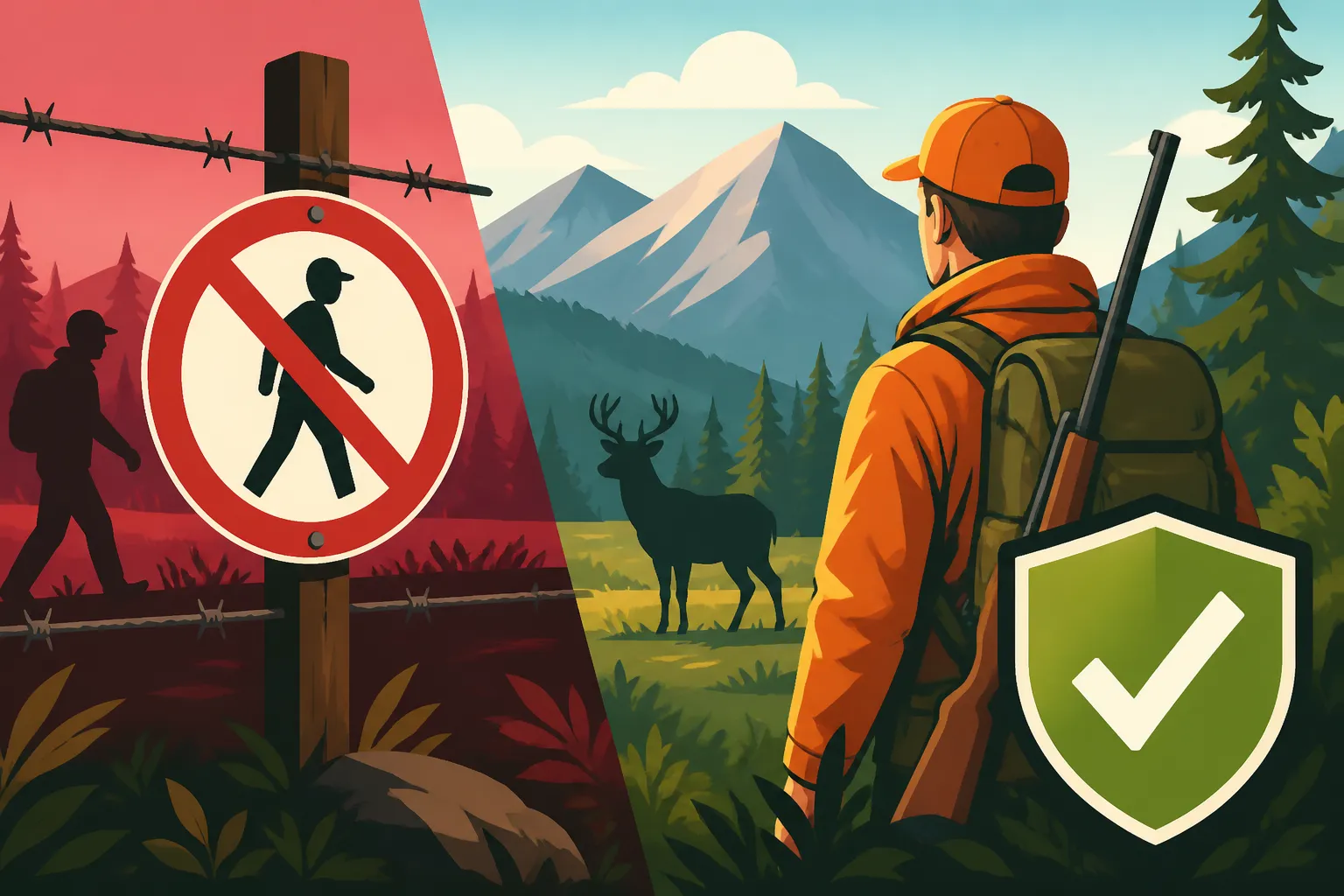
British Columbia's Trespass Act is quite specific about what constitutes trespassing. Unlike some jurisdictions where entering private land is automatically considered trespass, in BC, the landowner generally needs to provide "notice" that entry is prohibited. This notice can take several forms: clear fencing, signs explicitly stating "No Trespassing" or "Private Property," or even direct verbal communication from the landowner or their agent. For example, a gate painted with large red "No Trespassing" signs across a well-used road is unambiguous notice.
It's important to understand that while a lack of explicit signage might seem to imply access, this isn't a licence to roam freely. If a property is clearly cultivated, has structures, or is otherwise obviously being used for private purposes, a reasonable person would understand it's private, even without a specific sign at every corner. Moreover, "No Trespassing" signs don't need to be pristine or perfectly placed every few metres. A few clear signs along a property boundary or at access points are usually considered sufficient notice under the law. Always err on the side of caution. What British Columbia's Trespass Act Requires provides more detail on the specifics of this act.
Navigating Private Property: Rules and Responsibilities
Hunting responsibly in British Columbia means understanding that private property is not a suggestion, but a fundamental right. It's about more than just avoiding legal trouble; it's about being a good ambassador for hunting.
Explicit Permission is Key
When it comes to hunting on private land, the golden rule is "permission first." This means you must obtain explicit consent from the landowner before setting foot on their property with a hunting intention. This isn't a casual request; it's a formal understanding. Ideally, this permission should be obtained in writing, detailing the dates, areas, species, and any specific conditions or restrictions the landowner might have. Verbal permission is legally binding, but it can lead to misunderstandings or disputes if details aren't crystal clear or if memories differ down the road.
Imagine you've been granted verbal permission by Farmer Joe to hunt deer on his back forty. A few weeks later, his neighbour, who happens to be his brother-in-law, sees you with a rifle and assumes you're trespassing, calling the Conservation Officer Service. Without clear, written proof, you're in a tricky spot. Always ask for written permission if possible, even if it's just an email or a text message confirming the specifics. This protects both you and the landowner and fosters a relationship of trust.
Identifying Private Forest Land and Access Gates
British Columbia has extensive tracts of private forest land, especially in coastal regions and parts of the Interior. These lands are typically owned by large timber companies and are actively managed for logging. While they might feel like remote wilderness, they are unequivocally private property. Access to these lands is often controlled by gates, which may be open during specific hours, on certain days, or only to those with a valid access permit.
For example, on Vancouver Island, many prime hunting areas are found within these private timber holdings. Companies often implement permit systems during hunting seasons, requiring hunters to purchase a pass or obtain explicit authorization to enter. These systems are in place for safety (due to active logging operations), liability, and resource management. Ignoring these gates or attempting to bypass them is a serious trespass. Always check with the land management company before planning a hunt on what appears to be un-posted, yet gated, forest land. More information on this can be found in Private Forest Land Gates on Vancouver Island.
Understanding Posted Land Rules and Signage
"Posted" land in British Columbia refers to private property where the owner has clearly indicated that entry is prohibited, typically through signs. These signs aren't just a suggestion; they are a legal declaration. The British Columbia Trespass Act states that a person commits trespass if they enter land where the owner or occupier has given notice that entry is prohibited. This notice can be in various forms, including "No Trespassing," "Private Property," or other similar wording.
Beyond the legal wording, the spirit of posted land rules is about respect. If a landowner has gone to the trouble of putting up signs, it's because they want their privacy and property rights respected. As hunters, we have a responsibility to honour that. It's not always about preventing hunting; sometimes it's about managing liability, protecting livestock, or simply enjoying their land without unexpected visitors. Always assume that a clear sign means exactly what it says, regardless of how inviting the land beyond it might look. For a deeper understanding, look up British Columbia Posted Land Rules.
Practical Tools and Strategies for Identifying Land Ownership
In the age of digital mapping, there's no excuse for not knowing whose land you're on. Modern tools have revolutionized how hunters can research and navigate land ownership, making it easier than ever to stay on the right side of the law.
Utilizing Digital Mapping Applications
One of the most powerful tools in a modern hunter's arsenal is a robust digital mapping application. Platforms like onX Hunt have become indispensable for pre-scouting and in-field navigation. These apps layer property boundaries and ownership information directly onto topographic maps and satellite imagery. With just a few taps on your smartphone, you can see exactly where Crown land ends and private property begins, often with the landowner's name displayed. This level of detail is a game-changer for avoiding accidental trespass.
Before you even leave home, you can use these apps to identify potential hunting areas, locate public access points, and pinpoint any private parcels you need to either avoid or seek permission for. Once you're in the field, the GPS functionality allows you to track your position relative to these boundaries in real-time. This can prevent you from inadvertently crossing a property line, especially in areas with subtle terrain changes or unclear physical markers. While these apps are incredibly useful, remember they are guides and not infallible. Always cross-reference with other sources if you have doubts, but for everyday navigation, onX Hunt and similar tools are invaluable. Using onX for British Columbia Crown Land offers further insights into how these tools benefit hunters.
Consulting Official Government Resources
While digital apps are fantastic for convenience, official government resources provide the authoritative word on land ownership. The provincial government offers several online mapping tools, such as iMapBC, which can be used to view land titles, cadastral boundaries (property lines), and various land use designations. These platforms are typically more robust and technical than commercial hunting apps but offer a higher degree of accuracy for detailed research.
Another key resource is FrontCounter BC, which acts as a single window service for clients to access natural resource information and permits. While it might require a bit more digging, you can often find information about land tenure, Crown land use plans, and specific property details. Using these resources requires a bit of patience and a willingness to learn their interfaces, but the information gained is invaluable, especially for planning hunts in less-travelled or ambiguous areas. They won't tell you "who owns lot 123 Main Street," but they can confirm that a vast timber block is private or that a particular creek bottom is surrounded by Crown land. GoHunt, a popular resource for many hunters, also provides tools and articles that often reference these official data sources, helping hunters interpret them effectively.
Asking a British Columbia Rancher for Access
One of the most direct, and often most rewarding, ways to gain access to private land is simply to ask the landowner. British Columbia has a strong ranching and farming tradition, and many of these properties hold excellent hunting opportunities for deer, elk, and even bears. The key to successful access is a respectful, well-prepared approach. Don't just show up on opening morning with your rifle. Instead, approach landowners well in advance of the season, ideally in the off-season.
Introduce yourself politely, state your intentions clearly, and be prepared to offer something in return, whether it's helping with chores, sharing game meat, or simply being a responsible and vigilant presence on their land. Many ranchers appreciate hunters who are willing to keep an eye out for trespassers or suspicious activity. Be flexible with their conditions, which might include specific areas to hunt, times of day, or types of firearms. A handshake and an honest conversation can open doors that no mapping app can. Remember, your goal is to build a relationship, not just secure a one-time permit. For more advice, check out Asking a British Columbia Rancher for Access.
Common Scenarios and Hunter Etiquette
Even with the best preparation, unexpected situations can arise in the field. Knowing how to handle these moments with grace and legality is a hallmark of an ethical hunter.
Retrieving Game From Private Land
It's every hunter's nightmare: you make a good shot, the animal runs, and then crosses onto private land where you don't have permission. This is a highly stressful situation, but it's crucial to handle it correctly. Under no circumstances should you pursue a wounded animal onto private property without first obtaining permission from the landowner. Doing so is trespassing and can lead to severe legal penalties. Your harvested animal is important, but it does not grant you the right to violate private property.
The correct procedure is to immediately stop your pursuit at the property line. Contact the landowner as soon as possible, explain the situation calmly and honestly, and request permission to retrieve your animal. Be prepared for a "no." If permission is granted, follow any conditions they impose, such as not bringing your firearm onto their property or having them accompany you. If they refuse, you have to accept it. It's a tough pill to swallow, but it's the law. For detailed guidance, consult Retrieving Game From Private Land in British Columbia.
Road Hunting and Proximity to Private Holdings
British Columbia has specific rules about hunting from or near roads, which become even more critical when private land is involved. Generally, it's illegal to discharge a firearm or bow from a motor vehicle on a public highway or road. Beyond that, there are also rules about shooting across a road or within a certain distance of buildings. These rules are designed for public safety and to prevent disturbance to private landowners.
When hunting near private property, always be mindful of your backdrop and what lies beyond your target. A bullet can travel a long way. Even if you are legally on Crown land, shooting in a direction that could endanger private residences, livestock, or infrastructure is irresponsible and potentially illegal. Always assume there are people or property just out of sight and take extra precautions. Understanding Rules on Shooting Near a Road is vital for safe and legal hunting.
Private Land Lease vs. Rod and Gun Clubs
For those looking for consistent access to private hunting grounds, there are a couple of formal avenues to consider beyond simply asking a rancher. One option is to look for a private land lease. In some areas, landowners may lease hunting rights to individuals or groups for a season or longer. These arrangements typically involve a fee and clear contractual agreements outlining access, species, and other terms. This can provide exclusive access to prime hunting areas, but leases can be competitive and costly. Reading Finding a British Columbia Hunting Lease can give you more insight into this option.
Another excellent route, especially for newcomers or those seeking community, is joining a local rod and gun club. Many clubs in British Columbia own or have special access agreements with private landowners for hunting, shooting ranges, and conservation efforts. Becoming a member not only provides potential access but also connects you with experienced local hunters who can offer invaluable advice on local regulations and land access nuances. These clubs often play a significant role in fostering good relations with private landowners, helping to secure access for their members. Learn more about this by looking at Joining a British Columbia Rod and Gun Club.
Consequences of Trespassing and Responsible Hunting
The message bears repeating: trespassing while hunting is not a minor infraction. It carries real consequences, both legal and societal. Understanding these can help reinforce the importance of always respecting land boundaries.
Legal Penalties for a Hunting Violation
If you are caught trespassing on private land in British Columbia while hunting, you could face significant legal repercussions. The specific penalties can vary depending on the severity of the trespass, whether you had a firearm, if an animal was poached, and whether you caused any damage. At a minimum, you could face fines under the Trespass Act, and potentially charges under the Wildlife Act if hunting was involved. These fines can be substantial.
Beyond monetary penalties, a conviction can lead to the suspension or revocation of your hunting licence and a prohibition from obtaining future licences for a period. This means losing your privilege to hunt in British Columbia altogether, which for many, is a devastating consequence. Furthermore, if you are a non-resident, such a violation could impact your ability to enter Canada in the future. The impact on your hunting career can be long-lasting and severe. To fully grasp the potential downsides, refer to Penalties for a Hunting Violation.
Ethical Imperatives and Hunter Reputation
The legal consequences, while serious, are only part of the picture. Every time a hunter trespasses or acts irresponsibly on private land, it casts a shadow over the entire hunting community. Landowners, whether they are farmers, ranchers, or private forest companies, often see all hunters through the lens of the few bad apples. This can lead to increased restrictions, more posted land, and a general decline in public acceptance of hunting.
As ethical hunters, we have a responsibility to uphold the highest standards of conduct. This includes meticulously checking property boundaries, always seeking permission, respecting gates and signage, and leaving no trace. Our actions speak volumes about our respect for wildlife, land, and the rights of others. By consistently demonstrating ethical behaviour, we help preserve hunting opportunities for future generations and foster a positive image of hunters in society. It's about being part of the solution, not contributing to the problem.
Reporting a Poacher in British Columbia
While trespassing is a violation of land rights, it sometimes overlaps with more egregious crimes like poaching. If you encounter individuals who are clearly hunting illegally, whether on private land without permission, out of season, or with unlawful methods, it's your duty as a responsible citizen and hunter to report it. Poaching undermines conservation efforts, steals wildlife resources from legitimate hunters, and often involves blatant disregard for private property.
British Columbia operates a "Report All Poachers and Polluters" (RAPP) line, which is a critical tool for enforcing wildlife and environmental laws. If you witness or suspect poaching or trespassing that involves illegal hunting, gather as much information as possible (vehicle descriptions, license plates, physical descriptions, location, time) and contact the RAPP line immediately. Your anonymous tip can be crucial in catching offenders and protecting British Columbia's valuable wildlife resources. Find out more at Reporting a Poacher in British Columbia.
Comparing Crown Land vs. Private Land Access for Hunting
To summarize the key differences and considerations for hunting on Crown land versus private land in British Columbia, here's a helpful comparison:
| Feature | Crown Land (Public) | Private Land |
|---|---|---|
| Ownership | Provincial government (public) | Individual, company, or Indigenous nation (private) |
| Default Access | Generally open to licensed hunters (unless restricted) | Closed to public; requires explicit permission from landowner |
| Notice for Trespass | Not applicable (unless specific area closure) | Required (fencing, signs, verbal) for legal trespass charge |
| Tools for Identification | Government maps (iMapBC), commercial apps (onX Hunt) | Government maps, commercial apps (onX Hunt), physical signs, local knowledge |
| Permits Required | No special access permits (standard hunting licence/tags only) | Often required (verbal, written, company permit systems) |
| Key Considerations | Specific closures (parks, WMA), industrial activity, road access | Landowner relations, property boundaries, liability, specific conditions |
| Ethical Imperative | Leave No Trace, respect other users, follow regulations | Respect property rights, seek permission, build relationships, follow conditions |
| Consequences of Misuse | Fines for regulatory violations, environmental damage | Fines for trespass, hunting violations, loss of licence, damage to hunter reputation |
This table should give you a clear overview of the contrasting realities you'll encounter as you plan your hunting adventures in British Columbia. Always remember that knowledge and respect are your best tools in the field.
Disclaimer
This article is for general informational purposes only and does not constitute professional advice. Laws, prices and regulations vary by location and change over time. Consult a qualified professional for guidance on your specific situation.