British Columbia Rules on Hunting From a Vehicle
Hunting in British Columbia offers some of the most diverse and breathtaking experiences imaginable, but it also comes with a complex set of regulations designed to ensure safety, fair chase, and conservation. One area that often trips up even seasoned hunters is the specific rules around using a vehicle during a hunt. It's easy to assume that if you're on a public road, you can do what you want, or that turning off the engine makes everything okay, but that's simply not the case. This guide will meticulously break down British Columbia's rules on hunting from a vehicle, helping you navigate these waters legally and ethically.
The Fundamental Rules: What "Hunting From a Vehicle" Truly Means in BC
When you're out in British Columbia's vast wilderness, your vehicle is an indispensable tool for accessing remote areas, hauling gear, and ultimately, packing out your harvest. However, the line between using a vehicle for access and illegally hunting from it can be incredibly thin and often misunderstood. It’s not just about discharging a firearm from a truck window; the regulations cast a much wider net, aiming to uphold the principles of fair chase and prevent dangerous practices. Many hunters, especially those new to the province or visiting from elsewhere, are genuinely surprised by how strictly these rules are applied.
Defining "Vehicle" and "Road" in the Eyes of the Regulations
To truly understand British Columbia's rules, we need to start with the definitions provided in the Wildlife Act and its associated regulations. When the regulations talk about a "vehicle," they're not just referring to your everyday pickup truck on a paved highway. This term is incredibly broad, encompassing almost any conveyance that can move under its own power. This includes cars, trucks, vans, motorcycles, all-terrain vehicles (ATVs), utility task vehicles (UTVs), snowmobiles, aircraft (helicopters, planes), and even boats. Yes, even a boat on a lake or river is considered a "vehicle" under these specific hunting regulations.
The definition of a "road" is equally expansive. It doesn't just mean Highway 1. In British Columbia, a "road" often includes public highways, paved and gravel roads, forest service roads (FSRs), and even maintained trails that are clearly designed or used for vehicle traffic. This is where many hunters get into trouble, especially on the extensive network of British Columbia's Logging Road Network. What might look like a rough track winding deep into the bush could, by regulation, still be considered a road. The critical takeaway here is that you need to consider any path regularly used by motorized transport as a potential "road" for regulatory purposes, even if it's deactivated or rarely used. Tools like GoHunt can be incredibly helpful for deciphering road classifications and land status in real-time, helping you avoid accidental infractions.
The Core Prohibition: Shooting From or Across a Road
The heart of British Columbia's vehicle hunting regulations is a clear and unambiguous prohibition: "No person shall hunt, shoot at, attract, search for or molest wildlife from a motor vehicle or other conveyance, or from an aircraft, unless authorized by a permit." This single sentence covers a lot of ground and dispels many common myths.
First, notice the breadth of activities prohibited: "hunt, shoot at, attract, search for or molest." It's not just about the act of shooting. If you're using your truck to actively search for game by driving slowly and glassing extensively, ready to jump out, you might be seen as hunting from a vehicle. If you're honking your horn or using calls from your vehicle to "attract" wildlife, that's also prohibited. The intent is to prevent the vehicle from becoming an integral part of the hunting process itself.
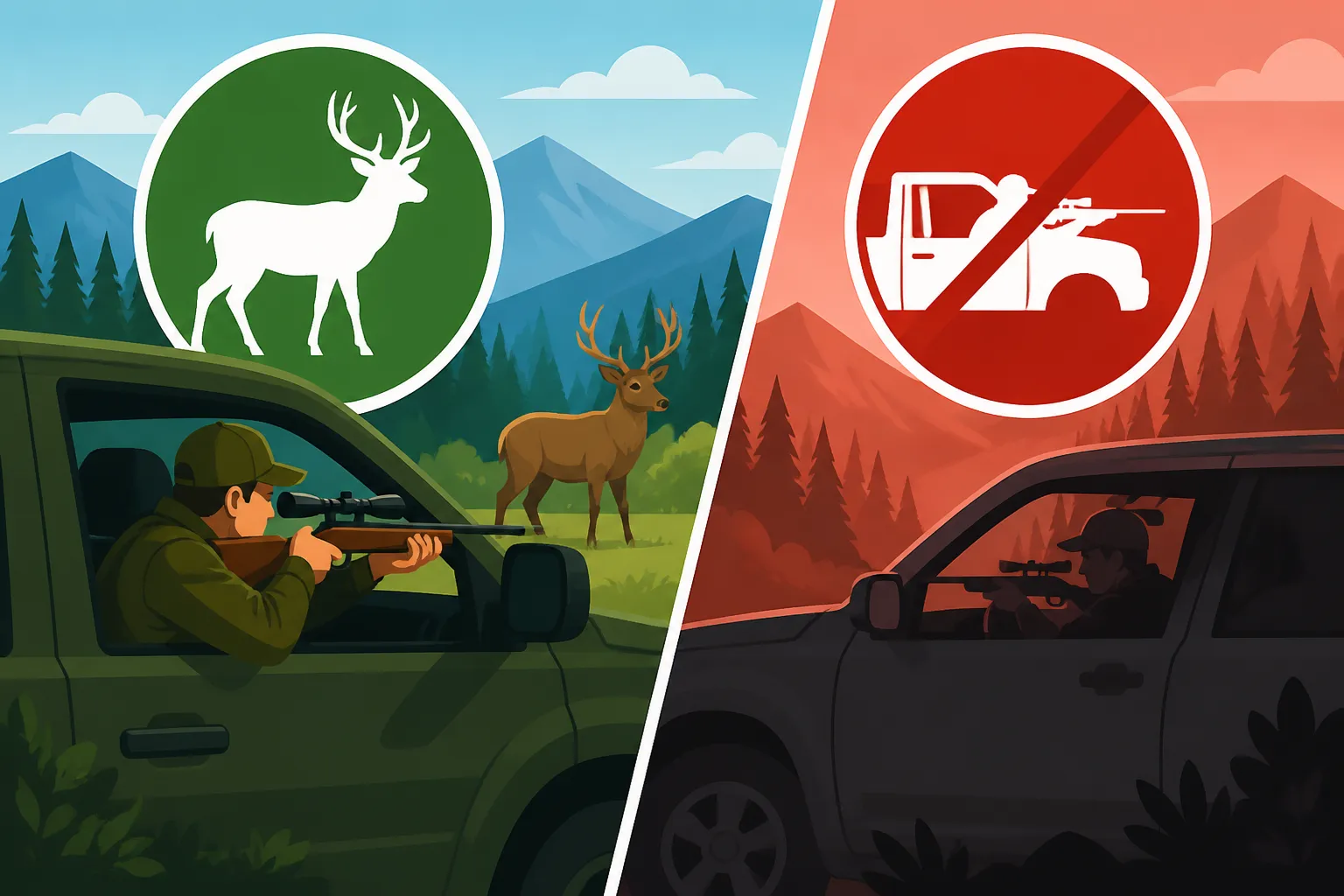
Second, the phrase "from a motor vehicle or other conveyance" is crucial. This means you cannot use the vehicle as a shooting platform, even if the engine is off or you're standing on the running boards. If you're leaning against the truck, or have your rifle resting on the hood, and shoot, that could be interpreted as hunting from the vehicle. The spirit of the law requires you to be completely disassociated from the vehicle when actively hunting.
Third, and just as important, is the implied rule about shooting across a road. While the Wildlife Act doesn't explicitly say "don't shoot across a road" in the same way some jurisdictions might, the prohibition of "shooting at wildlife from a motor vehicle" combined with other regulations concerning the discharge of firearms near highways effectively means you generally cannot shoot across any public road. This is largely a safety measure, protecting other road users and ensuring a clear backstop for your shot. In practice, this means if you spot an animal across a logging road from your parked truck, you need to exit your vehicle, get a safe distance away from the road, and only then make your shot if all other safety and legal requirements are met.
Common Misconceptions and Legal Grey Areas
It's easy to fall prey to misconceptions when rules seem ambiguous or you hear conflicting advice from fellow hunters. One common belief is that if your vehicle's engine is turned off, you're no longer "hunting from a vehicle." This is absolutely false. The engine status is irrelevant. As long as you are using the vehicle in a way that facilitates the hunt — whether it's as a spotting platform, a means to quickly cover ground while actively looking for game, or as a brace for your shot — you are likely in violation.
Another grey area often discussed is the use of boats. While a boat is considered a "vehicle," the rules for hunting waterfowl from a boat are somewhat different. Generally, you can hunt waterfowl from a boat, provided the boat is not under power and is not being used to actively pursue birds. If you're anchored or drifting, and not using the motor, that's typically permissible. However, for big game, the rules are much stricter, and you generally cannot hunt from a boat unless specifically authorized by a permit, which is rare. The intent is always to ensure a fair chase.
Consider a scenario where you're driving along a remote Driving a Deactivated Logging Road and spot a buck. Many hunters might instinctively stop, quickly exit, and shoot. While getting out is a good first step, if you're still within spitting distance of the road, or using the vehicle to hide your approach, you could still be on shaky ground. The safest practice is always to park, completely remove yourself from the immediate vicinity of the vehicle and the road, and then proceed to hunt on foot.
Specific Scenarios and How the Rules Apply
Understanding the broad definitions is one thing, but applying them to real-world hunting situations in British Columbia is where it truly matters. Hunters often grapple with the distinction between using a vehicle for necessary access and crossing the line into illegal hunting practices. Let’s dive into some common scenarios.
Using a Vehicle for Access vs. Active Hunting
This is arguably the most important distinction for hunters to grasp. British Columbia is a vast province, and vehicles are essential for reaching remote hunting grounds. You are absolutely permitted to use your truck, ATV, or other vehicle to drive into a management unit, park it, and then proceed to hunt on foot. This is how many successful backcountry hunts begin, whether you're embarking on Mule Deer Hunting in British Columbia or pursuing Moose Hunting British Columbia's Interior.
The critical moment comes when you transition from using the vehicle for transport to using it as part of your active hunting strategy. For example, driving slowly along a Hunting British Columbia's Logging Road Network with your rifle uncased, constantly scanning the clearcuts for game, and being ready to stop and shoot immediately, would likely be considered hunting from a vehicle. Even if you quickly jump out, the vehicle was actively involved in the "searching for wildlife" component of the hunt.
A legal approach would be to drive to a promising area, park your vehicle, get out, remove your rifle from its case, and then begin your hunt on foot, walking the edges of the cutblocks or glassing from a strategic vantage point a good distance from the road. This separation ensures that the vehicle is solely a means of transportation, not an extension of your hunting efforts. This also aligns with the principle of fair chase; an animal should have a reasonable chance to escape without being cornered or surprised by a hunter effectively mounted in a fast-moving machine.
Retrieving Game with a Vehicle: When It's Allowed (and When It's Not)
Another common point of confusion revolves around retrieving an animal once it’s down. The good news is that after an animal has been legally harvested, you can generally use a vehicle to retrieve it. This is a practical necessity, especially with large game like moose or elk, which are simply too heavy to pack out entirely by hand from some locations. Using a vehicle for retrieval saves meat from spoiling, ensures you can get the animal out efficiently, and is generally considered acceptable practice.
However, there are important caveats. You must retrieve the animal via an established road or trail where vehicle access is legally permitted. You cannot simply drive off-road through fragile terrain, clear-cuts, or private land without permission to get to your animal. Respect for the land and private property is paramount. If the animal falls in an area inaccessible by vehicle, you must Getting Meat Out of Steep British Columbia Country or use other non-motorized means like game carts, horses, or Packing Out of British Columbia's Steep Country.
Crucially, you cannot use a vehicle to finish a wounded animal if that act constitutes illegal hunting. If you wound an animal, you must pursue it on foot. Driving an ATV or truck to catch up to a wounded animal and then shooting it from the vehicle or just off it would be a violation. The vehicle's role is restricted to retrieval of a legally harvested animal, not participation in the hunt itself, even if the animal is wounded. Always be prepared for the pack-out, even if you hope to use your vehicle later.
Special Considerations for Off-Road Vehicles (ORVs) and ATVs
Off-Road Vehicles (ORVs), including ATVs and UTVs, are widely used by hunters in British Columbia to access rugged terrain. While incredibly useful for reaching remote areas, it's vital to remember that ORVs are still considered "vehicles" under the Wildlife Act, and the same rules against hunting from them apply. You cannot shoot from an ATV, pursue game on one, or use it as an active spotting platform.
Beyond the hunting regulations, ORVs have their own separate set of rules under British Columbia's Off-Road Vehicle Act. This includes requirements for registration, display of plates, and wearing helmets. More importantly for hunters, many forest service roads and resource roads are not open to recreational ORV use; they are designated for industrial traffic only, or for licensed vehicles. Navigating these rules can be tricky, as a road might appear suitable for an ATV but actually be restricted. Ignoring these ORV regulations can lead to hefty fines separate from any hunting infractions.
The correct way to use an ORV for hunting is to transport yourself and your gear to a specific point, park the ORV in a legal spot, and then continue your hunt on foot. Many hunters use their ATVs to cover long distances on legal trails or designated FSRs that are otherwise too far to walk, and then park and embark on a walk-in hunt. Using mapping tools like those from GoHunt can help you identify legal ORV trails and restricted areas, allowing you to plan your access points responsibly. Remember, your ORV is a tool for mobility, not a hunting blind or pursuit vehicle. For those considering a hunt without a truck, understanding the specific ORV regulations becomes even more critical for effective access.
| Scenario | Legality in BC | Key Condition/Explanation |
|---|---|---|
| Shooting from inside a parked vehicle | Prohibited | Regardless of engine status, vehicle cannot be used as a shooting platform. |
| Shooting from across a logging road | Prohibited | Considered hunting "from" the vehicle's zone, unsafe, and generally illegal. |
| Actively spotting game while driving slowly | Prohibited | "Searching for wildlife" from a vehicle is banned; vehicle cannot be part of the active hunt. |
| Parking, exiting, walking away, then shooting | Allowed | Vehicle used for access only; hunt conducted on foot, removed from the vehicle and road. |
| Using an ATV to pursue wounded game | Prohibited | Vehicle cannot be used to participate in the hunt, only for retrieval after the animal is legally dead. |
| Using an ATV to retrieve a downed animal | Allowed | Permitted if on a legal, established road/trail, and not causing damage or trespassing. |
| Calling game from a parked vehicle | Prohibited | "Attracting wildlife" from a vehicle is part of the overall prohibition on hunting activities from a conveyance. |
Enforcement, Penalties, and Staying on the Right Side of the Law
No one wants to have their hunting trip cut short by a run-in with a Conservation Officer, especially for something preventable. The rules surrounding hunting from a vehicle in British Columbia are serious, and so are the consequences for violating them. It's not just about losing a day of hunting; it can have long-lasting impacts on your hunting privileges and finances.
Consequences of Violating Vehicle Hunting Regulations
The penalties for hunting from a vehicle in British Columbia can be significant. Under the Wildlife Act, these offenses are often subject to hefty fines, which can range from several hundred to thousands of dollars depending on the severity of the infraction and whether it's a first offense or a repeat violation. Beyond financial penalties, one of the most impactful consequences for a hunter is the potential for licence suspension. This means you could lose your right to hunt in British Columbia for a period, sometimes extending for several years. Imagine planning your next big adventure, like Elk Hunting in British Columbia, only to find your licence has been revoked.
In more egregious cases, or for repeat offenders, the courts can order the forfeiture of equipment used in the commission of the offense. This could mean losing your firearm, your ATV, or even your truck. These assets, often representing significant investments, can be seized and permanently confiscated by the Crown. In the most severe situations, or those involving other concurrent violations (like poaching, unsafe firearm handling, or hunting out of season), jail time is also a possibility. Conservation Officers patrol extensively, often acting on public tips, so the chance of being caught is real. They are dedicated professionals, and they take these rules very seriously because they are fundamental to safe and ethical hunting.
How to Ensure Compliance and Protect Your Hunting Privileges
The best defense against a violation is a thorough understanding of the rules and a commitment to ethical hunting practices. Always, always, carry and consult the most current British Columbia's Two-Year Regulations Synopsis when you're in the field. Don't rely solely on what a friend told you or what you read on an old forum. Regulations can and do change, and it's your responsibility as a hunter to be aware of them.
The simplest and most effective way to ensure compliance with vehicle hunting rules is to embrace the "park and walk" principle. Whenever you spot game or are entering an area you intend to hunt, park your vehicle legally, step away from it, and continue your hunting activities on foot. This creates a clear separation between your transportation and your hunting efforts, removing any ambiguity. This isn't just about legality; it's about fair chase and immersion in the hunting experience.
Be hyper-aware of road definitions. If you're unsure whether a track is considered a "road," err on the side of caution. Similarly, always be mindful of British Columbia Trespass and Private Land Law. Know where property lines are, and never assume access. Utilizing modern mapping applications, such as those offered by GoHunt, on your phone or GPS device can provide real-time updates on Crown land boundaries, private property, and road classifications, helping you navigate complex areas with confidence. These tools are invaluable for planning routes and confirming your location relative to restricted zones or active logging operations.
Reporting Suspected Violations
As ethical hunters, we are stewards of the resource, and part of that responsibility includes reporting those who disrespect the rules and harm the reputation of the hunting community. If you witness someone hunting from a vehicle or committing any other wildlife violation, it's important to report it. British Columbia operates The Report All Poachers and Polluters Line, or RAPP line, a dedicated service for reporting environmental violations.
When making a report, try to gather as much information as possible without putting yourself in harm's way. This includes:
- The exact date and time of the incident.
- The precise location (GPS coordinates are best, but detailed landmarks work).
- A description of the vehicle involved (make, model, color, licence plate number).
- A description of the individuals involved.
- The specific nature of the violation you observed.
- Any other relevant details or observations.
Your report, even if it feels small, can contribute significantly to the efforts of Conservation Officers in enforcing wildlife laws and protecting British Columbia's valuable wildlife populations. Reporting allows the proper authorities to investigate and take action, ensuring that British Columbia hunting remains a privilege for those who abide by the rules.
Disclaimer
Please remember that this guide provides general information about British Columbia's hunting regulations regarding vehicle use. Regulations can be complex and are subject to change. It is every hunter's responsibility to consult the most current British Columbia Hunting and Trapping Synopsis and the official Wildlife Act and Regulations before heading into the field. This article should not be considered legal advice.