Glassing Logging Roads for Spring Bears
Spring bear hunting in British Columbia can be an incredibly rewarding experience, but finding those elusive bruins as they emerge from their dens can feel like searching for a needle in a haystack. The sheer vastness of the landscape, coupled with early season foliage, often leaves hunters frustrated, wondering where to even begin. This guide will walk you through the highly effective strategy of glassing logging roads for spring bears, helping you understand why these areas are hotspots, what gear you need, and how to maximize your chances of success.
Why Logging Roads Are Bear Magnets in Spring
Logging roads, often seen as mere access points, transform into prime bear habitat and observation platforms during the spring in British Columbia. They offer unique conditions that draw bears out into the open, making them ideal for glassing.
The Early Green-Up Advantage
One of the primary reasons logging roads are so effective for spring bear hunting is the phenomenon of early green-up. As winter snows recede, these disturbed areas, particularly cutblocks and south-facing slopes, are among the first places to burst forth with new, succulent vegetation. Think about it: a bear has just spent months in its den, slowly burning through its fat reserves. What it craves most upon emerging is easily digestible, high-energy forage. The tender shoots of grass, clover, and dandelions that sprout along road edges and disturbed ground are exactly what they're looking for. These nutrient-rich greens provide the much-needed calories and hydration to kickstart their metabolism and recovery. You'll often find bears methodically grazing these areas, sometimes for hours, completely focused on replenishing their systems.
Moreover, the exposed soil of logging roads and new cutblocks heats up faster in the spring sun compared to the shaded, dense forest floor. This warmth encourages plant growth even earlier, creating a localized buffet for hungry bears. It's not uncommon to see a large boar basking in the sun on a gravel road, enjoying both the warmth and the nearby forage. This early emergence of food sources along logging roads is a critical factor that draws bears like a magnet, and understanding this ecological pattern is key to successful spring bear hunting.
Accessibility and Visibility
Beyond the food source, logging roads offer unparalleled accessibility and visibility, which are huge advantages for hunters. Unlike navigating dense timber or tracking through thick underbrush, these roads provide a clear line of sight over relatively open terrain. When you're trying to locate a creature as dark and camouflaged as a black bear in the dappled light of a forest, any advantage in visibility is a game-changer. Driving a truck allows you to cover vast amounts of ground efficiently, accessing areas that would be arduous to reach on foot. This means you can scout dozens of kilometres of potential bear habitat in a day, rather than just a few.
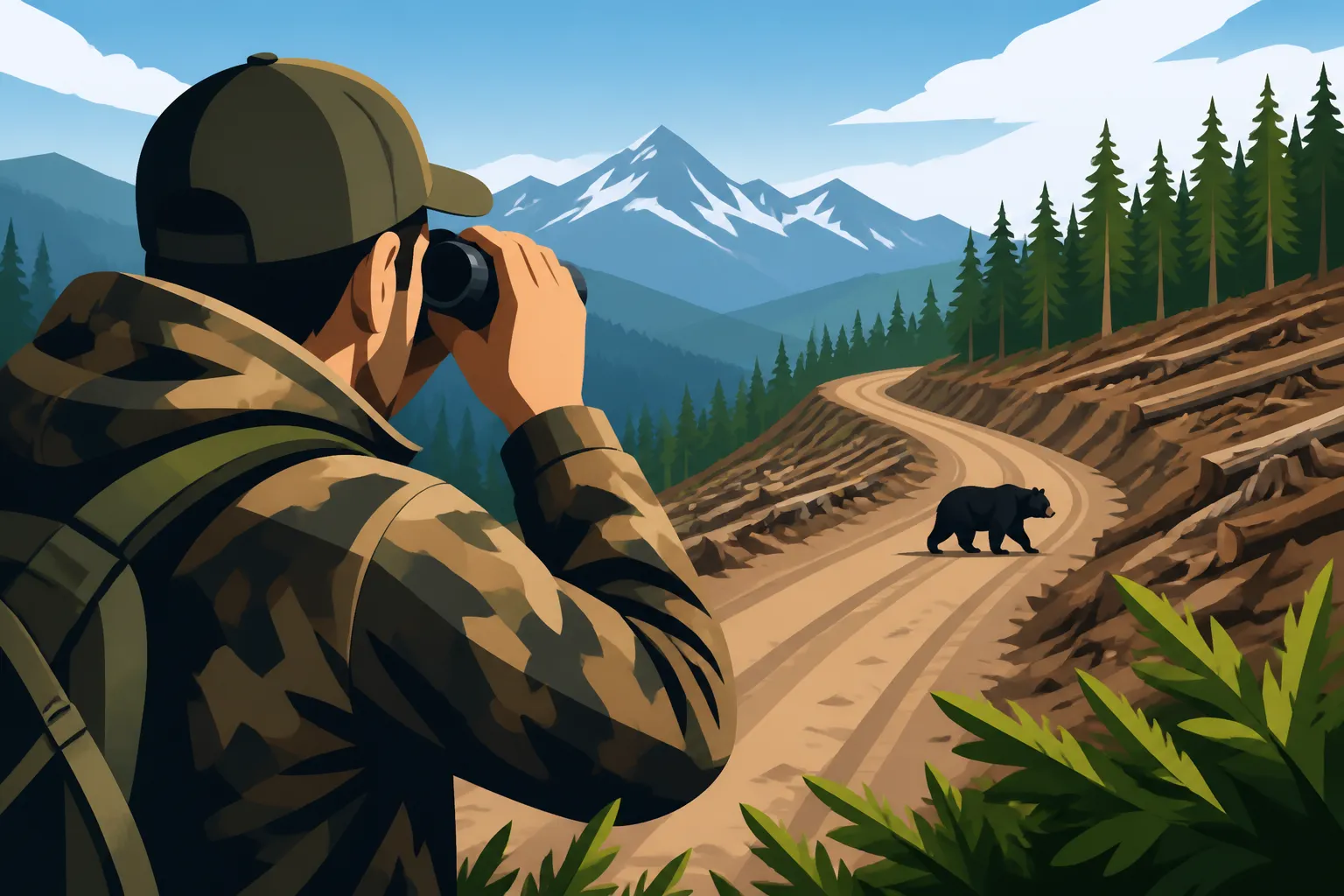
The open nature of the roadsides, cutbanks, and adjacent clearings also provides natural "windows" into the forest, allowing your optics to do their work. You can pull over safely, set up your spotting scope, and systematically scan large areas without physical obstruction. This ability to survey wide swaths of land from a stable, elevated position dramatically increases your chances of spotting a bear that might otherwise remain hidden. Even a small opening in the canopy or a distant hillside can be effectively glassed from the comfort of your vehicle, making these roads indispensable for spring bear hunters.
Following the Food Source
Bears, like most wildlife, are creatures of habit driven by their stomachs. In the spring, their primary motivation is to find the freshest, most nutritious vegetation available. This means they're constantly moving, following the progression of green-up as it sweeps across the landscape. Logging roads provide a linear path directly through these dynamic food zones. As you drive or walk these roads, you're essentially tracing the pathways that bears use to access their forage.
Think of an old logging road snaking its way up a valley. The lower, south-facing sections will green up first, attracting bears early in the season. As the snowline recedes and temperatures rise, the green-up will move higher up the slopes and deeper into the cutblocks. By focusing on areas where fresh growth is just emerging, you're putting yourself in the most likely spots to encounter feeding bears. This "following the green" strategy is incredibly effective, and logging roads provide the perfect infrastructure for it. They also often feature diverse habitat edges – where forest meets clearcut, or where a damp draw crosses a drier ridge – which creates microclimates that influence plant growth and, consequently, bear activity.
Essential Gear for Effective Road Glassing
Successful glassing isn't just about showing up; it's about being prepared with the right tools. Your gear plays a crucial role in your ability to spot bears and react effectively.
Optics: Binoculars, Spotting Scopes, and Tripods
When it comes to glassing for bears, your optics are your eyes, and investing in quality equipment will pay dividends. For most roadside glassing, a good pair of binoculars is your first line of defense. A 10×42 or 10×50 magnification is a solid choice, offering a wide field of view and enough power to pick out details at moderate distances. Look for binoculars from reputable brands that offer clear glass and good light transmission, especially important during dawn and dusk hours when bears are often most active. Carry them on a chest harness for quick access, so you're not fumbling when you spot something suspicious.
However, to really pick apart distant hillsides, old clearcuts, or the edges of dense timber, a spotting scope mounted on a sturdy tripod is indispensable. A 60-80mm objective lens with variable magnification (e.g., 20-60x) will allow you to zoom in and assess potential targets, confirming if that dark patch is indeed a bear or just a stump. A good tripod is non-negotiable; it provides the stability needed for extended glassing sessions and critical detail identification. Brands like Maven, Vortex, and Swarovski offer excellent options across various price points. Remember, the goal isn't just to see something, but to see it clearly enough to make a positive identification, especially when trying to differentiate between a boar and a sow with cubs, which is crucial for ethical hunting.
Vehicle and Navigation Tools
Your vehicle isn't just transport; it's an essential part of your glassing setup. A reliable 4×4 truck is often a necessity for accessing the vast network of British Columbia's logging roads, many of which can be rough, steep, or unmaintained. Ensure your vehicle is in good mechanical order, has adequate fuel, and carry a spare tire, jack, and basic recovery gear like a shovel and tow strap. Many of these roads can be remote, and cell service is often non-existent.
Beyond the vehicle itself, robust navigation tools are critical. While paper maps are always a good backup, digital mapping apps like GoHunt or onX Hunt are invaluable. These platforms provide detailed topographical maps, satellite imagery, and overlays showing Crown land boundaries, private land, and even potential wildlife habitat. They allow you to mark areas of interest, track your progress, and ensure you stay within legal hunting zones. Before heading out, download offline maps for your intended area, as streaming data will likely be unavailable. A satellite communication device, like an InReach or Zoleo, is also highly recommended for emergency communication when out of cell range. Remember, knowing where you are and where you're going is paramount for both safety and successful scouting.
Safety and Comfort Essentials
Spending long hours glassing from a truck or a vantage point requires more than just good optics and a map. Safety should always be your top priority, especially when hunting in bear country. Carry bear spray (and know how to use it) on your person, even when just scouting from the road, as close encounters can happen quickly. A first-aid kit, emergency shelter, fire-starting supplies, and enough food and water for at least 24-48 hours are non-negotiable. It's easy to get focused on finding a bear and forget the basics.
For comfort, dress in layers suitable for British Columbia's unpredictable spring weather. Temperatures can fluctuate wildly, from chilly mornings to warm afternoons, and rain is always a possibility. A comfortable seat or cushion for prolonged glassing sessions, and perhaps a small stove and some instant coffee or tea, can significantly enhance your experience and keep you alert. Don't forget bug spray, especially as the season progresses, as mosquitoes and black flies can quickly become a nuisance, distracting you from your task. Finally, make sure you inform someone of your planned route and estimated return time. Being well-prepared for any eventuality allows you to focus on the hunt with peace of mind.
Mastering the Art of Glassing Logging Roads
Glassing isn't just staring; it's a systematic and patient process that, when done correctly, vastly improves your success rate. There's an art to it, developed through practice and keen observation.
Strategic Road Selection and Timing
Not all logging roads are created equal, especially when it comes to spring bear hunting. Strategic selection is paramount. When planning your hunt, use your mapping tools like GoHunt to identify roads that traverse south-facing slopes, as these typically melt out and green up earliest. Look for areas with a mix of habitat: recent cutblocks, old growth edges, and natural clearings or avalanche chutes. Bears often move between these different zones, and roads that offer access to such diversity are usually more productive. Consider also the elevation; early in the season, focus on lower elevations where green-up begins, then gradually move higher as the spring progresses, following the receding snowline and the flush of new growth. This ties in with the concept of "Hunting British Columbia's Logging Road Network", where careful planning can lead to fruitful results.
Timing is equally crucial. Bears are most active during the cooler parts of the day: early morning, just after sunrise, and late afternoon into early evening. These are the "golden hours" for glassing. Bears tend to avoid the midday sun, often bedding down in thicker cover. Therefore, plan your glassing sessions around these peak activity times. It's often more productive to spend the midday hours exploring new roads, checking for fresh sign, or resting, rather than actively glassing. Be mindful of the weather as well; bears are often more active on overcast days or just after a light rain, as the vegetation is moist and the air is cooler. Sunny, warm days might see them out in the open, but they can also choose to stay in the shade.
Systematic Scanning Techniques
Effective glassing isn't a random glance; it's a methodical process. Once you've chosen a vantage point overlooking a promising area – perhaps a newly regenerated cutblock or a long, open hillside – set up your spotting scope on a tripod. Start by scanning the nearest terrain, slowly working your way outwards. Divide the area into grids, and methodically sweep your optics across each section, pausing to scrutinize any anomalies. Don't rush. A bear can look like a stump, a dark rock, or even a shadow. Train your eye to look for subtle movements, a different texture, or an unnatural colour amidst the natural landscape. Pay close attention to edges where different habitats meet, such as the line where an old growth forest meets a clearcut, or where a logging road cuts through dense timber.
Take your time with each scan. It's better to thoroughly examine a smaller area than to quickly skim a large one. Once you complete a grid, shift your focus slightly and repeat. After a thorough initial scan with your spotting scope, switch to your binoculars for a wider field of view, looking for anything you might have missed. Sometimes, a bear will appear only after you've looked away and then looked back, as they might have been bedded or hidden. Practice patience; many successful glassing sessions involve hours of meticulous scanning before a bear is finally located. Understanding how to scout a British Columbia Management Unit effectively from the road can also greatly enhance your chances.
Approaching and Stalking Once Spotted
Spotting a bear from a distance is only half the battle; the real work begins when you need to close the distance for a shot. The first step is to confirm it’s a legal bear – ideally a boar, and certainly not a sow with cubs. Use your high-power optics to carefully evaluate the animal. Look for signs like overall body size, shoulder hump, head shape, and general demeanor. If there's any doubt, especially about cubs, back out. Once you've positively identified your target, immediately mark its exact location on your GPS or mapping app. This is crucial because bears can move quickly, and what looks like an obvious landmark from a distance can disappear once you're on the ground.
Next, plan your approach. Consider wind direction, cover, and terrain. Bears have an incredible sense of smell, so staying downwind is paramount. Use available cover—trees, brush, terrain features—to conceal your movement. Move slowly and deliberately, pausing frequently to re-confirm the bear's location and ensure it hasn't detected you. This might involve a long hike through thick bush, or a careful stalk along a parallel ridge. Be prepared for a long, arduous stalk, especially if the bear is in a difficult-to-reach area. Sometimes, the best approach might mean driving to a different access point, adding kilometres to your journey but putting you in a much better position. Remember to always prioritize safety, especially if you're alone, and be prepared for "What to Do If You See a Grizzly" in the area, even when targeting black bears.
Safety, Regulations, and Ethical Considerations
Hunting, especially for bears, comes with significant responsibilities regarding safety, adherence to regulations, and ethical practices. These aren't just rules; they're commitments to conservation and personal well-being.
Bear Safety Beyond the Road
While glassing from the relative safety of your vehicle, it's easy to feel secure. However, as soon as you step out to stalk a bear or retrieve game, you're entering their domain, and bear safety becomes paramount. British Columbia is home to both black bears and grizzly bears, and while you might be targeting a black bear, encounters with grizzlies are always a possibility, especially in certain regions. Always carry bear spray on your person, readily accessible, and know how to deploy it quickly. Practice drawing and firing it (with an inert can, not a live one) so it becomes second nature under stress.
Travel in pairs if possible, as an extra set of eyes and ears can make a huge difference. Make noise while walking to avoid surprising a bear, particularly in dense cover. Pay attention to fresh bear sign: scat, tracks, claw marks on trees. If you encounter a grizzly, or a sow black bear with cubs, give them a wide berth and back away slowly, avoiding direct eye contact. Never approach a bear, especially one feeding on a carcass. Understanding "Bear Safety While Hunting in British Columbia" is not just a suggestion, but a critical part of ensuring you and your hunting partners return home safely.
Understanding British Columbia's Spring Bear Regulations
Navigating hunting regulations can be complex, and British Columbia's rules for spring bear hunting are no exception. Before you even think about heading out, you absolutely must read the most current British Columbia Hunting and Trapping Synopsis. This document is updated every two years and outlines season dates, bag limits, management unit (MU) specific rules, and mandatory reporting requirements. Pay close attention to the "British Columbia Bear Season Dates" for your specific region, as these can vary. Some MUs might have different opening and closing dates, or even specific restrictions on what kind of bear you can harvest (e.g., no grizzlies, specific antler/size requirements if other species are open).
A crucial regulation for spring bear hunting is the identification of sex. It is illegal to harvest a sow with cubs, and often illegal to harvest cubs themselves. Therefore, learning "Judging a Boar From a Sow With Cubs" in the field is a critical skill. This can be challenging, particularly at a distance or in varying light conditions. If you cannot definitively determine that the bear is a boar and not accompanied by cubs, you must pass on the shot. After a successful harvest, mandatory reporting requirements apply. You'll often need to submit a completed harvest report within 30 days. Failure to comply with any of these regulations can result in significant fines, loss of hunting privileges, and even criminal charges. Staying informed and compliant is your responsibility as a hunter.
Ethical Hunting Practices and Respect for the Resource
Ethical hunting goes beyond simply following the rules; it embodies a deep respect for the animal, the land, and the hunting tradition. For spring bears, this means ensuring a clean, humane kill. Only take shots you are confident you can make, within your effective range and skill level. Practice extensively with your firearm or bow beforehand to ensure accuracy. If you make a shot and the animal doesn't go down immediately, tirelessly track it to ensure it is recovered. Wasting game meat is not only unethical but illegal in British Columbia. Be prepared for "Meat Care in British Columbia's Warm Early Seasons" if you are successful, as spring temperatures can quickly spoil meat.
Respect for the resource also extends to conservation. British Columbia's bear populations are generally healthy, but sustainable hunting practices are key to maintaining them. This includes making conscious choices about which animals to harvest, prioritizing mature boars, and avoiding sows with cubs. It also means leaving the land as you found it, packing out all your trash, and minimizing your impact on the environment. Participate in hunter education programs, support conservation efforts, and uphold a positive image of hunting. By adhering to these ethical principles, you not only ensure the longevity of hunting but also honour the wildlife we pursue.
| Optics Type | Best Use Case | Magnification Range | Key Advantages | Considerations |
|---|---|---|---|---|
| Binoculars | General scanning, closer distances, quick identification | 8x-12x | Portable, wide field of view, good for spotting movement, handheld | Limited detail at long range, can cause eye strain over long periods |
| Spotting Scope | Long-range detail, identifying sex, evaluating trophy | 20x-80x (variable) | High magnification, excellent detail, essential for distant observations | Requires tripod, narrower field of view, less portable |
| Tripod | Stabilizing spotting scopes and high-power binoculars | N/A | Eliminates shake, reduces eye fatigue, allows for prolonged, steady glassing | Adds bulk and weight to gear list, can be cumbersome to carry |
Disclaimer
Please be aware that hunting regulations in British Columbia can change. While every effort has been made to provide accurate and up-to-date information, it is the hunter's sole responsibility to consult the official British Columbia Hunting and Trapping Synopsis and other relevant government publications before planning and undertaking any hunting activity. Always confirm season dates, bag limits, and specific management unit regulations.