Hunting an Old Growth Draw
Hunting an old growth draw in British Columbia can feel like stepping into another world entirely – a world that’s often intimidatingly dense and dark, causing many hunters to simply walk on by. But this reluctance means those ancient, tangled sections of timber become sanctuaries for game, especially for big, cagey animals looking for security. This guide is all about peeling back the layers of these incredible habitats and giving you the practical strategies to confidently hunt these often-overlooked havens.
What is an Old Growth Draw and Why Hunt It?
When we talk about "old growth draws," we're really describing a specific type of mature forest habitat, often found tucked into valleys, alongside creeks, or on shaded slopes. These aren't your easily accessible, open timber stands or recent cutblocks; they are dense, complex ecosystems that represent some of the most challenging, yet rewarding, hunting grounds in British Columbia. Many hunters focus on more open country, missing the prime opportunities these draws offer.
Defining Old Growth and Its Features
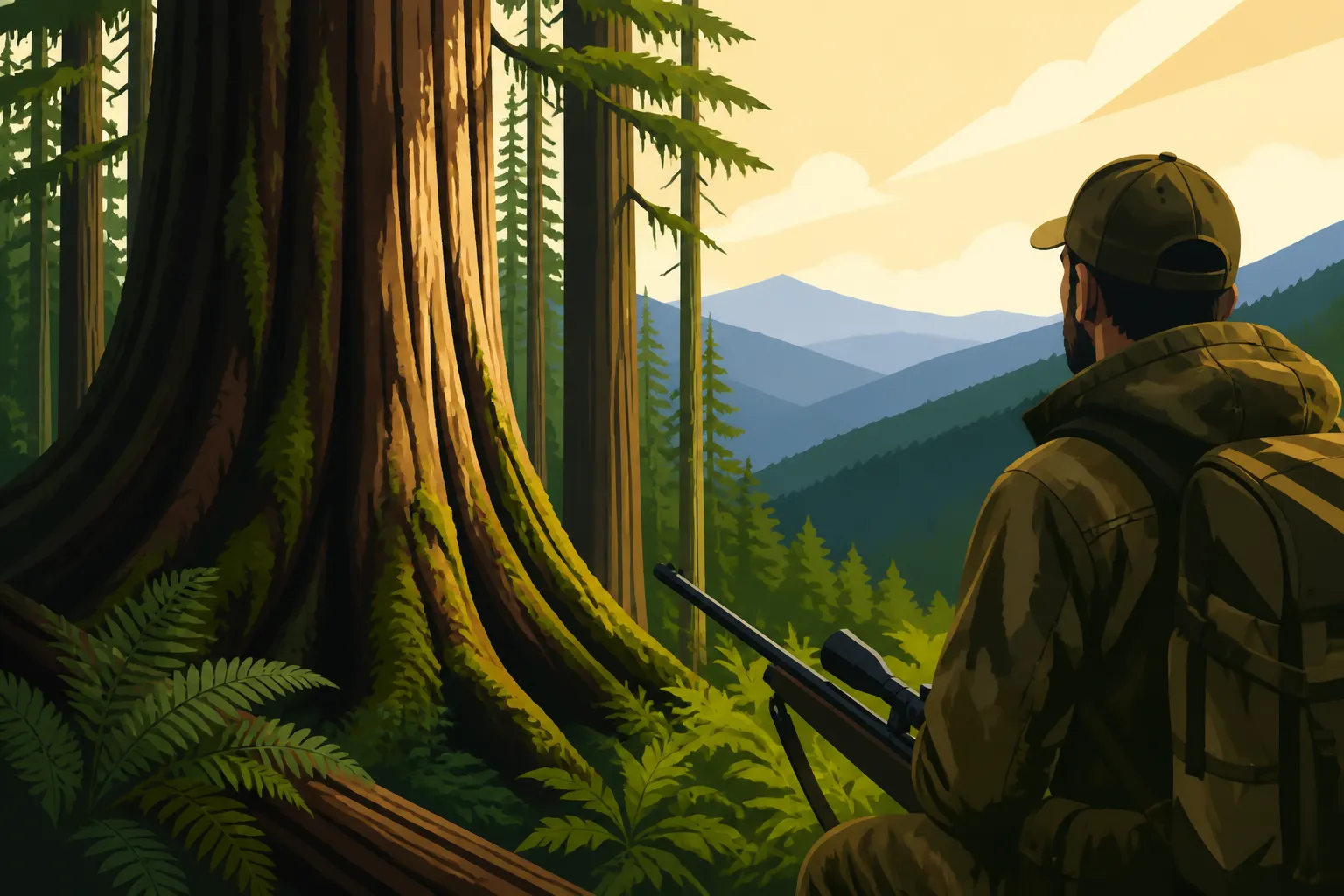
Old growth forests are characterized by trees that have reached a significant age and size for their species and site conditions. Think towering conifers like Douglas fir, western red cedar, or Sitka spruce, often with incredibly wide trunks that have stood for centuries. But it's not just the big trees. The draw part of "old growth draw" specifically refers to a topographical feature—a depression, a gully, a small valley, or a low-lying area where moisture tends to collect. Combine these two, and you get a unique environment.
These draws are a tangled mess of life and decay. You'll find a multi-layered canopy, allowing very little light to penetrate to the forest floor. Below the canopy, there's often a dense understory of ferns, salal, devil's club, and smaller trees, all competing for that dim light. And perhaps most importantly for wildlife, there’s an abundance of woody debris: fallen logs, nurse logs giving life to new trees, and stumps in various stages of decomposition. This debris creates a labyrinth of obstacles, but also provides incredible cover and bedding sites. The ground underfoot is often soft and mossy, making for quiet movement, but also hiding treacherous footing with hidden holes and slippery surfaces. Understanding these features is the first step in learning to hunt them.
Why Wildlife Seeks Out These Areas
Animals, especially mature bucks and bulls, are incredibly savvy about finding places where they feel safe. Old growth draws offer exactly that. First, the dense canopy and understory provide exceptional thermal regulation. In summer, they offer cool shade, a respite from the sun, and a place to avoid biting insects. In winter, the heavy canopy can intercept snowfall, creating areas with less snow on the ground, making movement and foraging easier. They are often less affected by high winds and extreme cold compared to exposed ridges or open clearings.
Secondly, and perhaps most crucially, these draws offer unparalleled security cover. The dense vegetation and topographical features create a fortress where deer, elk, and bear can disappear instantly. The maze of fallen logs, thick brush, and natural depressions makes it incredibly difficult for predators—both two-legged and four-legged—to spot them. When an animal feels pressured in more open areas, it will inevitably retreat to these secure zones. They are also often less disturbed by human activity because, frankly, most people avoid them due to the difficult travel. This makes them prime bedding areas, travel corridors between feeding grounds and higher elevations, and crucial escape routes when they sense danger. You might spend a lot of time still-hunting through seemingly empty woods only to stumble upon the biggest buck of your life tucked into a small pocket of timber within an old growth draw. Many of these draws are also connected to ancient game trails, forming vital highways for animals. You might find a well-worn trail leading from a Hunting an Old Growth Edge right into the heart of a dense draw.
Unlocking the Secrets: Reading Old Growth Sign
Hunting an old growth draw isn't about covering vast amounts of ground quickly; it's about meticulous observation and slow, deliberate movement. The density means you won't see animals from far off, so you need to understand where they’ve been, where they’re going, and where they feel most comfortable. This requires a sharp eye and a deep appreciation for subtle details.
Identifying Key Game Trails and Rubs
In the thick chaos of an old growth draw, finding clear game trails can be challenging, but they are absolutely essential. Animals will always take the path of least resistance, even if it's not obvious to human eyes. Look for subtle depressions in the moss, broken twigs, or scuff marks on muddy patches between fallen logs. These trails often weave around obstacles, creating tunnels through the densest brush. You'll notice they tend to follow contour lines, creek beds, or natural benches within the draw. Sometimes, a trail might be faint and only visible for a few feet before disappearing into a thicket, but if you keep your head up and look for the next logical opening, you can often pick it back up.
Pay close attention to where these trails intersect, or where several converge. These are natural funnels, choke points where animals are likely to pass. Look for fresh tracks, especially after a rain, or disturbed moss and leaves. Rubs on small trees or branches, particularly during the rut, are also critical indicators. While you might not see massive rubs on large trees in a dark draw, smaller saplings or even thick vines rubbed smooth by antlers can tell you a buck or bull is using that specific corridor. Hunting a Second-Growth Timber Block involves similar sign reading, but old growth often demands even more attention to detail due to the sheer volume of visual clutter.
Understanding Thermal and Security Cover
Animals are master strategists when it comes to utilizing their environment for comfort and safety. In an old growth draw, understanding thermal and security cover means predicting where an animal will be at different times of the day, and in varying weather conditions.
- Thermal Cover: This is about temperature regulation. On a hot, sunny day, animals will seek the deepest, darkest shade, often on north-facing slopes or in dense pockets where the canopy is thickest. The cooler, damp air in the bottom of a draw can be a major draw for deer or elk trying to escape the midday heat. Conversely, on a cold, blustery day, they might shift to areas where the dense timber offers a break from the wind, perhaps a slight ridge within the draw that gets a sliver of sun in the afternoon. The dense canopy also traps warmth, creating a slightly warmer microclimate under the trees.
- Security Cover: This is about feeling safe from predators. In old growth, security cover is everywhere, but some spots are better than others. Look for bedding areas on small rises or benches within the draw, often against a large fallen log or at the base of a massive tree, giving the animal a good vantage point downwind while obscuring its profile. They want to be able to see or smell danger before it sees them. These bedding areas will often be just off a main trail, allowing for a quick escape. When you're reading a British Columbia MU map, pay attention to north-facing slopes and deep ravines, as these are often prime candidates for holding old growth draws with excellent thermal and security cover.
Tactics for Navigating and Hunting Old Growth Draws
Hunting old growth isn't like hunting open country. Forget long shots or glassing for miles. This is up-close, personal hunting that demands patience, stealth, and a different set of skills. You're entering the animal's fortress, and you need to play by its rules.
Still-Hunting the Understory
Still-hunting is probably the most effective tactic for old growth draws. This isn't just "walking slowly"; it's a methodical process of moving a few steps, then stopping to scan and listen for several minutes, repeating this over and over. Your eyes should be constantly searching for horizontal lines (the back of an animal) in a vertical world (trees). Look for patches of contrasting color, unnatural shapes, or the subtle flicker of an ear. The dappled light and shadows can play tricks on your eyes, so take your time.
Focus on moving silently. The mossy ground can be forgiving, but fallen branches, slippery logs, and dense brush are everywhere. Pick up your feet, place them down gently, and be prepared to take extra time to navigate obstacles. Wind direction is paramount; always try to hunt into the wind or with a crosswind. In a draw, thermals can be tricky, often moving downhill in the morning and evening, and rising during the day. Observe the movement of fine dust or a wisp of dryer lint to gauge air currents. This slow, deliberate approach, similar to Still-Hunting Second Growth for Blacktail, allows you to cover ground thoroughly without spooking game that might be bedded only yards away. You're hunting with your senses, not just your eyes.
Setting Up for Ambushes and Patience
Sometimes, instead of constantly moving, the best strategy is to find a key funnel or bedding area and set up an ambush. If you've identified a well-used game trail, a creek crossing, or a patch of particularly appealing browse within the draw, positioning yourself quietly downwind can be incredibly effective. This requires scouting beforehand, either physically or by utilizing mapping tools like onX Hunt to identify potential travel corridors and bedding zones based on topography and vegetation.
Once you’ve found your spot, commit to it. Get comfortable, minimize your movement, and settle in for an extended period. This could mean hours. Being patient in a thick, dark draw can be mentally challenging, but it pays off. Animals will often move at very specific times – early morning, late evening, or during a mid-day lull when they feel most secure. Having the discipline to wait them out, rather than pushing through and potentially bumping them, is a key to success. This is especially true when Hunting Blacktail in British Columbia's Coastal Rain, where animals are used to moving silently through wet, dense environments.
Calling Strategies in Dense Timber
Calling in old growth draws is a different game than in open country. The dense vegetation will muffle and distort sounds, meaning your calls won't carry as far, but also that they sound more realistic for close-quarters interactions.
- Deer: A fawn bleat can be incredibly effective for enticing a curious buck, especially during the rut. A soft grunt might also get a response. Keep your calls subtle and don't overdo it. The goal is to make the animal think another deer is nearby, not to blast a call that sounds out of place.
- Elk: Cow calls and soft mews can work to draw in a bull, particularly if you're trying to locate one in thick timber. Bugles, while exciting, should be used with caution; a full-on challenge bugle in dense cover might spook a bull if he can't immediately pinpoint you. A soft, questioning bugle or chuckle can sometimes be enough to elicit a response and get him to investigate.
- Bears: If you're hunting bears, a distress call can sometimes bring them in, but again, be mindful of the range and the density of the cover. Bears often use these draws as travel corridors, especially during salmon runs or berry seasons.
Always consider the wind and your cover. If you make a call, be ready for an immediate, close-range response. Have your weapon ready and be prepared to move quickly if an animal approaches from an unexpected direction.
Essential Gear and Safety in Dense Cover
The unique challenges of old growth draws demand specific gear choices and a heightened focus on safety. You're going into areas that are less traveled, often remote, and inherently more difficult to navigate and extract yourself from if something goes wrong.
Navigational Tools and Communication
Getting lost in an old growth draw is a very real possibility. The dense canopy often blocks GPS signals, and without distant landmarks, it's easy to become disoriented. A reliable GPS unit or a smartphone with offline mapping capabilities (like onX Hunt, which works brilliantly for showing topography and access roads even without cell service) is absolutely crucial. However, don't solely rely on electronics. Always carry a physical compass and a topographic map of the area. Know how to use them. Before you enter, take a bearing to a known feature, like a road or a major creek, and check it regularly. Mark your entry point on your map and GPS.
Cell service is often nonexistent in these deep, timbered draws. For communication, especially if you're hunting alone or in a small group, a satellite messenger or satellite phone is a wise investment. Devices like those offered by Garmin InReach or Spot can send texts, track your movements, and, most importantly, send an SOS signal if you find yourself in an emergency. Satellite Communication on a Remote Hunt is not just a luxury; it's a lifeline in British Columbia's wild backcountry. Always let someone know your hunting plan, including your intended route and expected return time. This is a fundamental part of Emergency Planning in British Columbia's Backcountry.
Footwear, Clothing, and Packing Out
Your gear needs to be robust and functional for the conditions you'll encounter.
- Footwear: Sturdy, waterproof boots with excellent ankle support and aggressive tread are non-negotiable. You’ll be navigating slippery logs, wet moss, uneven ground, and potentially small creeks. A blown-out boot or a twisted ankle deep in an old growth draw can quickly turn a hunt into a survival situation.
- Clothing: Layers are your friend. You'll be exerting yourself climbing over obstacles, but then stopping for long periods of still-hunting or waiting. Wicking base layers, an insulating mid-layer, and a durable, waterproof outer shell are essential. Expect to get snagged on brush, so choose tough fabrics. Blaze orange requirements are important for visibility, so make sure your outer layer meets the regulations. Given that many of these areas are damp, Hunting British Columbia's Coastal Rain gear advice applies here – breathable waterproofing is key.
- Packing Out: This is where the real challenge begins once you've harvested an animal. Getting a What a British Columbia Mule Deer Weighs or What a Coastal Blacktail Weighs out of a dense, obstacle-ridden old growth draw is a monumental task. A good frame pack is essential for hauling meat, and you should consider how you'll quarter and cool the animal in such an environment. Be prepared for multiple trips. Don't underestimate the difficulty; this is often Packing Out of British Columbia's Steep Country at its most challenging, with less clear paths and more obstacles.
| Aspect of Old Growth Draw | Hunting Implication | Recommended Action |
|---|---|---|
| Dense Canopy | Low light, poor visibility. | Hunt slowly, use binoculars for detail, focus on movement. |
| Thick Understory | Restricted movement, muffled sound. | Wear durable clothing, pick steps carefully, listen intensely. |
| Fallen Logs/Debris | Obstacles, bedding spots, cover. | Use as natural blinds, check behind/under logs for game. |
| Soft, Mossy Ground | Quiet movement, poor footing. | Take slow, deliberate steps, wear supportive boots. |
| Limited Vistas | Short shooting lanes. | Practice close-range shots, be ready for quick target acquisition. |
| Poor Cell Service | Isolation. | Carry satellite communication, tell someone your plan. |
| Good Thermal/Security | Prime bedding/refuge areas. | Target early morning/late evening, scout for bedding sign. |
Hunting an old growth draw is a commitment, a test of patience, and a deep dive into some of British Columbia's most pristine and challenging hunting grounds. But for those willing to put in the effort, the rewards can be truly unforgettable. You’re not just hunting for an animal; you’re immersing yourself in an ancient, vibrant ecosystem that demands respect and offers profound lessons in the art of the hunt. Keep an eye on regional British Columbia Deer Season Dates by Region to time your trips effectively. Even if you're not planning a guided hunt, resources like GoHunt can provide useful insights into harvest data and unit characteristics that can help inform your decision-making for these specific kinds of habitats.
Disclaimer
This article is for general informational purposes only and does not constitute professional advice. Laws, prices and regulations vary by location and change over time. Consult a qualified professional for guidance on your specific situation.