Mountain Goat Season Dates by Region
Trying to pin down the exact mountain goat season dates across British Columbia's vast and diverse landscape can feel like an exercise in frustration. The province's hunting regulations are renowned for their complexity, with season openings and closures differing significantly not just by large geographical regions, but often by individual Management Units (MUs) and whether a season is a General Open Season (GOS) or a highly coveted Limited Entry Hunt (LEH). This can make planning a mountain goat hunt, arguably one of BC's most challenging and rewarding pursuits, incredibly difficult. This comprehensive guide aims to untangle that intricate web, providing clarity on where and when you can legally pursue these incredible alpine animals in British Columbia.
Navigating British Columbia's Diverse Hunting Regions for Mountain Goats
British Columbia is a massive province, and its diverse geography means that wildlife populations, and thus hunting regulations, vary dramatically from one area to another. For mountain goats, this variability is particularly pronounced, making a general "BC goat season" a concept that simply doesn't exist.
Why Regional and Management Unit Specifics are Paramount
Understanding British Columbia's hunting regulations for mountain goats begins with recognizing the importance of regional and Management Unit (MU) specifics. Unlike some more widespread species where seasons might be broadly consistent across a large swathe of land, mountain goat populations are often localized, relatively small, and highly sensitive to hunting pressure. Wildlife managers in BC therefore tailor regulations to very specific areas to ensure sustainable harvest and healthy herds.
What this means for hunters is that you cannot assume that a season in one valley will be the same as a season just a mountain range over. A Management Unit, which is a subdivision of a larger hunting region, is the granular level at which most mountain goat regulations are defined. These MUs account for local population dynamics, habitat conditions, and access challenges. It’s this meticulous approach that ensures the long-term viability of these majestic animals. Failing to check the specific MU you intend to hunt could lead to you being out of season, or worse, hunting an area designated for LEH without authorization, which carries severe penalties.
Understanding the Landscape of British Columbia's Nine Hunting Regions
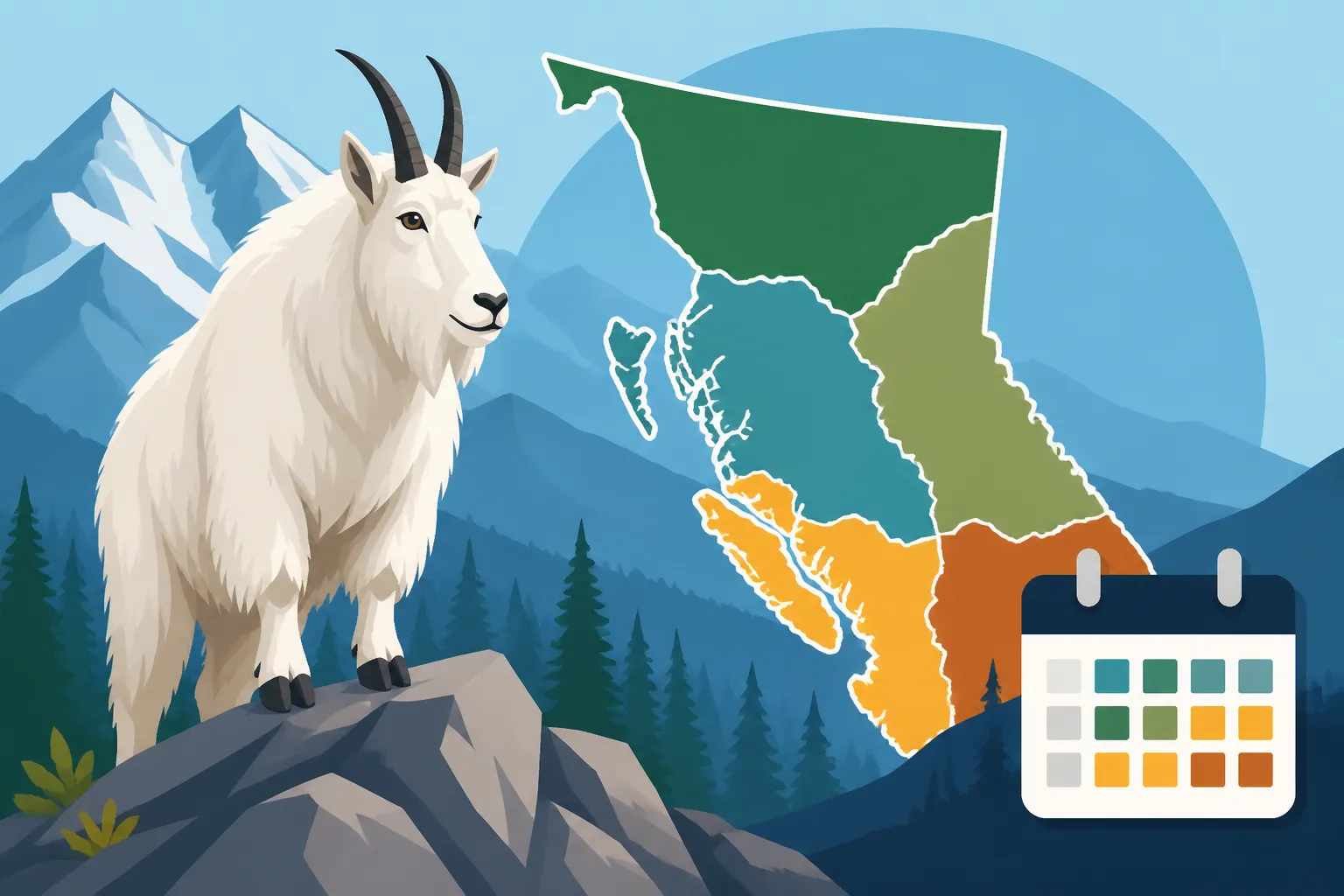
British Columbia is divided into nine administrative hunting regions, each with its own unique characteristics, ecosystems, and hunting opportunities. From the coastal rainforests of Region 1 (Vancouver Island) and Region 2 (Lower Mainland), to the sprawling interior plateaus of Region 3 (Thompson-Nicola) and Region 5 (Cariboo), the vast northern wilderness of Region 6 (Skeena), Region 7 (Omineca), and Region 8 (Peace), and the rugged peaks of Region 4 (Kootenays) and Region 9 (Okanagan), each offers a different experience.
For mountain goats, the most prominent regions where viable populations exist are generally the mountainous parts of the Kootenays (Region 4), Omineca (Region 7), Peace (Region 7), Skeena (Region 6), and Coast (Region 1, 2, 6) regions. However, even within these regions, the specific MUs holding huntable populations are isolated. For instance, the Kootenays might have goats in the Purcell Mountains, but not necessarily in the valley bottoms. The regulations synopsis will detail these breakdowns with precision, indicating which MUs within a region have GOS or LEH opportunities. Tools like GoHunt's mapping system or iHunter can be invaluable for visualizing these boundaries and overlaying them with potential habitat, giving you a crucial advantage in your planning.
Decoding Mountain Goat Season Dates: General Open Season vs. Limited Entry Hunting
When it comes to mountain goats in British Columbia, understanding the distinction between General Open Seasons (GOS) and Limited Entry Hunting (LEH) is absolutely critical. This isn't just a minor detail; it dictates whether you can simply buy a tag and go, or if you need to be successful in a competitive draw.
General Open Season Opportunities for Mountain Goats
Historically, British Columbia offered General Open Seasons for mountain goats in some areas, meaning any resident hunter with a valid hunting licence and a mountain goat species tag could legally hunt during the specified dates. These GOS opportunities were typically found in more remote, harder-to-access MUs where hunting pressure was naturally low, or in areas with robust populations. However, due to the sensitive nature of mountain goat populations and increasing hunter access, true GOS for any mountain goat are becoming increasingly rare.
If GOS for mountain goats do exist in the current regulations synopsis, they are often for specific conditions, such as "any male" or "male, full curl," rather than "any mountain goat." These seasons are generally short, often running from early September to mid-October, and are extremely localized. Hunters must meticulously check the current year's British Columbia Hunting Regulations Synopsis for precise dates, bag limits, and any specific antler or horn restrictions. Never rely on past year's regulations, as GOS opportunities can be removed or altered with little notice. For example, a GOS that existed two years ago might now be an LEH, or completely closed. You can find detailed information on these general seasons within the British Columbia Big Game Season Dates section of the synopsis.
The Limited Entry Hunting (LEH) System for Mountain Goats
The vast majority of mountain goat hunting opportunities in British Columbia fall under the Limited Entry Hunting (LEH) system. This is a draw system where a finite number of authorizations are issued for specific species, MUs, and seasons. The primary purpose of LEH is to carefully manage harvest levels, ensure sustainable populations, and provide high-quality hunting experiences by controlling hunter density. For species like mountain goats, which are slow to reproduce and inhabit fragile alpine environments, LEH is an indispensable management tool.
Applying for an LEH authorization requires careful planning. Hunters must typically submit their applications in the spring (usually by late May or early June) for the upcoming fall seasons. The draw results are then released later in the summer. Success in the draw can be extremely challenging, with odds often being very low, especially for highly desirable goat MUs. Many dedicated goat hunters apply for years, even decades, before drawing an authorization. Understanding the LEH system, including application deadlines and how your points accumulate, is crucial. For more detailed insights into the process, you can consult our guide on British Columbia's Limited Entry Hunting Draws and understand What an LEH Application Costs.
Typical Season Date Ranges by Region and Management Unit
While exact dates are meticulously outlined in the annual synopsis, we can discuss typical patterns for mountain goat seasons in British Columbia. Generally, mountain goat seasons, whether GOS or LEH, run from late summer into late fall. A common opening is around September 1st, extending through October, and sometimes into early November. The timing is strategic, often coinciding with cooler weather which aids in meat care and also allows for the goats to grow their winter coats, making for better capes.
For instance, in the Kootenays (Region 4), LEH seasons might open in early September and run through to mid-October. In the Skeena region (Region 6), you might see seasons stretching from September 1st to October 31st, or even into the first week of November in some MUs. The Peace region (Region 7) can also offer similar timeframes, often with varying start and end dates within the same region but different MUs. It’s important to note that these are broad generalizations. You simply must consult the official BC Hunting Regulations Synopsis for the specific year and MU you are interested in. This document is the ultimate authority. You can find detailed maps and breakdowns of these zones in our guide to British Columbia's Management Units and Regions.
Here's a representative table illustrating typical (hypothetical, as actual dates vary annually) mountain goat LEH season date ranges in some key regions:
| Region Name (Number) | Representative Management Units (MUs) | Typical LEH Season Start | Typical LEH Season End | Notes & Specifics |
|---|---|---|---|---|
| Kootenays (Region 4) | 4-18, 4-19, 4-20 (Purcell Mts.) | September 1st | October 15th | Often "Any Mountain Goat" LEH. Highly competitive draw. |
| Skeena (Region 6) | 6-2, 6-3 (Bulkley-Nechako) | September 1st | October 31st | Remote access, often "Any Mountain Goat" LEH. |
| Peace (Region 7) | 7-22, 7-30 (Northern Rockies) | September 10th | November 10th | Seasons can extend later into fall due to northern latitude. "Any Mountain Goat" LEH. |
| Omineca (Region 7) | 7-10, 7-12 (Cariboo Mountains) | September 1st | October 31st | Wilderness areas, "Any Mountain Goat" LEH. |
| Coast (Region 2) | 2-11, 2-12 (Coast Range) | September 1st | October 20th | Limited opportunities, some specific "Male Mountain Goat" LEH. |
Disclaimer: This table provides typical date ranges based on historical patterns and general information. Actual season dates, specific MUs, and hunt conditions (e.g., 'any goat', 'male only') are subject to annual changes and must be verified in the most current British Columbia Hunting Regulations Synopsis.
Essential Considerations Beyond the Dates for British Columbia Mountain Goat Hunts
Obtaining an LEH authorization or finding a GOS for mountain goats is just the first step. The challenges and responsibilities associated with hunting these incredible animals extend far beyond merely knowing the dates. Hunters must be prepared for the arduous physical demands, adhere to strict regulations, and commit to ethical practices in a truly unforgiving environment.
The Critical Role of Compulsory Inspection and Reporting
Mountain goats, like many of British Columbia's premier big game species, are subject to compulsory inspection and reporting. This isn't just a bureaucratic hurdle; it's a vital component of wildlife management. When you harvest a mountain goat, you are typically required to bring the head, horns, and sometimes other parts of the animal, to an authorized Compulsory Inspection station or a provincial Fish and Wildlife Branch office within a specific timeframe (often 72 hours). During this inspection, biologists collect crucial data such as age, sex, and health indicators, which helps them monitor the health of the population and inform future management decisions.
Furthermore, regardless of whether your animal needs compulsory inspection, all hunters who harvest an animal in British Columbia are required to submit a harvest report. This must typically be done online within 30 days of the kill. This reporting is essential for tracking harvest numbers and ensuring sustainable management of the province's wildlife resources. Ignoring these requirements can result in fines or loss of hunting privileges. Our guides on Which Species Still Need Compulsory Inspection and Compulsory Reporting Within Thirty Days offer more detailed information on these critical obligations.
Physical Demands, Gear, and Ethical Hunting for Goats
Hunting mountain goats is universally regarded as one of the most physically demanding hunts in North America. These animals inhabit extreme alpine environments, often dwelling in precipitous cliffs, steep rock slides, and high-elevation basins. A successful goat hunt requires exceptional cardiovascular fitness, strength, and mental fortitude. You'll likely be hiking for days at high altitudes, navigating treacherous terrain, and carrying heavy loads (including substantial meat and hide) out of very difficult country. This is not a hunt for the faint of heart or the unprepared.
Beyond physical conditioning, the right gear is non-negotiable. This includes rugged, mountain-specific boots with excellent ankle support and traction, quality optics (spotting scope, binoculars), layered clothing systems designed for rapidly changing alpine weather, a reliable rifle capable of accurate long-range shots (often necessary in open mountain environments), and a robust frame pack for packing out meat. Ethical hunting also plays a huge role. This means taking responsible shots, minimizing disturbance to other wildlife, and committing to retrieving every edible portion of the animal, no matter how challenging the pack-out. It’s often said that Why Goat Hunting Is the Hardest Pack Out, and that sentiment is entirely accurate. Being prepared for the unique challenges of Hunting Mountain Goat on British Columbia Rock will make all the difference.
Planning Your British Columbia Mountain Goat Expedition
A successful mountain goat hunt in British Columbia hinges on meticulous planning, thorough research, and a realistic assessment of the challenges involved. This isn't a spur-of-the-moment trip; it's an expedition that requires months, sometimes years, of preparation.
Thorough Research and Scouting Tools
Before you even consider applying for an LEH or looking at GOS dates, dive deep into research. Start with detailed topographic maps (digital and paper), satellite imagery, and aerial photos of potential MUs. These tools are invaluable for identifying goat habitat, escape routes, bedding areas, and potential travel corridors. Look for features like steep, broken terrain, cliff bands, high-elevation meadows, and south-facing slopes that might hold early-season forage.
For truly in-depth planning, consider platforms like GoHunt which offer detailed land ownership maps, topography, and even historical draw odds for specific LEH zones in some jurisdictions, providing a comprehensive view of your hunting area. Leveraging resources like GoHunt to study satellite imagery and identify potential goat habitat well before your boots hit the ground can save you countless hours of unproductive hiking. Combine this with reading hunter reports, consulting with local wildlife biologists (where appropriate and available), and understanding the specific characteristics of the MUs you are targeting. This initial phase of Scouting a British Columbia Management Unit Online and Reading a British Columbia LEH Zone Map is critical to developing an effective strategy.
Preparing for British Columbia's Rugged Mountain Environments
Physical fitness is not just a recommendation for a British Columbia mountain goat hunt; it's a prerequisite. Begin an intense training regimen months in advance, focusing on cardiovascular endurance, leg strength, and carrying heavy loads over uneven terrain. Simulate mountain conditions by hiking with a weighted pack, climbing stairs, and incorporating exercises that build core strength and stability. Many seasoned goat hunters train year-round for these challenging excursions.
Logistically, plan for spike camps, reliable water sources (and purification methods), and the unpredictable nature of alpine weather. You'll likely encounter everything from warm sunshine to freezing rain, snow, and high winds within a single trip, or even a single day. Pack accordingly with high-quality rain gear, insulation, and robust shelter. Always have a robust Emergency Planning in British Columbia's Backcountry strategy, including satellite communication devices like an InReach or Garmin Messenger, and a comprehensive first-aid kit. Understanding the movements and seasonal patterns of Mountain Goats in British Columbia's Peaks will give you a significant edge, but physical readiness will ensure you can execute your plan safely and effectively.
Disclaimer
The information provided in this guide is for general informational purposes only and should not be considered legal advice. Hunting regulations in British Columbia are subject to change annually and can be highly specific to regions, Management Units, and species. It is the sole responsibility of the hunter to consult and comply with the most current British Columbia Hunting Regulations Synopsis, available from the provincial government, before engaging in any hunting activities. Always prioritize safety, ethical hunting practices, and respect for wildlife and the environment.