What a Coastal Blacktail Weighs
It's a classic hunter's dilemma: you've got a beautiful coastal blacktail buck on the ground, adrenaline is coursing, and you're already trying to estimate its size and weight. More often than not, the animal looks twice as big on the ground as it did through your scope, and you're left wondering just how much of a grunt it's going to be to get it back to camp. This guide is here to shed some light on what a coastal blacktail actually weighs, what factors influence that weight, and how to best prepare for the pack-out, so you're never caught off guard again.
Understanding Coastal Blacktail Weights: More Than Just a Number
When we talk about a deer's weight, it's rarely a simple, single number. There are so many variables at play, from the specific subspecies to the time of year and the richness of their local habitat. Coastal blacktail, or as they're officially known, Columbian blacktail deer, are found along British Columbia's coast, especially concentrated on Vancouver Island and the adjacent mainland. These aren't the monster-bodied mule deer of the interior, but don't let their relatively smaller stature fool you – they can still be a significant undertaking to pack out.
Average Live Weights for Coastal Blacktail
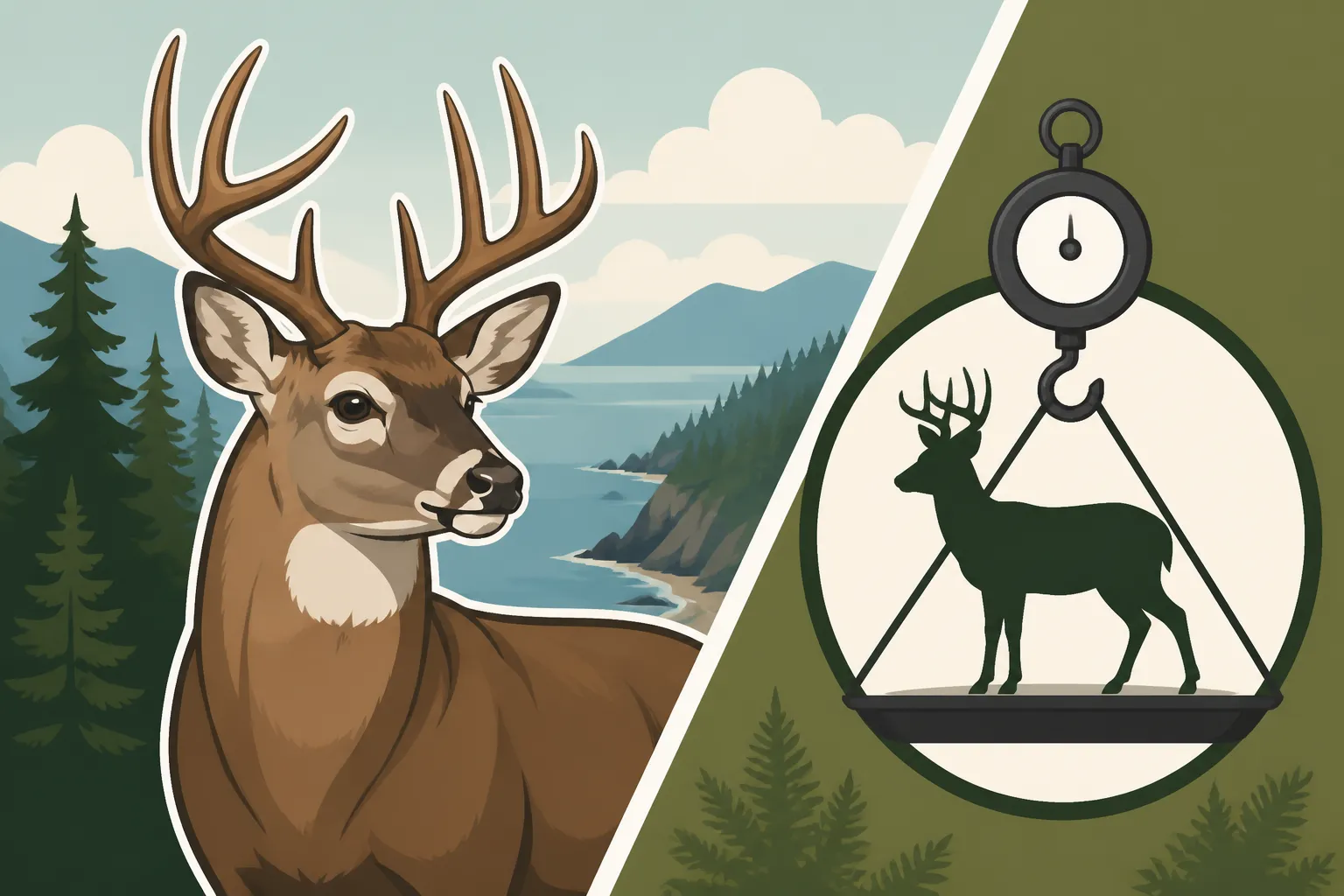
So, what are we really talking about? A typical mature coastal blacktail buck, in good condition, might weigh anywhere from 130 to 200 pounds live weight. Yearling bucks, often identifiable by spike or small fork antlers, usually fall in the 90 to 120-pound range. Does are generally lighter, with a mature doe usually tipping the scales between 80 and 130 pounds. Of course, you'll hear tales of a truly exceptional buck pushing past that 200-pound mark, maybe even flirting with 220 or 230 pounds, but these are truly the giants of the species.
It's important to remember that these are just averages. Picture a prime two-and-a-half-year-old buck in September, sleek and fat after a summer of feasting on lush coastal vegetation. It's going to be significantly heavier than a similar-aged buck that just scraped through a hard winter, or one taken later in the rut when it's lost a lot of body mass from breeding activity and not eating much. The time of year plays a huge role in their overall condition and, subsequently, their weight. Hunters who target these animals often find themselves Hunting British Columbia's Coastal Rain, which can add a few pounds of water weight to the hide and hair, but more significantly, contributes to the abundant forage that helps them grow.
Factors Influencing a Buck's Size and Weight
Beyond just the average, several key factors can really swing a blacktail's weight one way or another. Understanding these can help you better anticipate what you're dealing with when you're out in the field.
First off, age is a huge determinant. A young buck is still growing, putting energy into developing its body and antlers. A two to four-year-old buck is often at its peak physical condition and weight, assuming good nutrition. Older bucks, while they might have impressive antlers, can sometimes start to decline in body mass, especially if they've endured tough winters or intense rutting seasons year after year.
Secondly, habitat and nutrition are paramount. A blacktail living in an area with abundant, high-quality forage – think lush clearcuts, productive estuaries, or areas with a good mix of browse and mast crops – is going to be heavier and healthier than one scratching out a living in marginal, overgrazed land. The sheer richness of British Columbia's coastal ecosystems, particularly on Vancouver Island, contributes to healthy deer populations. Deer that consistently have access to a varied diet, including fresh greens, berries, and fungi, will show it in their body condition. For example, if you're Hunting a British Columbia Island Clearcut Edge, you might encounter deer that are particularly well-fed due to the new growth stimulated by logging.
Finally, time of year and rutting activity cannot be overstated. Bucks are typically at their heaviest in late summer and early fall, before the rigours of the rut. Once the breeding season begins, they expend massive amounts of energy chasing does and fighting off rivals, often eating very little. By the time the rut winds down in late November or early December, a big buck can easily have dropped 15-25% of its pre-rut body weight. This is why a buck taken during the early archery season in September might feel like a much heavier animal than a comparable one shot in the late rifle season, even if their antler size is similar.
Field Dressing and Pack Out Considerations
So you've harvested your blacktail. Now the real work begins. Knowing the live weight is one thing, but understanding how that translates to field-dressed weight is crucial for planning your pack out. Many hunters underestimate the sheer physical effort involved, especially in British Columbia's often steep and rugged coastal terrain.
The Importance of Dressed Weight for Packing
When we talk about "dressed weight," we're referring to the weight of the animal after the entrails have been removed. This is the practical weight you'll be dealing with for the initial haul out of the woods. For a coastal blacktail, removing the gut pile typically reduces the total live weight by about 25-35%. So, our 150-pound live weight buck now becomes roughly 97-112 pounds of field-dressed meat and bone. That's still a substantial load, especially if you're navigating dense timber or steep terrain.
Many hunters choose to quarter their deer in the field, reducing the weight of each individual load and making it much more manageable to carry. This usually involves removing the four quarters, backstraps, tenderloins, neck meat, and sometimes the rib meat. The hide and head, if you're planning a full shoulder mount, will add back some weight, but often a hunter will opt to bone out the meat entirely, further reducing the pack weight dramatically. This decision often comes down to how far you are from the truck and how challenging the terrain is. For hunters tackling remote areas, being able to bone out an animal quickly and efficiently is a critical skill, allowing them to carry out pure meat, significantly lightening the load. This is especially true when you're deep in the bush, and considering how to manage Getting Meat Out of Steep British Columbia Country.
Estimating Live Weight from Field-Dressed Weight
It's a common practice for hunters to weigh the dressed carcass once they're back at camp or the vehicle, but how do you work backward to estimate the live weight? A good rule of thumb is to take your dressed weight and multiply it by 1.3 to 1.5, depending on how thoroughly the animal was gutted. If you just removed the basic gut pile, a multiplier closer to 1.3 is often accurate. If the animal was gutted, had the heart and lungs removed, and possibly the liver, a 1.4 or 1.5 multiplier might be more appropriate.
Let's look at an example. If you weigh your field-dressed buck and it comes in at 110 pounds, multiplying by 1.4 gives you an estimated live weight of 154 pounds. This isn't an exact science, but it gives you a much better sense of the animal's true size. Knowing these figures can be incredibly useful, not just for bragging rights, but for accurately reporting your harvest or for personal record-keeping. It also helps you appreciate the animal's journey and growth.
Coastal Blacktail Weight Estimation Table
| Category | Average Live Weight (lbs) | Average Dressed Weight (lbs) | Notes |
|---|---|---|---|
| Mature Buck (3+ yrs) | 150 – 200 | 105 – 140 | Peak physical condition, varies by season (pre-rut vs. post-rut) |
| Yearling Buck | 90 – 120 | 63 – 84 | Still growing, often smaller antlers |
| Mature Doe | 80 – 130 | 56 – 91 | Generally lighter than bucks, critical for herd health |
| Exceptional Buck | 200 – 230+ | 140 – 160+ | Rare, usually older animals in prime habitat with good genetics |
Note: Dressed weight assumes gut pile removal only, typically 25-30% reduction from live weight. Actual dressed weight can vary based on specific field dressing practices.
Why Knowing Your Blacktail's Weight Matters
Beyond the numbers game and satisfying curiosity, having a realistic understanding of blacktail weights impacts several practical aspects of your hunt. It can influence your gear choices, your hunting strategy, and even your safety in the backcountry.
Gear Selection and Pack Strategy
Knowing the potential weight of a coastal blacktail should directly inform your gear choices, especially your backpack. A flimsy daypack isn't going to cut it for hauling out even a small doe, let alone a mature buck. You'll need a robust frame pack designed for heavy loads, with a comfortable hip belt and padded shoulder straps. Believe me, your back will thank you. When you're facing down British Columbia's rugged terrain, a proper pack can make the difference between a successful, albeit arduous, pack-out and a miserable, potentially dangerous one.
Consider the other tools you'll need: a good, sharp knife for field dressing, game bags to protect the meat, and perhaps even a small saw for quartering. If you're planning to hunt in an area far from road access, like many of the excellent spots where hunters go for Hunting British Columbia's Coastal Blacktail, you absolutely need a plan for breaking down the animal and getting it out. For those aiming for a full shoulder mount, the weight of the cape and skull must also be factored in. It’s a lot to carry, and having the right equipment like sturdy game bags and a strong frame pack for Packing Meat With a Frame Pack is non-negotiable. Don't forget that a heavy load also requires more water and snacks for you during the pack-out, so plan accordingly.
Trophy Photos and Bragging Rights
Let's be honest, part of the joy of a successful hunt is sharing the story and the pictures! Knowing the estimated live weight of your blacktail adds a real dimension to your hunting narrative. It provides a tangible measure of the animal's impressive size and the effort you put into the hunt. It's a testament to the health of the herd and the richness of the local habitat.
However, a word of caution: "ground shrinkage" is a real phenomenon! What looks like an absolute giant through the binoculars often appears a bit smaller once it's on the ground. This is perfectly normal. The truly impressive aspect of a coastal blacktail isn't always its sheer bulk, but its cunning, its ability to navigate dense cover, and the challenge it presents to hunters. The memory of the hunt, the experience in the wild, and the meat it provides are the real trophies, regardless of the exact number on the scale. When showing off your successful hunt, having an accurate weight adds to the realism and respect for the animal.
Regional Variations and Subspecies Nuances
While we generally refer to them as "coastal blacktail," there can be subtle variations in size and characteristics depending on where you are along British Columbia's vast coastline. These nuances can sometimes influence the average weights you might encounter.
The Vancouver Island blacktail herd is often cited as producing some of the larger-bodied individuals. The island's temperate climate, abundant rainfall, and varied forage in both old-growth and second-growth forests provide ideal conditions for deer to thrive. Hunters targeting specific areas on Vancouver Island, for example, when Hunting Vancouver Island Blacktail in Second Growth, often report seeing healthy, well-fed deer. These areas, rich in browse and cover, contribute to a stable and robust deer population, allowing bucks to reach a good age and size.
Further north, or in more challenging, high-elevation coastal zones, deer might trend slightly smaller due to harsher conditions or less abundant forage. Even the famous Sitka blacktail, found on Haida Gwaii (Queen Charlotte Islands) and further north into Alaska, are a subspecies of blacktail deer and are generally considered smaller-bodied than their Columbian blacktail cousins on the mainland and Vancouver Island, though they are incredibly tough animals. These populations are often shaped by unique island ecosystems and can face different nutritional pressures. Understanding these regional differences can help set realistic expectations for the size of the animal you might encounter. Using a tool like GoHunt can help you research specific management units and understand their habitat, which can indirectly give you clues about the potential size and health of the deer there. A healthy habitat often means healthy, heavier deer.
Disclaimer
This article is for general informational purposes only and does not constitute professional advice. Laws, prices and regulations vary by location and change over time. Consult a qualified professional for guidance on your specific situation.