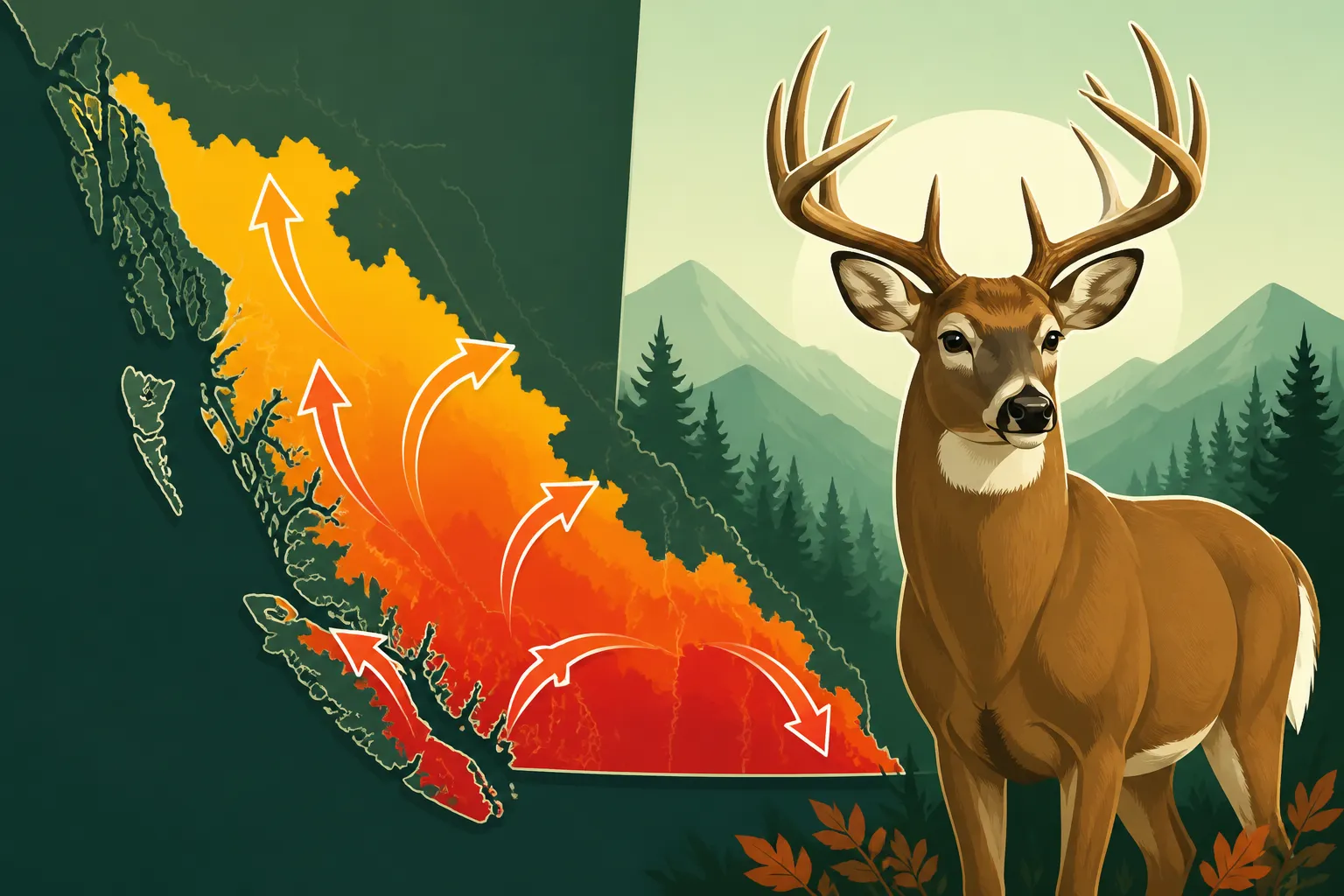
Where British Columbia’s Whitetails Are Spreading
For years, when we thought about deer hunting in British Columbia, our minds often went straight to those majestic mule deer in the Interior or the elusive blacktail ghosting through the coastal rainforest. But if you've been paying attention, or perhaps had a surprising encounter yourself, you've probably noticed a growing presence: whitetail deer. This once less-common species is steadily expanding its range across our province, raising questions for hunters about where they're showing up and what that means for our cherished hunting traditions. This guide is all about understanding that subtle but significant shift, pinpointing where these adaptable deer are establishing new territories, and exploring why this spread is happening.
Whitetails Establishing Footholds: The Initial Ingress Points
It wasn't that long ago that whitetail deer were largely confined to specific corners of British Columbia, mainly along the eastern and northeastern borders. They weren't a widespread species like our mule deer or blacktail. But these tenacious animals are incredibly adaptable, and they’ve slowly but surely been pushing their boundaries, finding new homes in unexpected places. Understanding where they first gained a solid foothold helps us track their journey across the province.
The Kootenays and Peace Country: Traditional Strongholds and Expansion Corridors
Historically, the most prominent populations of whitetail deer in British Columbia have been concentrated in the Kootenay region, particularly the southeastern valleys, and further north in the Peace River Country. These areas provided the perfect blend of habitat: a mix of agriculture, riparian zones, and diverse forest cover that whitetails thrive in. The Kootenays, bordering Alberta and the US, served as a natural entry point, with whitetails migrating across state and provincial lines. Similarly, the Peace Country, with its extensive agricultural fields mixed with boreal forests, offered an ideal environment for them to flourish.
In these traditional strongholds, whitetails have long been a familiar sight. Hunters in the East Kootenays have adapted their strategies to target these wily deer, often finding them in valley bottoms, along river systems like the Kootenay and Elk, and on the fringes of agricultural land. The same goes for the Peace Region, where you'll find them using the vast grain fields for forage and the numerous river drainages for cover. These regions haven't just held static populations; they've acted as launchpads, with whitetails gradually expanding from these dense pockets, using river systems and accessible valley networks as natural highways to new territories. Understanding these initial growth points is key to grasping the broader pattern of their spread across British Columbia.
Following the River Systems: Natural Arteries for Dispersal
One of the most significant factors in the whitetail's expansion is their affinity for river systems and associated riparian habitats. Rivers like the Kootenay, Columbia, Fraser, and Peace, along with their numerous tributaries, provide excellent travel corridors. These river bottoms typically offer a consistent water source, lush vegetation for browse, and dense cover along their banks, which whitetails utilize for security and bedding. As populations in the traditional strongholds grew, younger bucks in particular would disperse along these waterways, seeking out new, unoccupied territories. This natural dispersal often occurs in a leapfrog fashion, with individuals pushing further downstream or up connecting valleys, establishing small, nascent populations that, given favourable conditions, then begin to grow.
This pattern means that areas far removed from the core whitetail regions can suddenly see a new presence. A lone whitetail buck might wander dozens or even hundreds of kilometres along a river, eventually settling in a new basin. If a doe follows, a small population can quickly take root. This makes scouting challenging but also exciting, as you might discover whitetail sign in areas traditionally considered mule deer or blacktail country. This river-centric movement is a testament to the adaptability of whitetails, using the landscape's natural features to their advantage, silently extending their reach across British Columbia.
The Spreading Front: New Territories and Emerging Hotspots
The expansion of whitetail deer in British Columbia is no longer just about their traditional eastern strongholds. We're seeing them pop up in areas that would have surprised hunters even a decade ago. This dynamic shift means that many hunters accustomed to only encountering mule deer or blacktail are now having to learn the habits and patterns of this new game animal.
The Okanagan and Thompson Valleys: Moving Westward
Perhaps one of the most notable expansions is into the dry, interior valleys like the Okanagan and Thompson. Hunters in these regions, who have long focused on mule deer, are increasingly reporting whitetail sightings. While still not as prevalent as mule deer, their presence is undeniable and growing. They're particularly gravitating towards the valley bottoms, using the mix of agricultural fields, orchards, and fragmented forest patches. The dense cover offered by riverine areas and irrigated lands provides a perfect refuge in these otherwise open, dry landscapes.
This westward push is likely facilitated by the river systems connecting these valleys to the traditional Kootenay populations, but also by the changing landscape. As more land is developed or altered for agriculture, it inadvertently creates pockets of prime whitetail habitat. For a hunter used to glassing expansive hillsides for mule deer, finding a whitetail buck sneaking through a vineyard or a dense creek bottom requires a different approach, a keen eye for subtle signs, and perhaps a fresh look at your hunting maps. Utilizing resources like GoHunt to analyze habitat types and historical sightings can be incredibly valuable in identifying these emerging whitetail zones within familiar mule deer stomping grounds.
Central and Northern Interior: From Patchy to Present
Further into the central and northern interior, beyond the immediate influence of the Peace Country, whitetails are also making their mark. Areas around Prince George, Vanderhoof, and even further west towards the Bulkley Valley are experiencing an increase in whitetail numbers. This expansion is often more patchy and less concentrated than in the southern valleys, but it's a clear trend. Here, whitetails are taking advantage of logged areas, which create new browse opportunities, and the interface between forest and agricultural clearings.
The logging road network throughout British Columbia's interior also serves as a critical conduit for this spread. While traditionally used for accessing moose or black bear, these roads also provide new avenues for whitetail dispersal into previously less-occupied areas. A hunter driving a deactivated logging road in search of deer might now find themselves scanning not just for a mule deer track, but for the smaller, daintier print of a whitetail. This northward and westward drift means that understanding the subtle differences, like those mentioned in "Telling a Whitetail From a Mule Deer", becomes even more critical, especially when seasons and antler point regulations might differ.
Coastal Lowlands and Fraser Canyon: A Glimpse of the Coast
While the vast majority of whitetail expansion is occurring in the interior, there have been occasional reports, though less frequent and sustained, of whitetails in the Fraser Canyon and even pushing towards the fringes of the coastal lowlands. This is still quite rare compared to their interior presence, and it's a testament to their incredible adaptability. These areas present a different set of challenges, with denser vegetation and often more consistent rainfall, akin to some of the habitat preferred by blacktail deer.
Should whitetails establish more permanent populations in these transitional zones, it could significantly alter the hunting landscape. Imagine having to adapt your hunting techniques for a whitetail in a mixed forest or on a river estuary, where you'd typically expect to find blacktail. This is why paying attention to local reports and consulting current regulations, like "British Columbia Deer Season Dates by Region", is crucial, as game managers respond to these shifting populations. For now, the interior remains the primary stage for their expansion, but the occasional coastal report hints at their potential to adapt even further.
Here’s a snapshot of the generalized whitetail expansion in British Columbia:
| Region | Current Whitetail Presence Trend | Key Habitat Types Utilized | Hunter Impact Implications |
|---|---|---|---|
| Kootenays (SE BC) | Established, actively expanding | Valley bottoms, riparian zones, agriculture, mixed forest | Familiar species, but increasing density and spread |
| Peace Country (NE BC) | Established, actively expanding | Agriculture, boreal forest edge, river drainages | Common species, often targeted specifically |
| Okanagan/Thompson Valleys | Emerging, steadily increasing westward | Agricultural fringes, orchards, river bottoms, dry forest | New species for many, requires adapting scouting for "new" habitat |
| Central Interior | Patchy but growing, sporadic sightings | Logging cuts, mixed forest, agriculture interfaces | Less common, but becoming more regular, especially near settlements |
| Fraser Canyon/Coastal Fringes | Rare, occasional sightings, potential future expansion | River corridors, mixed forest, some agricultural pockets | Very rare now, but indicates long-term dispersal potential |
Drivers Behind the Spread: Why Are Whitetails Moving In?
So, why are these whitetail deer, once relatively constrained, now showing up in more and more places across British Columbia? It's not just a random occurrence; there are several interlocking factors at play, creating a perfect storm for their expansion. Understanding these drivers is crucial for both hunters and wildlife managers.
Habitat Alteration: Logging, Agriculture, and New Opportunities
One of the primary engines of whitetail expansion is the alteration of habitat across British Columbia. Whitetails are disturbance-adapted animals, meaning they thrive in landscapes that have been altered by human activity or natural events like wildfires. Extensive logging operations create a mosaic of clear-cuts and regenerating forest, providing an abundance of new browse for deer. Unlike deep, mature forests that offer less undergrowth, these regenerating areas are a whitetail's buffet.
Similarly, the expansion of agriculture, even on a small scale, provides consistent food sources. Whether it’s grain fields, hay operations, or even backyard gardens, these human-modified landscapes offer high-quality forage that supports larger deer populations. Whitetails are incredibly adept at living alongside humans, often using small patches of cover near developed areas to their advantage. This interplay of logging and agriculture is constantly reshaping the landscape, inadvertently creating new, attractive habitat for whitetails to exploit. This is evident in areas like "Hunting a Peace Country Grain Field" where whitetails have long found abundant forage.
Milder Winters and Reduced Predator Pressure
Climate patterns play a significant role in deer survival, and a series of milder winters in many parts of British Columbia has undoubtedly contributed to whitetail survival rates and subsequent population growth. Severe winters with deep snow can be extremely hard on deer populations, especially fawns. Milder conditions allow more deer to survive the lean months, leading to higher fawn recruitment and overall population increases. This gives them a stronger base from which to disperse into new territories.
While British Columbia still boasts healthy predator populations, there can be localized areas where predator pressure on deer might be less intense, especially near human settlements or in fragmented habitats. Whitetails are known for their reproductive capacity, and in areas where winter mortality is low and predation is manageable, their numbers can quickly rebound and grow, pushing individuals to seek out new, unoccupied ranges. This natural process of population expansion, when combined with favorable environmental conditions, fuels their spread.
The Whitetail's Unmatched Adaptability and Generalist Diet
Perhaps the most significant driver is the whitetail deer itself. This species is simply a master of adaptability. They are not as specialized as, say, a mountain goat or a caribou, which require very specific habitats. Whitetails are generalists; they can thrive in a wide variety of environments, from dense forests to open grasslands, from remote wilderness to suburban fringes. Their diet is incredibly varied, consuming a vast array of forbs, grasses, shrubs, and agricultural crops. This flexibility means they can exploit almost any new area that offers a modicum of food and cover.
They learn quickly, adapt their behaviour to local conditions, and are generally quite prolific breeders. This inherent ability to adjust to diverse conditions and capitalize on available resources means that once a few individuals establish themselves in a new area, the population can quickly take hold. This makes them a formidable force in colonizing new ranges, gradually asserting their presence across British Columbia. Hunters need to be aware of this, and tools like GoHunt can help visualize habitat types where this adaptable species might be establishing itself.
Implications for Hunters: Adapting to a Changing Landscape
For British Columbia hunters, the spread of whitetail deer presents both new opportunities and a need to adapt. It means potentially expanding your hunting repertoire, understanding new regulations, and recognizing how the presence of whitetails might influence other deer species.
New Hunting Opportunities and Strategies
The most immediate implication is the creation of new hunting opportunities. For those who enjoy pursuing whitetails, there are now more areas to explore. However, hunting whitetails effectively often requires different strategies than those used for mule deer or blacktail. Whitetails are notoriously cagey, often utilizing dense cover and relying on their incredible sense of smell and hearing. Still-hunting, hunting from stands, or focusing on pinch points and travel corridors are often more effective than the long-range glassing tactics common for mule deer.
You might find yourself "Hunting a British Columbia Logging Road Network" for a whitetail that has just moved in, or perhaps concentrating on dense willow flats along a river system. This calls for a shift in mindset and technique. If you’re used to open country, adapting to hunting whitetails in thicker cover can be a refreshing challenge. For non-residents, understanding "Rules for Non-Residents Hunting British Columbia" becomes crucial, especially as some whitetail opportunities might be General Open Seasons (GOS) while others could fall under Limited Entry Hunting (LEH) as their populations solidify.
Potential Impacts on Mule Deer Populations
One of the concerns among wildlife biologists and hunters is the potential impact of expanding whitetail populations on native mule deer. In some areas where whitetails have established themselves and increased significantly, there have been observed declines in mule deer numbers. This could be due to several factors, including competition for resources, habitat displacement, or even the potential for disease transmission. Whitetails are often more aggressive competitors in certain types of habitat, particularly in agricultural fringes and riparian zones.
While the full extent of this impact in British Columbia is still being studied and observed, it’s a dynamic that hunters should be aware of. It might mean that in certain management units, mule deer populations become more concentrated in specific areas, or shift their patterns of use. This highlights the importance of staying informed about local deer populations and participating in wildlife management discussions. When scouting, using resources like "Reading a British Columbia LEH Zone Map" and observing historical harvest data can give you clues about these population dynamics.
Evolving Regulations and Management Considerations
As whitetail populations spread, wildlife managers in British Columbia are continuously monitoring the situation and adapting regulations. You might see changes in season dates, bag limits, or antler point restrictions in specific management units to address the growing whitetail presence. For instance, some areas might have more liberal whitetail seasons compared to mule deer to encourage harvest and manage populations. This is why always checking the latest British Columbia Hunting Regulations Synopsis is paramount before heading out.
The presence of whitetails can also influence conservation efforts for other species. For example, if mule deer populations are pressured by whitetail expansion, management strategies might focus on habitat enhancement or specific harvest regulations to support mule deer. It’s a complex ecological puzzle, and as hunters, our role is to be informed, responsible, and adaptable. Being proactive in understanding "British Columbia's Species Licences and Tags" and any species-specific regulations will ensure you're hunting legally and ethically in this evolving landscape.
Disclaimer
This article is for general informational purposes only and does not constitute professional advice. Laws, prices and regulations vary by location and change over time. Consult a qualified professional for guidance on your specific situation.